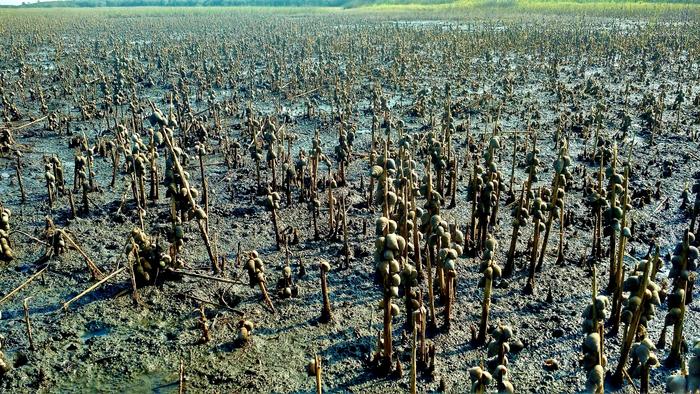
Re-establishing plantings of trees, grasses and other vegetation is essential for restoring degraded ecosystems, but a new survey of almost 2,600 restoration projects from nearly every type of ecosystem on Earth finds that most projects fail to recognize and control one of the new plants’ chief threats: hungry critters that eat plants.
“While most of the projects took steps to exclude competing plant species, only 10% took steps to control or temporarily exclude herbivores, despite the fact that in the early stages these plants are like lollipops — irresistible little treats for grazers,” said Brian Silliman, Rachel Carson Distinguished Professor of Marine Conservation Biology at Duke University’s Nicholas School of the Environment.

By not protecting plants in their early states, conservationists are missing out on great opportunity to significantly speed restoration, improve its outcomes, and lower its costs, he said.
“Our analysis of the surveyed projects shows that introducing predators to keep herbivore populations in check or installing barriers to keep them at bay until plantings become more established and less vulnerable, can increase plant re-growth by 89% on average,” said Silliman, who helped conceptualize the study and was one of its coauthors.
Sign up for the Daily Dose Newsletter and get every morning’s best science news from around the web delivered straight to your inbox? It’s easy like Sunday morning.
Those gains are equal to or greater than the gains realized by excluding competing plant species, the new survey shows.
“This begs the question: Why aren’t we doing it more?” he asks.
The new survey was conducted with input from an international team of researchers affiliated with 20 universities and institutions. They published their peer-reviewed findings Nov. 3 in Science.
Qiang He, professor of coastal ecology at Fudan University and a former postdoctoral research associate of Silliman’s at Duke, co-led the study with Changlin Xu, a member of He’s Coastal Ecology Lab at Fudan.
The survey’s findings have far-reaching implications for efforts to restore vegetation at a time of climate change, He said.
“Herbivores’ effects were particularly pronounced in regions with higher temperatures and lower precipitation,” He noted.
All of which leads to one inescapable conclusion, Silliman said.
“If we want more plants, we have to let more predators in or restore their populations,” Silliman said. “Indeed, the decline of large predators, like wolves, lions, and sharks, that normally keep herbivore populations in check, is likely an important indirect cause of high grazing pressures.”
“Conventional restoration is slowing our losses, but it’s not expanding vegetation in many places, and climate change could make that even more difficult,” he said.
Using predators to keep herbivores in check at restored sites is a relatively untapped approach that could help us boost plant diversity and restore ecosystems that are vital to human and environmental health, in less time and at lower costs,” Silliman said. “It’s like learning a new gardening trick that doubles your yield.”
Once a planting is established, the herbivores are essential too, he added. “Plants just need a small break from being eaten to get restarted making ecosystems. Once they establish, herbivores are key to maintaining plant ecosystem diversity and function.”
IMAGE CREDIT: Brian Silliman, Duke University
If you enjoy the content we create and would like to support us, please consider becoming a patron on Patreon! By joining our community, you’ll gain access to exclusive perks such as early access to our latest content, behind-the-scenes updates, and the ability to submit questions and suggest topics for us to cover. Your support will enable us to continue creating high-quality content and reach a wider audience.
Join us on Patreon today and let’s work together to create more amazing content! https://www.patreon.com/ScientificInquirer




Leave a Reply