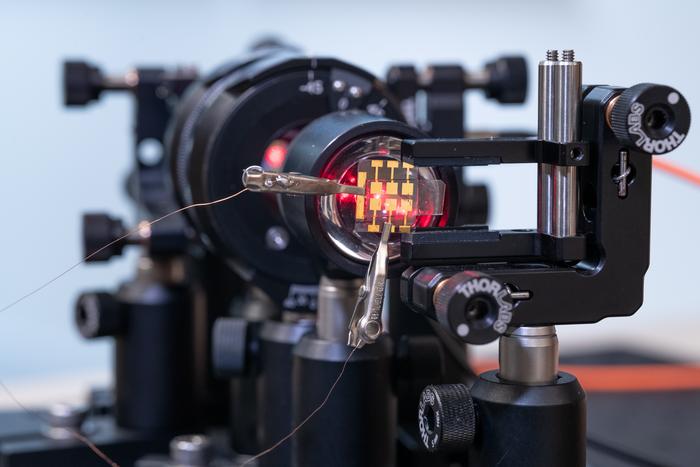
Digital information exchange can be safer, cheaper and more environmentally friendly with the help of a new type of random number generator for encryption developed at Linköping University, Sweden. The researchers behind the study believe that the new technology paves the way for a new type of quantum communication.
In an increasingly connected world, cybersecurity is becoming increasingly important to protect not just the individual, but also, for example, national infrastructure and banking systems. And there is an ongoing race between hackers and those trying to protect information. The most common way to protect information is through encryption. So when we send emails, pay bills and shop online, the information is digitally encrypted.

To encrypt information, a random number generator is used, which can either be a computer programme or the hardware itself. The random number generator provides keys that are used to both encrypt and unlock the information at the receiving end.
Different types of random number generators provide different levels of randomness and thus security. Hardware is the much safer option as randomness is controlled by physical processes. And the hardware method that provides the best randomness is based on quantum phenomena – what researchers call the Quantum Random Number Generator, QRNG.
Sign up for the Daily Dose Newsletter and get every morning’s best science news from around the web delivered straight to your inbox? It’s easy like Sunday morning.
“In cryptography, it’s not only important that the numbers are random, but that you’re the only one who knows about them. With QRNG’s, we can certify that a large amount of the generated bits is private and thus completely secure. And if the laws of quantum physics are true, it should be impossible to eavesdrop without the recipient finding out,” says Guilherme B Xavier, researcher at the Department of Electrical Engineering at Linköping University.
His research group, together with researchers at the Department of Physics, Chemistry and Biology (IFM), has developed a new type of QRNG, that can be used for encryption, but also for betting and computer simulations. The new feature of the Linköping researchers’ QRNG is the use of light emitting diodes made from the crystal-like material perovskite.
Their random number generator is among the best produced and compares well with similar products. Thanks to the properties of perovskites, it has the potential to be cheaper and more environmentally friendly.
Feng Gao is a professor at IFM and has been researching perovskites for over a decade. He believes that the recent development of perovskite light emitting diodes (PeLEDs) means that there is an opportunity to revolutionise, for example, optical instruments.
“It’s possible to use, for example, a traditional laser for QRNG, but it’s expensive. If the technology is eventually to find its way into consumer electronics, it’s important that the cost is kept down and that the production is as environmentally friendly as possible. In addition, PeLEDs don’t require as much energy to run,” says Feng Gao.
The next step is to develop the material further to make the perovskite lead-free and to extend its lifetime, which is currently 22 days. According to Guilherme B Xavier, their new QRNG could be available for use in cybersecurity within five years.
“It’s an advantage if electronic components that are to be used for sensitive data are manufactured in Sweden. If you buy a complete randomness generator kit from another country, you can’t be sure that it’s not being monitored.”
IMAGE CREDIT: Magnus Johansson
If you enjoy the content we create and would like to support us, please consider becoming a patron on Patreon! By joining our community, you’ll gain access to exclusive perks such as early access to our latest content, behind-the-scenes updates, and the ability to submit questions and suggest topics for us to cover. Your support will enable us to continue creating high-quality content and reach a wider audience.
Join us on Patreon today and let’s work together to create more amazing content! https://www.patreon.com/ScientificInquirer



Leave a Reply