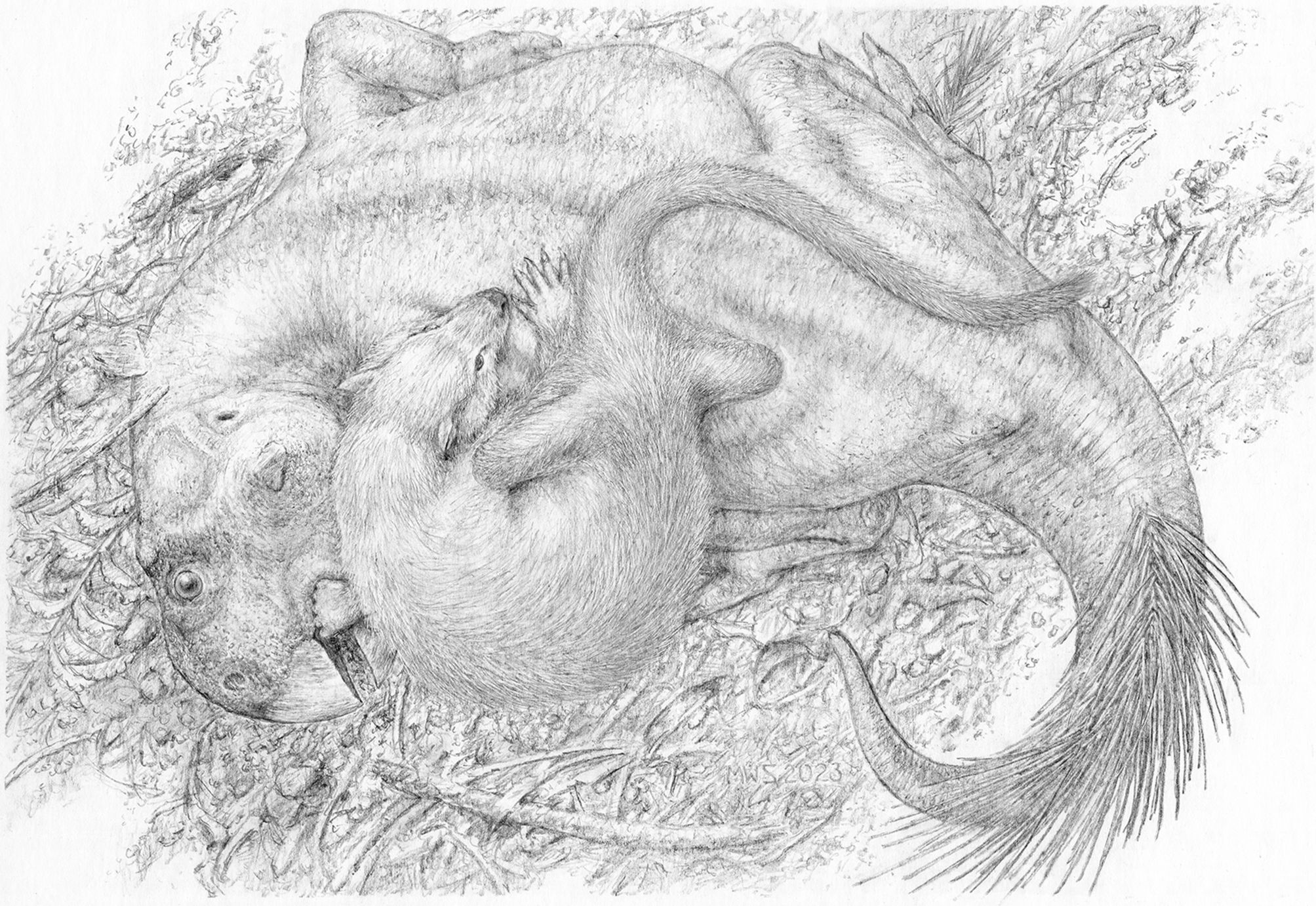
Canadian and Chinese scientists have described an unusual fossil from around 125 million years ago that shows a dramatic moment in time when a carnivorous mammal attacked a larger plant-eating dinosaur.
“The two animals are locked in mortal combat, intimately intertwined, and it’s among the first evidence to show actual predatory behaviour by a mammal on a dinosaur,” explains Dr. Jordan Mallon, palaeobiologist with the Canadian Museum of Nature and co-author on the study published today in the journal Scientific Reports.
The fossil’s presence challenges the view that dinosaurs had few threats from their mammal contemporaries during the Cretaceous, when dinosaurs were the dominant animals. The rare fossil is now in the collections of the Weihai Ziguang Shi Yan School Museum in China’s Shandong Province.
If you enjoy the content we create and would like to support us, please consider becoming a patron on Patreon! By joining our community, you’ll gain access to exclusive perks such as early access to our latest content, behind-the-scenes updates, and the ability to submit questions and suggest topics for us to cover. Your support will enable us to continue creating high-quality content and reach a wider audience.
Join us on Patreon today and let’s work together to create more amazing content! https://www.patreon.com/ScientificInquirer
The dinosaur in the well-preserved fossil is identified as a species of Psittacosaurus, which is about the size of a large dog. Plant-eating psittacosaurs are among the earliest known horned dinosaurs and lived in Asia during the Early Cretaceous, from around 125 to 105 million years ago. The mammal in the fossil pair is a badger-like animal, called Repenomamus robustus. Although not large by dinosaur standards, it was among the largest mammals during the Cretaceous, at a time when mammals had not yet come to dominate the Earth.
Prior to this discovery, palaeontologists knew that Repenomamus preyed on dinosaurs including Psittacosaurus because of fossilized baby bones of the herbivore found in the mammal’s stomach.
“The co-existence of these two animals is not new, but what’s new to science through this amazing fossil is the predatory behaviour it shows,” says Mallon.
The fossil was collected in China’s Liaoning Province in 2012, and both skeletons are nearly complete. Their completeness is due to the fact that they come from an area known as the Liujitun fossil beds, which have been dubbed “China’s Dinosaur Pompeii”.
The name refers to the many fossils of dinosaurs, small mammals, lizards and amphibians in the area, animals that were buried suddenly en masse by mudslides and debris following one or more volcanic eruptions. The existence of volcanic material in the rock matrix of the study’s fossil was confirmed following analysis by Canadian Museum of Nature mineralogist Dr. Aaron Lussier.
The Psittacosaurus-Repenomamus fossil was in the care of study co-author Dr. Gang Han in China, who brought it to the attention of Canadian Museum of Nature palaeobiologist Xiao-Chun Wu. Dr. Wu has worked with researchers in China for decades and knew it was special when he saw it.
A close examination of the fossil pair shows that the Psittacosaurus is lying prone, with its hindlimbs folded on either side of its body. The body of the Repenomamus coils to the right and sits atop its prey, with the mammal gripping the jaw of the larger dinosaur. The mammal is also biting into some of the ribs, and the back foot of Repenomamus is gripping onto the dino’s hind leg. “The weight of the evidence suggests that an active attack was underway,” says Dr. Mallon.
Mallon, Wu and colleagues ruled out the possibility that the mammal was simply scavenging a dead dinosaur. The bones of the dinosaur have no tooth marks, for example, suggesting it was not being scavenged, but rather was being preyed upon. And it’s unlikely the two animals would have become so entangled if the dinosaur had been dead before the mammal came upon it. The position of the Repenomamus over top of the Psittacosaurus suggests it was also the aggressor.
Analogies of smaller animals attacking larger prey are known in the modern world. Mallon and Wu note that some lone wolverines are known to hunt larger animals, including caribou and domestic sheep. And on the African savanna, wild dogs, jackals and hyenas will attack prey that are still alive, with the prey collapsing, often in a state of shock.
“This might be the case of what’s depicted in the fossil, with the Repenomamus actually eating the Psittacosaurus while it was still alive—before both were killed in the roily aftermath,” explains Mallon.
The research team speculates in their paper that the volcanically derived deposits from the Lujiatun fossil beds in China will continue to yield new evidence of interactions among species, otherwise unknown from the rest of the fossil record.
IMAGE CREDIT: NASA.





Leave a Reply