The 1,200-mile-long Denali Fault stretches in an upward arc from southwestern Alaska and the Bering Sea eastward to western Canada’s Yukon Territory and British Columbia. The long-lived and active strike-slip fault system, which slices through Denali National Park and Preserve, is responsible for the formation of the Alaska Range.
“It’s a big, sweeping fault and the source of a magnitude 7.9 earthquake in 2002, that ruptured more than 200 miles of the Denali Fault, along with the Totschunda Fault to the east, causing significant damage to remote villages and central Alaska’s infrastructure,” says Utah State University geochemist Dennis Newell.
Understanding the restless fault’s mantle-to-crust connections provides critical information for understanding the lithospheric-scale fault’s seismic cycle, says Newell, associate professor in USU’s Department of Geosciences. He and colleagues Jeff Benowitz, an Alaska-based geochronologist, Sean Regan of the University of Alaska Fairbanks, and doctoral candidate Coleman Hiett of USU, collected and analyzed helium and carbon isotopic data from springs along a nearly 250-mile segment of the fault and published their findings, “Roadblocks and Speed Limits: Mantle-to-Surface Volatile Flux in the Lithospheric Scale Denali Fault, Alaska,” in the June 1, 2023 print issue of the journal Geology.
If you enjoy the content we create and would like to support us, please consider becoming a patron on Patreon! By joining our community, you’ll gain access to exclusive perks such as early access to our latest content, behind-the-scenes updates, and the ability to submit questions and suggest topics for us to cover. Your support will enable us to continue creating high-quality content and reach a wider audience.
Join us on Patreon today and let’s work together to create more amazing content! https://www.patreon.com/ScientificInquirer
The research was funded by a one-year National Science Foundation Early-Concept Grant for Exploratory Research (EAGER) awarded to Newell and Regan in 2020.
“Active strike-slip faults like Denali have three-dimensional geometries with possible deep conduit connections below the Earth’s surface,” Newell says. “But we don’t know much about how and if these connections are maintained.”
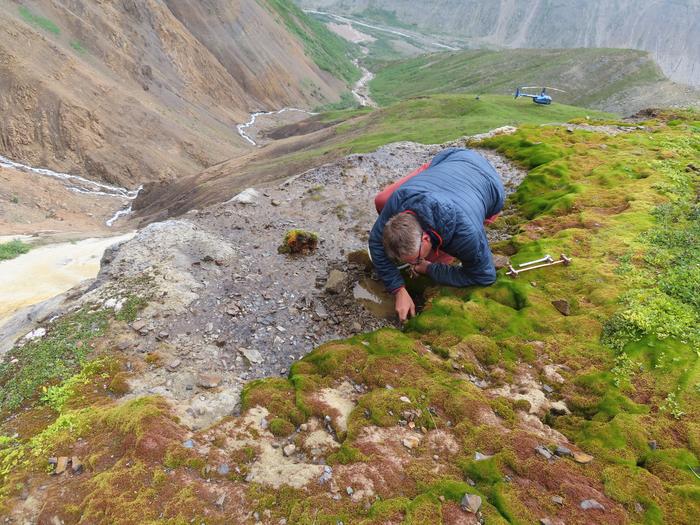
To examine these possible deep connections, Newell and Regan sampled 12 springs along the Denali and Totschunda Faults, by way of helicopter and on foot, to the remote, mountainous regions of Alaska’s interior.
“Helium-3, a rare isotope of helium gas, in springs is a good indicator of whether or not an area has a connection to the Earth’s mantle,” Newell says. “Warm, bubbling springs west of the 2002 earthquake rupture, along the Cantwell segment of the Denali Fault, have a strong helium-3 signature, indicating intact connections to the mantle. In contrast, springs along the ruptured fault segment only have atmospheric gases, suggesting a ‘roadblock’ preventing the flow of mantle helium to the surface.”
These observations, he says, have implications for how groundwater pathways along the fault are changed by earthquakes, and the timescales on which they heal.
“The last major earthquake on the Cantwell segment was 400 years ago, and the helium data suggest those mantel connections have been reestablished,” Newell says. “These bubbling springs are indicative of the possibility of a future large destructive earthquake along the Denali Fault segment near Denali National Park, which receives some 600,000 visitors each summer.”
The geoscientists also seek data on how fast helium can move from the mantle to the crust along active faults.
“That’s the ‘speed limit’ part of our research,” Newell says. “This is important as it reveals mantle-to-surface volatile flux and how fluid pressure gradients may impact fault strength and seismicity along the fault.”
The fault’s mantle fluid flow rates fall in the range observed for the world’s other major and active strike-slip faults that form plate boundaries, he says, including California’s San Andreas Fault and Turkey’s North Anatolian Fault Zone. These types of faults host large, devastating earthquakes, such as February 2023’s deadly earthquake on the East Anatolia Fault, which caused widespread destruction in Turkey and Syria.
“Quantifying crust-to-mantle connections along major strike-slip faults is critical for understanding linkages between deep fluid flow, seismicity and fault healing,” Newell says.
IMAGE CREDIT: Jeff Benowitz



Leave a Reply