HAVE YOUR SAY.
Join us in The Bullpen, where the members of the Scientific Inquirer community get to shape the site’s editorial decision making. We’ll be discussing people and companies to profile on the site. On Wednesday, March 22 at 5:30pm EST, join us on Discord and let’s build the best Scientific Inquirer possible.
In a step forward for genetic engineering and synthetic biology, researchers have modified a strain of Escherichia coli bacteria to be immune to natural viral infections while also minimizing the potential for the bacteria or their modified genes to escape into the wild.
The work promises to reduce the threats of viral contamination when harnessing bacteria to produce medicines such as insulin as well as other useful substances, such as biofuels. Currently, viruses that infect vats of bacteria can halt production, compromise drug safety, and cost millions of dollars.
Results are published March 15 in Nature.

“We believe we have developed the first technology to design an organism that can’t be infected by any known virus,” said the study’s first author, Akos Nyerges, research fellow in genetics in the lab of George Church in the Blavatnik Institute at Harvard Medical School and the Wyss Institute for Biologically Inspired Engineering.
“We can’t say it’s fully virus-resistant, but so far, based on extensive laboratory experiments and computational analysis, we haven’t found a virus that can break it,” Nyerges said.
The work also provides the first built-in safety measure that prevents modified genetic material from being incorporated into natural cells, he said.
The authors said their work suggests a general method for making any organism immune to viruses and preventing gene flow into and out of genetically modified organisms (GMOs). Such biocontainment strategies are of increasing interest as groups explore the safe deployment of GMOs for growing crops, reducing disease spread, generating biofuels, and removing pollutants from open environments.
Building on what came before
The findings build on earlier efforts by genetic engineers to achieve a helpful, safe, virus-resistant bacterium.
In 2022, a group from the University of Cambridge thought they’d made an E. coli strain immune to viruses. But then Nyerges teamed up with research fellow Siân Owen and graduate student Eleanor Rand in the lab of co-author Michael Baym, assistant professor of biomedical informatics in the Blavatnik Institute at HMS. When they sampled local sites rife with E. coli, including chicken sheds, rat nests, sewage, and the Muddy River down the street from the HMS campus, they discovered viruses that could still infect the modified bacteria.
Discovering that the bacteria weren’t fully virus-resistant “was a bummer,” Nyerges said.
The initial method had involved genetically reprogramming E. coli to make all their life-sustaining proteins from 61 sets of genetic building blocks, or codons, instead of the naturally occurring 64. The idea was that viruses wouldn’t be able to hijack the cells because they couldn’t replicate without the missing codons.
The HMS team, however, figured out that deleting codons wasn’t enough. Some viruses were bringing in their own equipment to get around the missing pieces.
So, Nyerges and colleagues developed a way to change what those codons tell an organism to make — something scientists hadn’t done to this extent in living cells.
Lost in translation
The key lay in transfer RNAs, or tRNAs.
Each tRNA’s role is to recognize a specific codon and add the corresponding amino acid to a protein that’s being built. For instance, the codon TCG tells its matching tRNA to attach the amino acid serine.
In this case, the Cambridge team had deleted TCG along with sister codon TCA, which also calls for serine. The team had also removed the corresponding tRNAs.
The HMS team now added new, trickster tRNAs in their place. When these tRNAs see TCG or TCA, they add leucine instead of serine.
“Leucine is about as different from serine as you can get, physically and chemically,” said Nyerges.
When an invading virus injects its own genetic code full of TCG and TCA and tries to tell the E. coli to make viral proteins, these tRNAs mess up the virus’s instructions.
Inserting the wrong amino acids results in misfolded, nonfunctional viral proteins. That means the virus can’t replicate and go on to infect more cells.
Viruses, however, also come equipped with their own tRNAs. These can still accurately turn TCG and TCA into serine. But Nyerges and colleagues provided evidence that the trickster tRNAs they introduced are so good at their jobs that they overpower their viral counterparts.
“It was very challenging and a big achievement to demonstrate that it’s possible to swap an organism’s genetic code,” said Nyerges, “and that it only works if we do it this way.”
The work may have cleared the last hurdle in rendering a bacterium immune to all viruses, although there’s still a chance something will appear that can break the protection, the authors said.
The team takes confidence in knowing that overcoming the swapped codons would require a virus to develop dozens of specific mutations at the same time.
“That’s very, very unlikely for natural evolution,” Nyerges said.
Safety measures
The work incorporates two separate safeguards.
The first protects against horizontal gene transfer, a constantly occurring phenomenon in which snippets of genetic code and their accompanying traits, such as antibiotic resistance, get transferred from one organism to another.
Nyerges and colleagues short-circuited this outcome by making substitutions throughout genes in the modified E. coli cells so that all codons that call for leucine got replaced with TCG or TCA — the codons that in an unmodified organism would call for serine. The bacteria still correctly made leucine in those places because of their trickster tRNAs.
If another organism were to incorporate any of the modified snippets into its own genome, though, the organism’s natural tRNAs would interpret TCG and TCA as serine and end up with junk proteins that don’t convey any evolutionary advantage.
“The genetic information will be gibberish,” said Nyerges.
Similarly, the team showed that if one of the E. coli’s trickster tRNAs gets transferred to another organism, its misreading of serine codons as leucine codons damages or kills the cell, preventing further spread.
“Any modified tRNAs that escape won’t get far because they are toxic to natural organisms,” said Nyerges.
The work represents the first technology that prevents horizontal gene transfer from genetically modified organisms into natural organisms, he said.
For the second fail-safe, the team designed the bacteria themselves to be unable to live outside a controlled environment.
The team used an existing technology developed by the Church lab to make the E. coli reliant on a lab-made amino acid that doesn’t exist in the wild. Workers cultivating these E. coli to produce insulin, for instance, would feed them the unnatural amino acid. But if any bacteria escaped, they would lose access to that amino acid and die.
Therefore, no humans or other creatures are at risk of getting infected by “superbacteria,” Nyerges emphasized.
Nyerges looks forward to exploring codon reprogramming as a tool for coaxing bacteria to produce medically useful synthetic materials that would otherwise require expensive chemistry. Other doors have yet to be opened.
“Who knows what else?” he mused. “We’ve just started exploring.”
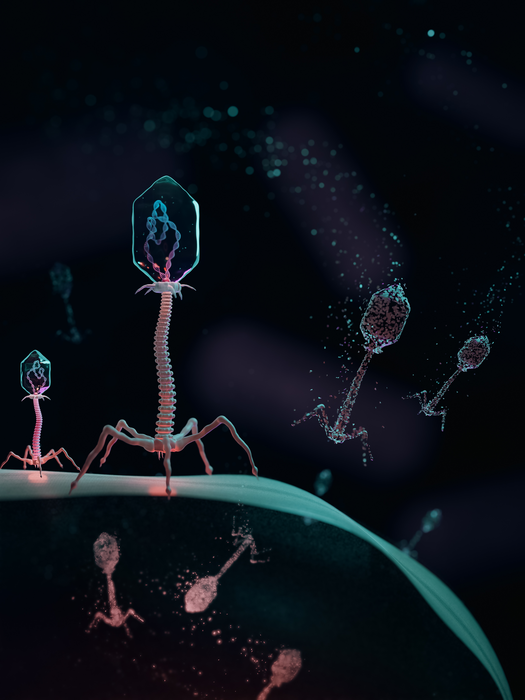
IMAGE CREDIT: Behnoush Hajian



Leave a Reply