HAVE YOUR SAY.
Join us in The Bullpen, where the members of the Scientific Inquirer community get to shape the site’s editorial decision making. We’ll be discussing people and companies to profile on the site. On Wednesday, March 22 at 5:30pm EST, join us on Discord and let’s build the best Scientific Inquirer possible.
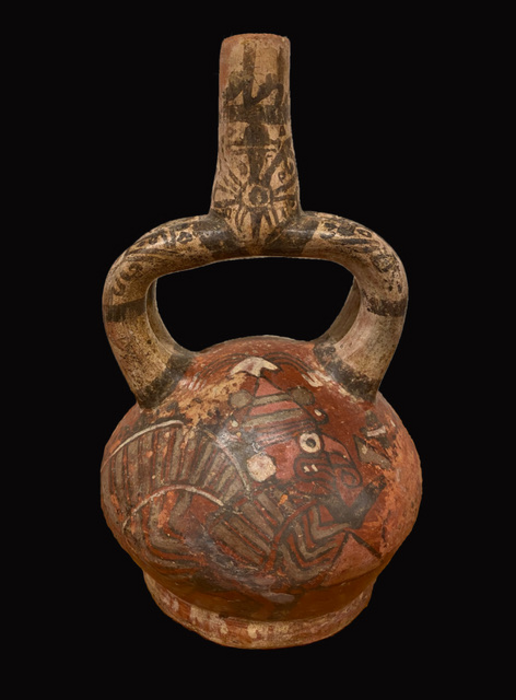
Color plays a huge role in our lives — the hues we wear and decorate with are a way for us to signal who we are, where we’re from, and what we care about. And it’s been that way for a long time. In a new study in the Journal of Archaeological Science: Reports, archaeologists compared the colors on pieces of ancient Peruvian pottery. They found that potters across the Wari empire all used the same rich black pigment to make ceramics used in rituals: a sign of the empire’s influence.
The Wari empire spread over Peru’s highlands and coastal areas from 600-1050 CE. “People sometimes think of the Inka as the first big empire in South America, but the Wari came first,” says Luis Muro Ynoñán, the study’s corresponding author and a research associate and former postdoctoral scientist at the Field Museum in Chicago.
The Wari didn’t leave behind a written record (or at least a system similar to the one we use now). “Since they didn’t use writing, material culture — things like pottery — would have been an important means for conveying social and political messages,” says Muro Ynoñán. “The visual impact of these objects would have been super powerful.” Even little details, like using the correct shade of a color, could help signify an object’s importance and legitimacy as a part of the empire.

“I remember seeing some of these Wari-influenced pots as an undergraduate archaeology student in Peru, they’re fascinating,” says Muro Ynoñán. “The rich black color on them is very distinctive, I’ve been obsessed with it for years.” Muro Ynoñán finally got to pursue his interest in the pigment in-depth during his postdoctoral position at the Field Museum.
He and his co-authors, including Donna Nash, an adjunct curator at the Field and associate professor and head of anthropology at the University of North Carolina Greensboro, examined pottery from different regions under Wari influence, focusing on the chemical makeup of the black pigment used.
The exact formulation of pigments varied from site to site, but overall, there was one striking similarity: many of the Wari pots examined in the study used black pigment made from minerals containing the element manganese.
“Some of the sites, specifically in northern Peru,used a different recipe for black, using iron- and calcium-rich minerals, before the Wari arrived, but after the Wari took over, they switched to the manganese-based recipes,” says Muro Ynoñán. The shift makes the authors suspect that the Wari empire asserted some sort of “quality control” over the pottery produced in different regions, perhaps even supplying artisans with the “correct” black pigment. “In general, black minerals are relatively easy to obtain from the valleys we looked at,” says Muro Ynoñán. But just any old black mineral didn’t fit the official Wari look — instead, he thinks that artisans may have been supplied with the manganese-bearing minerals from the Wari capital to produce the right shade of black.
The changes in hue are subtle, but Muro Ynoñán says that the symbolic meaning of using “Wari black” may have been very important. “In general in the Andean region, the color black is related to the ancestors, to the night, to the passage of time. In Wari times, the color was likely important for imposing a specific Wari ideology to the communities they conquered.”
While the colors on Wari pottery might indicate imperial control, the ceramics from different regions do maintain their own local character. “Local potters had a lot of flexibility in producing hybrid material culture, combining the Wari imperial style and decoration with their own,” says Muro Ynoñán. The ceramics were unified by the use of black pigments that were controlled and put in circulatation by the Wari empire through its imperial trade channels, but from there, artists could put their own spin on their work.
“One thing I hope people will take away from this study is that every beautiful artifact you see in a museum was made by real people who were very intelligent and possessed specific technologies to achieve their goals,” says Nash, co-author of the study. “Further, these people shared technologies and made choices. Artisans talked to each other and learned from each other, but sometimes multiple ways of doing things, such as creating black lines and decoration on a decorated pot, co-existed.These different approaches to the same problem may have persisted because of wealth or class differences, but it may have been that some people were willing to try new things, while others preferred their traditions.”
IMAGE CREDIT: Field Museum anthropology collections (FM 2959.171668)




Leave a Reply