HAVE YOUR SAY.
Join us in The Bullpen, where the members of the Scientific Inquirer community get to shape the site’s editorial decision making. We’ll be discussing people and companies to profile on the site. On Wednesday, February 22 at 5:30pm EST, join us on Discord and let’s build the best Scientific Inquirer possible.
Think of a new longer-term memory as a construction site inside the brain. The brain’s neurons restructure themselves and build or demolish connections with other neurons to store the memory for retrieval when needed.
The neurons can’t do the work without help. They need building materials from a distant warehouse. So, trucks hit the highway to transport cargo to the construction site.
The cargo of those trucks varies over time depending on the strength of the memory. Do the neurons need supplies to build a structure that endures hours, days, weeks or even years?

Researchers at The Herbert Wertheim UF Scripps Institute for Biomedical Innovation & Technology have discovered that these cellular building materials — in this case, sets of proteins — undergo experience-dependent changes while forming short- and long-term memories.
A paper on the discovery by a team of Wertheim UF Scripps Institute scientists was published on Jan. 5 in eNeuro, an open-access journal of the Society for Neuroscience.
It’s a glimpse into the brain’s plasticity, or its ability to adapt and change its structure as we live our lives and accumulate memories.
Additionally, it enlightens future research about how the brain’s enormously complex systems operate. That has potential implications, scientists said, for better understanding neurological disorders. Those include Alzheimer’s and amyotrophic lateral sclerosis, known as ALS or Lou Gehrig’s disease.
“This is giving us a much more detailed insight into a process that we know is important for memory,” said senior author Sathyanarayanan V. Puthanveettil, Ph.D. He is an associate professor at The Wertheim UF Scripps Institute.
“The connections of these neurons need to be selectively modified to form long-term memory,” he added. “And for the modification to occur, the neuron needs to send materials from the cell’s soma to its distant synapses. Unique packets of proteins are sent, and this cargo of proteins changes over time as memory is encoded. This is an exciting finding.”
The soma is the main cell body of a neuron where its nucleus resides, while synapses are the place where connections between neurons are built. On a cellular level, it’s a long trip.
Puthanveettil’s team used a species of sea slug called Aplysia to explore how memories are encoded. The slugs have gigantic neurons compared with those in the human brain, making them easier to study.
A neural mechanism for storing certain memories in slugs is thought to be extremely similar to what occurs in the human brain, Puthanveettil said.
Memory, of course, is the essence of what it means to be human.
Sometimes memories are short-lived, as when we see a stranger’s face at a party and cannot recall it the next day. A simple biochemical change in the brain creates shorter-term memories that are with us for several minutes to a few hours, he said.
Longer-term memories, however, bring out the full construction crew that indelibly encodes the brain’s circuitry, especially when the brain is sensitized to a strong event — a car crash, a child’s birth, the moment someone learns shocking news.
Puthanveettil said how the brain accomplishes this has been poorly understood, and even now, it will take much more research to fully decipher the cellular building blocks that form memory.
The material that moves between soma and synapse includes numerous proteins, which are crucial workhorses that drive many of the processes and chemical reactions that allow human cells to function and carry out tasks.
Other cellular materials might also change over time, Puthanveettil said. But that will be a topic of future research.
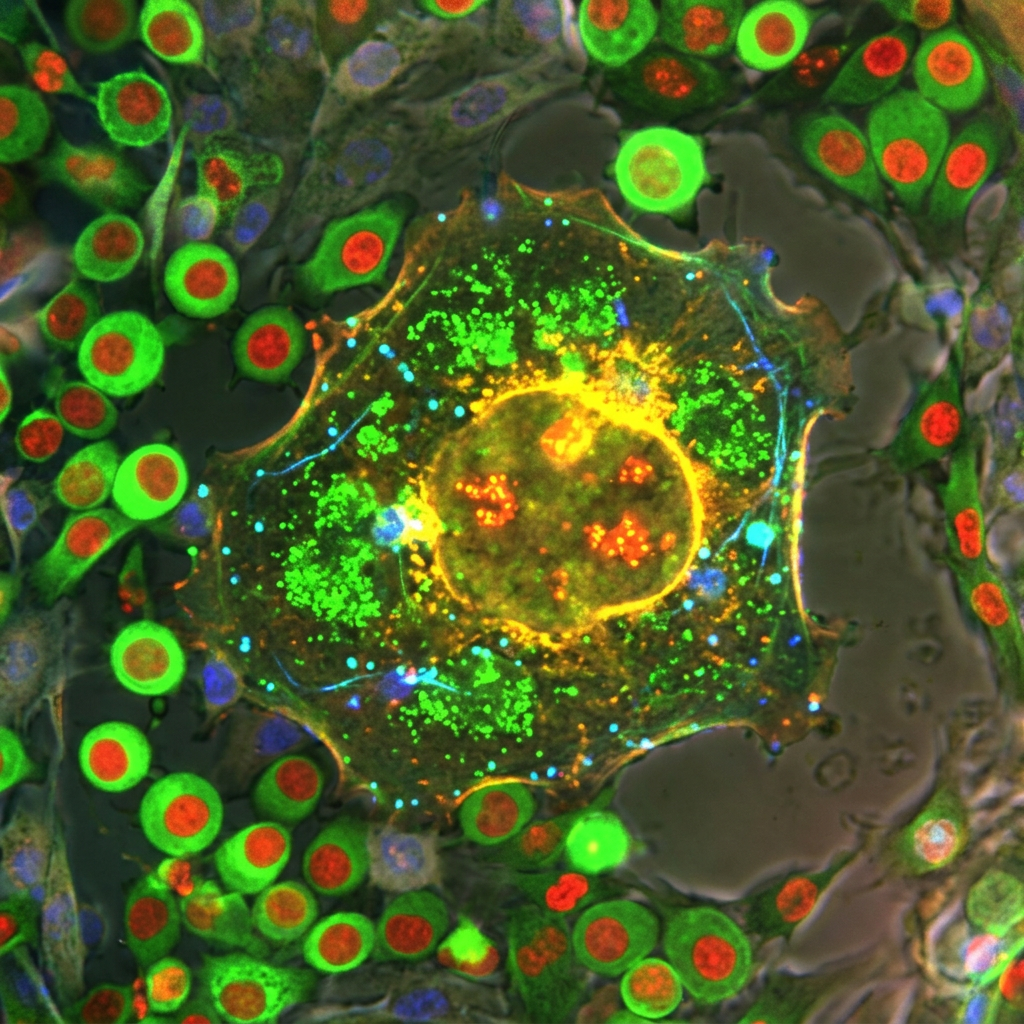
IMAGE CREDIT: Abhishek Sadhu
Leave a Reply