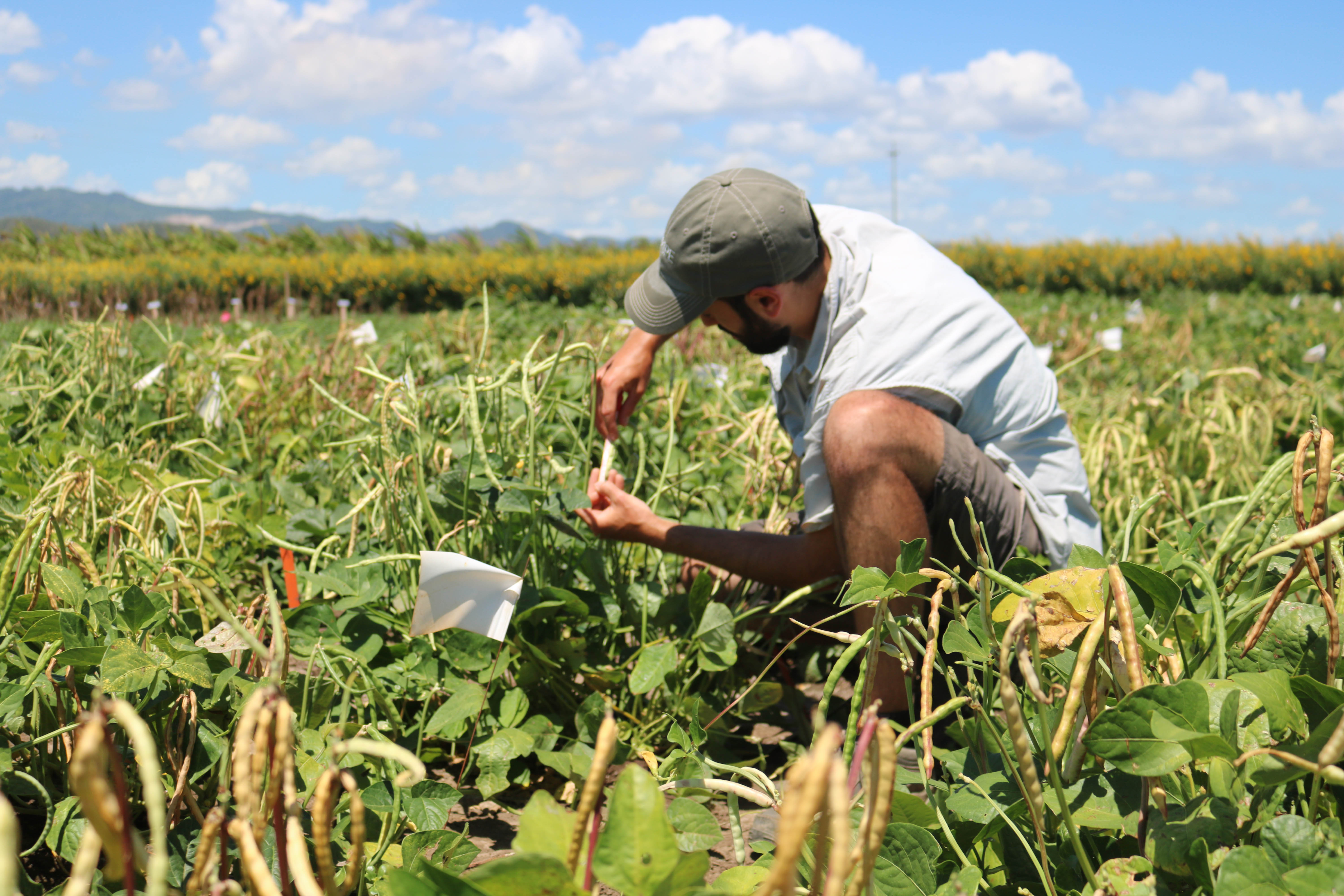
In a collaboration between RIPE researchers and cowpea breeders from Ahmadu Bello University, and the International Institute of Tropical Agriculture, the width of cowpea leaves was found to correlate with above-ground biomass across diverse germplasm and environmental conditions. This easy-to-measure trait can be readily used for selection in breeding programmes for cowpea biomass in Nigerian fields.

“Cowpeas are a key source of rich protein for millions of people in sub-Saharan Africa and beyond,” said Saba Mohammed, Senior Research Fellow for the Institute for Agricultural Research of Ahmadu Bello University. “Cowpea grains are used for a variety of other purposes, whereas its fodder serves as a nutritious feed for livestock and a source of income for farmers who cut and store the fodder for sale during the dry season. Hence, developing cowpea varieties that can produce both grain and fodder optimally is vital, especially since there is a big market for the sale of both the grain and fodder in Nigeria and other areas in West Africa.”
This joint work between the University of Illinois, the USDA Agricultural Research Service, Lancaster University, and the Nigerian universities used a critically important collection of 21 cowpea genotypes from Nigeria and other African countries. While looking at productivity differences among the germplasms, the group from Lancaster, led by Elizabete Carmo Silva, found that in their greenhouse, the cowpea with wider leaves tended to produce more biomass.
The Illinois-based team of Lisa Ainsworth and Anthony Digrado had previously grown 50 different genotypes as part of their research on how canopy architecture affects canopy carbon assimilation. They also collected leaf size and above-ground biomass measurements finding a correlation between those traits when measured in the field.
“It was very exciting to find the same correlation in two different studies with different cowpea germplasm,” said Digrado, a postdoctoral researcher for the Realizing Increased Photosynthetic Efficiency (RIPE) project. “This meant that leaf width was a robust trait that could be used to quickly and easily screen for plant biomass.”
This work is part of RIPE, an international research project which aims to increase global food production by developing food crops that turn the sun’s energy into food more efficiently with support from the Bill & Melinda Gates Foundation, Foundation for Food & Agriculture Research, and U.K. Foreign, Commonwealth & Development Office. Cowpea is one of RIPE’s focus food crops.
While the measurements of leaf traits and biomass may have been the same in experiments in Lancaster and Illinois, the plant age at the time of measurement, environment, and the cowpea lines studied in the experiments were not. The experiments in Lancaster were made on cowpea cultivars from Nigeria and plants were measured at just three weeks old. The greenhouse environment was set up to replicate a Nigerian field environment as much as possible.
“We want our research to have an impact where cowpea is being grown,” said Carmo-Silva, professor of crop physiology at Lancaster. “In the greenhouse, we were looking at controlled growth conditions and at Illinois, plants were being grown in a dynamic field environment. The key finding is that the correlation holds true with different germplasms and growing conditions.”
IMAGE CREDIT: With attribution



Leave a Reply