Like many other viruses, COVID-19 is transmitted primarily via particles carried in the air. An infected person breathes out particles containing the virus into the air, which can then be inhaled by another person, who then becomes infected.

Masks are widely considered an important first-line defense against airborne transmission of the disease, as is supported by a preponderance of evidence. Fueled by the omicron variant, the latest wave of the pandemic prompted public health officials to recommend more protective face coverings because not all masks are created equal.
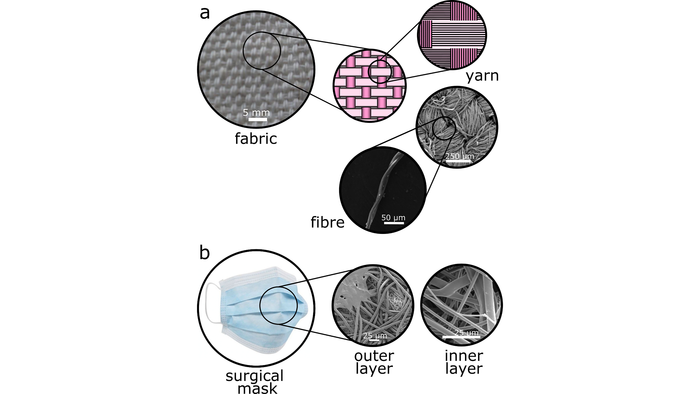
In Physics of Fluids, by AIP Publishing, researchers from England, Germany, and France focus their expertise — and their microscopes — on examining the efficacy of particle filtration by woven fabric, which, unlike material used in standard air filters and masks, consists of fibers twisted together into yarns. There are, therefore, two lengthscales: the diameters of the fiber and the yarn.
Using 3D imagery produced by confocal microscopy to see the air flow channels, the scientists simulate the airflow through these channels and calculate filtration efficiency for particles a micrometer and larger in diameter. The study concludes for particles in this size range, the filtration efficiency is low.
“Masks are air filters, and woven fabrics, such as cotton, make for good jeans, shirts, and other apparel, but they are lousy air filters,” said co-author Richard Sear, from the University of Surrey. “So, use woven fabric for clothing, and N95s or FFP2s or KF94s for masks.”
Indeed, the flow simulations suggest when a person breathes through cloth, most of the air flows through the gaps between the yarns in the woven fabric, bringing with it with more than 90% of the particles.
“In other words, these relatively large gaps are responsible for cloth being a bad material to make air filters from,” said Sear. “In contrast, the filtering layer of an N95 mask is made from much smaller, 5-micrometer fibers with gaps that are 10 times smaller, making it much better for filtering nasty particles from the air, such as those containing virus.”
While earlier research revealed similar findings, this study represents the first to simulate particles going directly through the gaps in woven fabric.
Sear added good masks should feature the “two Fs: good filtration and good fit.”
“Surgical masks fit badly, so a lot of air goes unfiltered past the edges of the mask by the cheeks and nose,” said Sear.
IMAGE CREDIT: Richard P. Sear



Leave a Reply