Despite similar symptoms, loneliness and social anxiety are driven by different brain states, according to new research published in JNeurosci.

Loneliness can have detrimental consequences on physical and mental health, yet there are currently few behavioral interventions for loneliness like there are for other conditions. Lieberz et al. explored the basis for these two conditions by comparing how people with social anxiety and high and low loneliness behaved in a social gambling task.
Participants played a computer game where they could make a safe bet and win a smaller amount of money or make a riskier bet for a larger sum. If they took the riskier bet, they watched a video of a virtual human showing approval or disapproval.
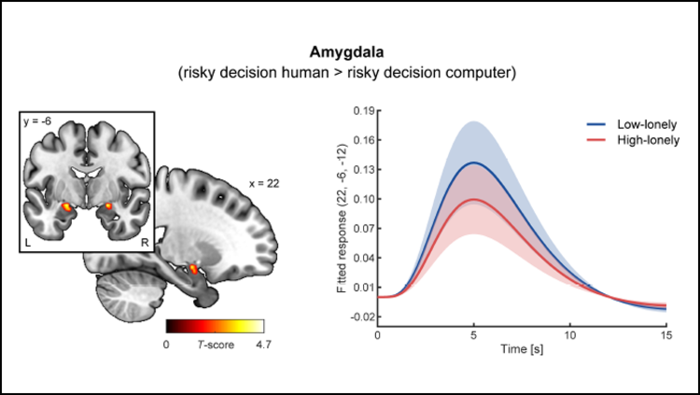
People with social anxiety took the safe bet more often to avoid social feedback from the videos. But people with high loneliness did not display this social avoidance. By measuring the participants’ brain activity during the task with fMRI, the researchers found people with social anxiety displayed increased amygdala activation during the decision phase — a sign of heightened anxiety — and reduced nucleus accumbens activation during the feedback phase — a sign of reduced social reward. Neither activity pattern appeared in people with high loneliness, indicating loneliness is a unique condition requiring its own interventions.
IMAGE CREDIT: Lieberz et al., JNeurosci 2021




Leave a Reply