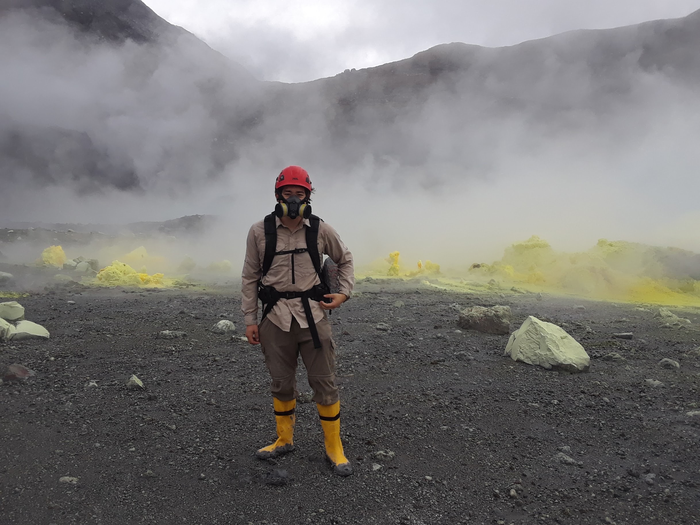
A few specialist microbes survive conditions analogous to those of Mars’ early history, reports a new publication in Frontiers in Astronomy and Space Science—and this may be thanks to a broad range of adaptations.

The hydrothermal crater lake of the Poás volcano in Costa Rica is one of the most hostile habitats on the planet. The water is ultra-acidic, full of toxic metals and the temperatures range from comfortable to boiling. In addition, recurrent ‘phreatic eruptions’ cause sudden explosions of steam, ash and rock. Despite such deadly eruptions, hydrothermal environments may be where the earliest forms of life began on Earth—and potentially also on Mars, if there ever was life. Beyond discovering how life can survive these harsh conditions, studying these microbes provides clues about if and how life might have existed on Mars.
“One of our key findings is that, within this extreme volcanic lake, we detected only a few types of microorganisms, yet a potential multitude of ways for them to survive,” says first author Justin Wang, a graduate student at the University of Colorado Boulder, in the United States. “We believe they do this by surviving on the fringes of the lake when eruptions are occurring. This is when having a relatively wide array of genes would be useful.”
This current interdisciplinary collaboration follows up on prior work from 2013. At that time, the researchers found that there was just one microbial species coming from the Acidiphilium genus in the Poás volcanic lake. Unsurprisingly, this type of bacteria is commonly found in acid mine drainages and hydrothermal systems, and they are known to have multiple genes adapted to diverse surroundings.
In the following years, there was a series of eruptions and the team returned in 2017 to see whether there had been changes in the microbial diversity, as well as to study the organisms’ biochemical processes more comprehensively. This latest work shows that there was a bit more biodiversity, but still a dominance of the Acidiphilium bacteria.
Through DNA sequencing of the organisms in the lake samples, the team confirmed that the bacteria had a wide variety of biochemical capabilities to potentially help them tolerate extreme and dynamic conditions. These included pathways to create energy using sulfur, iron, arsenic, carbon fixation (like plants), both simple and complex sugars and bioplastic granules (which microorganisms can create and use as energy and carbon reserves during stress or starvation).
“We expected a lot of the genes that we found, but we didn’t expect this many given the lake’s low biodiversity,” says Wang. “This was quite a surprise, but it is absolutely elegant. It makes sense that this is how life would adapt to living in an active volcanic crater lake.”
Despite the oftentimes lethal surroundings, hydrothermal systems provide most of the key ingredients for the evolution of life, including heat, water and energy. This is why leading theories for both Earth and Mars focus on these locations. So far, previous efforts in search of life on Mars have focused on streambeds or river deltas, but the authors suggest that more attention should be given to the sites of past hot springs (which were present on Mars for billions of years).
“Our research provides a framework for how ‘Earth life’ could have existed in hydrothermal environments on Mars,” explains Wang. “But whether life ever existed on Mars and whether or not it resembles the microorganisms we have here is still a big question. We hope that our research steers the conversation to prioritize searching for signs of life in these environments, for example there are some good targets on the crater rim of Jezero Crater, which is where the Perseverance rover is right now.”
IMAGE CREDIT: Justin Wang


Leave a Reply