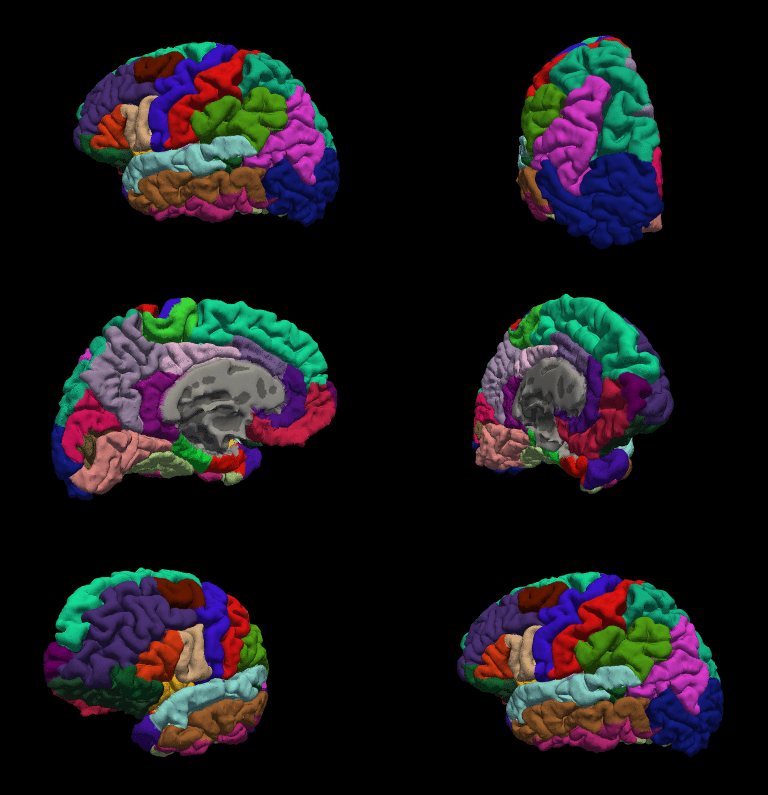
In the brain, billions of neurons reach to each other, exchanging information, storing memories, reacting to danger and more. Scientists have barely scratched the surface of the most complex organ, but a new device to automatically collect tissue for analysis may allow for a quicker, deeper dive into the brain.
Their approach was published in IEEE/CAA Journal of Automatica Sinica, a joint publication of the IEEE and the Chinese Association of Automation.
“The ultimate goal of this study is to further promote the speed and quality of 3D-reconstruction of brain neural connections,” said the author Long Cheng, professor with the State Key Laboratory of Management and Control for Complex Systems, Institute of Automation, Chinese Academy of Sciences.
Currently, researchers make thin serial slices of biopsied brain tissue or of animal tissue samples — smaller than the width of a human hair — using a cutting tool called a microtome. The tissue floats in water, from which researchers collect the sections and place them on a silicon wafer to be imaged with an electron microscope. Once the images are taken, they are digitally reconstructed into a 3D model.
The researchers developed a circular silicon wafer that rotates as part of the microtome. As brain sections are cut, the rotation motion moves the water so that the sections adhere automatically to the wafer. The device, called the automated silicon-substrate ultra-microtome (ASUM), is controlled by an automated system that detects the brain sections on the surface of the water to improve collection efficiency, increasing the number of sections each wafer can hold.
“The proposed ASUM can reduce the collection skill requirement of the operator, and the interventions the operator must perform are less demanding than using existing assisting devices,” Cheng said. “It also ensures the quality of electron microscopic imaging of brain sections without cumbersome post-processing operations.”
However, Cheng said, it is not a completely automated system, as the device cannot automatically replace the silicon wafer. Next, the researchers plan to introduce an automatic silicon wafer replacement device that incorporates an advanced control system.
“Understanding the structure of neural connections in the brain is helpful to explore the working mechanism of the human brain, so as to promote the diagnosis and treatment of brain diseases and the development of brain-like intelligence systems,” Cheng said. “Our ultimate goal is to test whether the quality and efficiency of the reconstruction of the brain’s neural network can be improved by the designed automatic collection device.”

Leave a Reply