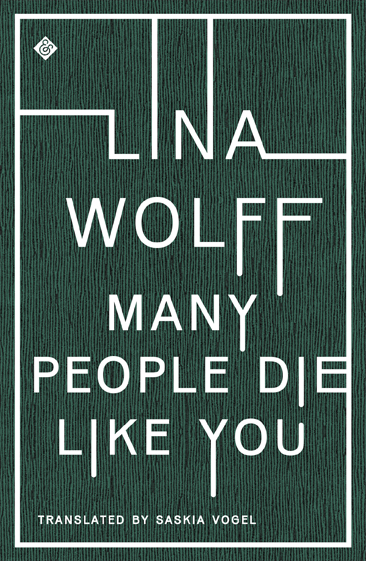
2020 has been a rough year. A cycle of panic, lockdowns, tentative reopenings, all polluted by a constant, nagging uncertainty. It’s been a year spent languishing in limbo, caught between what was (the pre-COVID-19 world) and what will be (the changed post-COVID-19 world). Stuck in the middle, the thing that stands out is the transience that silently dictates daily life. And as anyone can tell you, it isn’t always easy, especially as the years accumulate and become heavier on the backend than the front. Usefulness withers with age until most of what remains is melancholy. There’s always a sliver of optimism though. It’s a sentiment that’s echoed by a character in Many People Die Like You when he declares, “You must simply endure. At least spring is on its way.”
Originally published in 2009, Många månniskor dör som du (Many People Die Like You) is Swedish author Lina Wolff’s first book. Now, her short story collection has been translated and re-released in English by the publisher, And Other Stories. Since then she’s followed up with two novels, Bret Easton Ellis and the Other Dogs and The Polyglot Lovers. In addition to creative writing, she has also published works in translation.
Written mostly while Wolff was living in Spain, Many People Die Like You features many characters and settings that are decidedly Spanish, yet their frailties and foibles are universal. “Maurice Echegaray” is a coming of age story where a young girl learns a valuable lesson about intolerance. Love and melancholy surfaces in “Many People Die Like You,” a tale as much about aging as it is about extramarital affairs. “And By the Elevator Hung a Key” features an elderly couple who has fallen out of love long ago and are simply waiting for each other to pass. In “Odette Klockare,” a young man is forced to choose between his friends and his significantly older girlfriend because of the unorthodox nature of his relationship.

People are in a constant state of coming and going in Wolff’s stories, literally and figuratively. While best exemplified by our transition between life and death, it isn’t limited to that. Her characters search for guidance and wisdom only to see their goals chased away. They attain their desire only to not only lose it but lose to it. Many of her stories feature a yearning that often manifests itself in destructive fashion. Even the way people interact with each other — notably in “Maurice Echegaray” — fluctuates between adoration and admonition.
In the case of Maurice Echegaray, he experiences how a fickle neighborhood’s sentiment turns on a dime. One day, the businessman is the toast of the local rumor mill, albeit one viewed more than a little wariness.
The neighborhood was calling Maurice Echegaray a sales whiz, a jet-setter. Dad said he was now one of the bank’s most important clients, that Fraga could pay half his salaries with the income his operations alone pulled in. And still, Fraga suspected that the morals were loose at our office. That there were connections to the underworld.
But by the end, when the sheen has come off from their flamboyant affectations, Almudena’s mother explains
“What makes people hate them the most,” Mom said at breakfast, “isn’t that they earn good money, it’s that they act like they own the whole world. That’s it. They act like they own the world.”
Ultimately, Echegaray and his new love flee the town, forced out by.
“Many People Die Like You” is a tale ostensibly about mid-life infidelity but invariably about an existential crisis of the most banal, self-pitying forms. In the Vicente Jiménez’s mind, stagnation and suffocation are hallmarks of growing old, something most people experience, further heaping indignity upon indignity.
As heatching the city pass by his window.
Sweet floral perfumes from the women in light clothing basking him by. He found this to be a lovely time of the year, a time when you wanted to be in love, and for that feeling to be mutual. But as the years went by, this equation became ever more difficult to square. Your standards were higher, but your life force was draining away. You became less attractive as you had less to give.
Jiménez is offended and hurt by the suggestion by his lover that “at his age you weren’t really contributing anything special.”
Death by stifling is in fact the most common death of all and in the end, “death is coming for many people like him.”
In “Odette Klockare,” the main character, Malcolm, finds the companion he’s longed for in a woman much older than he. Unfortunately, in addition to her age, Odette Klockare’s eccentric and reclusive existence automatically classifies her as the unacceptable Other among Malcolm’s friends. This puts him at odds with them the deeper his relationship with Klockare grows.
The story concludes with the image of Malcolm and Klockare, now nothing more than lovelorn spectral castaways, escaping from the tall town, presumably to the far off city. No matter. They are together and that’s what counts. Having transitioned from a state of solitude to one of companionship, it’s not something they were willing to relinquish.
They stood at the bus stop by the mailboxes. Two shadowy, slim figures, their breath clouding as they spoke. They stamped their feet, leaned against each other now and then and looked at each othe, but we couldn’t see their faces — they’d wrapped their scarves around their heads and only their eyes peered out. The Lund bus arrived, stopped, gobbled them up, and drove out of the village.
Unlike many of the characters in Many People Die Like You, their transition isn’t necessarily a negative experience. On the contrary, it’s positive, or at least ambiguous. It proves that sometimes, spring does actually come.
In Many People Die Like You, Lina Wolff creates a sunlit world where the shadows are exceptionally deep and saturated. The images she conjures in one story sticks with you even after moving on to another. Her work is never obvious. That’s something to be savored.
WORDS: Marc Landas
IMAGE SOURCE: And Other Stories Press


Leave a Reply