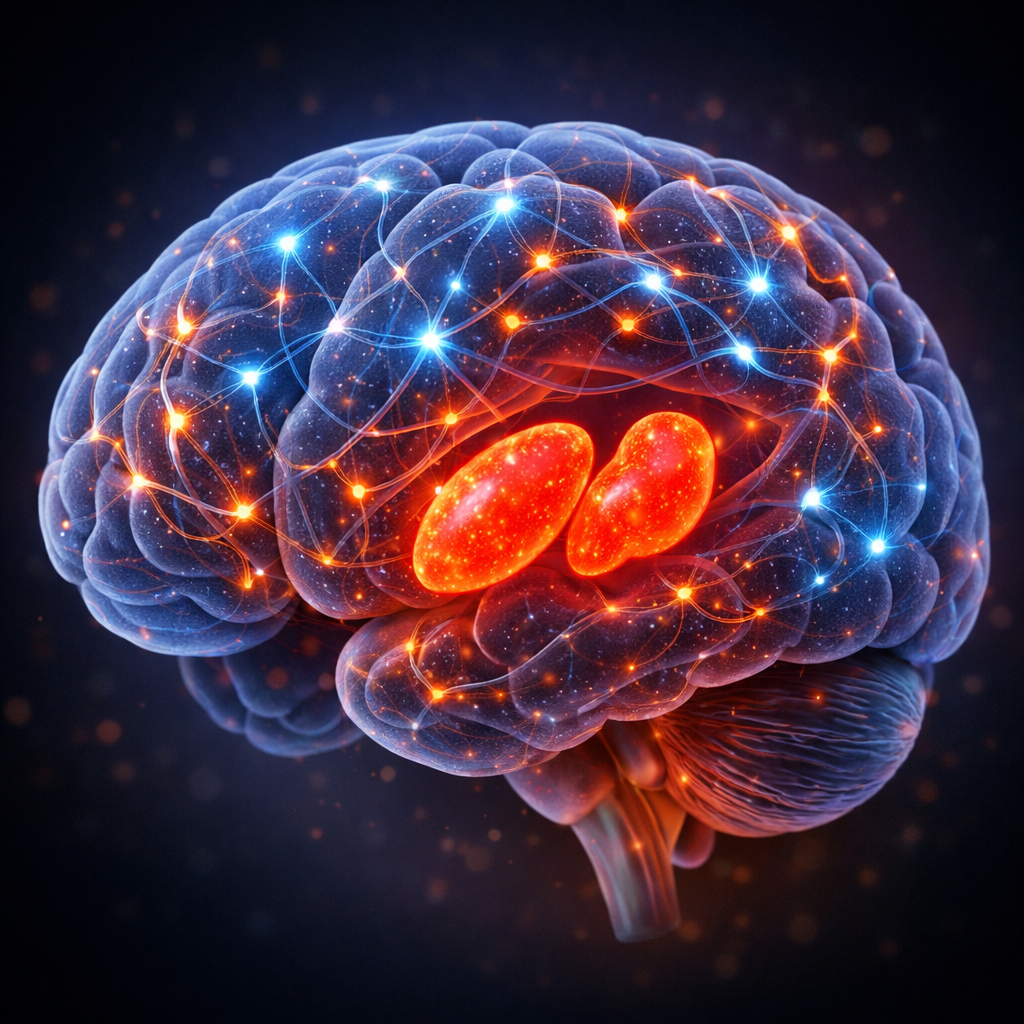
For decades, researchers studying psilocybin, LSD, mescaline, and other classic psychedelics operated in relative isolation, each laboratory accumulating its own small cache of brain scans and drawing its own conclusions. The field advanced fitfully: studies were expensive, regulations were strict, and sample sizes were rarely large enough to yield rock-solid findings. Now, in what may be the most consequential methodological leap the discipline has yet made, an international consortium of scientists has pooled data from eleven independent research groups spanning five countries and three continents to produce the largest neuroimaging study of psychedelic drugs ever conducted. The results, published in Nature Medicine, reveal that five chemically distinct compounds — psilocybin, lysergic acid diethylamide (LSD), mescaline, N,N-dimethyltryptamine (DMT), and ayahuasca — all trigger a recognizable, shared pattern of changes in how the brain organizes itself.
“This is a breakthrough in how we think about psychedelic drugs. For the first time, we show there’s a common denominator among drugs that we currently consider completely separate,” said Danilo Bzdok, McGill University.
The study, led by Manesh Girn of the University of California San Francisco and senior author Danilo Bzdok, Associate Professor of Biomedical Engineering at McGill University, integrated resting-state functional MRI (fMRI) data from 267 participants and more than 500 individual brain scanning sessions. Resting-state fMRI captures the spontaneous, coordinated activity between brain regions when a person is not engaged in a specific task — essentially a map of the brain’s default chatter. By applying a uniform preprocessing pipeline and a Bayesian hierarchical modeling framework across all eleven datasets, the researchers could, for the first time, separate reliable cross-drug neural effects from the methodological noise that had long muddied the field.
What they found was striking. Psychedelics consistently increased functional connectivity between two broad classes of brain networks that normally operate in relative independence: transmodal networks — including the default mode network and the frontoparietal network, associated with higher cognition, self-referential thought, and executive control — and unimodal sensorimotor networks, which process basic visual and bodily experience. In plain terms, regions of the brain responsible for abstract thinking began talking more freely to regions devoted to raw sensory experience. The researchers describe this as a flattening of the brain’s intrinsic processing hierarchy, an effect consistent with the profound perceptual and ego-dissolution experiences users commonly report.
The Striatum Steps Into the Spotlight
Beyond the cortex, the study identified a robust increase in coupling between the dorsal striatum — specifically the caudate nucleus and putamen — and unimodal cortical areas. Both structures receive converging input from visual, motor, and association cortices and play central roles in action selection and the contextual modulation of perception. Their heightened connectivity with sensory networks under psychedelics may reflect altered weighting of how the brain links incoming sensory information to behavioral output, a process the authors say is consistent with cortico-striato-thalamocortical models of psychedelic action. Notably, the thalamus, long theorized to play a gating role in psychedelic states, showed weaker and less consistent effects in the Bayesian analysis, complicating prior accounts that emphasized thalamic disinhibition as a primary mechanism.
According to Bzdok, “This approach gives us an X-ray view of the entire research community.”
A key methodological contribution of the study is its use of Bayesian hierarchical modeling, which departs from the binary pass-or-fail logic of conventional null hypothesis testing. Rather than asking simply whether an effect exists, the Bayesian framework asks how confident we can be that an effect exists, and how large it likely is. This approach explicitly accounts for variability across studies and individuals, and — crucially — it discounts apparent effects that may be driven by a single outlier dataset. By these more stringent standards, the team found that several effects widely reported in earlier single-site studies, particularly widespread reductions in within-network connectivity, were actually weak, inconsistent, and often indistinguishable from noise. Sensorimotor networks did show modest reductions in internal coherence, but the default mode network and other higher-order circuits showed little reliable change in their within-network organization.
Resolving a Decade of Contradictions
The new paper arrives at a moment when the contradictions in the psychedelic neuroimaging literature have grown too large to ignore. A 2018 direct comparison of three datasets — two LSD, one psilocybin — could not identify a single between-network connectivity increase that held up across all three. Two independent research groups applying the same global functional connectivity approach to psychedelic data reported nearly opposite topographic patterns. The BOLD Psychedelic Consortium, as the new international team has named itself, was organized specifically to address this fragmentation. By standardizing the preprocessing of all data and running every dataset through the same analytic pipeline, the researchers could disentangle genuine drug effects from researcher-specific methodological choices, what the paper calls the ‘researcher’s degrees of freedom’ problem that has quietly afflicted the field.
The clinical stakes are considerable. Psychedelic-assisted therapies have demonstrated efficacy across more than a dozen randomized, placebo-controlled trials for conditions including treatment-resistant depression, end-of-life distress, generalized anxiety disorder, tobacco addiction, and alcoholism. A search of clinicaltrials.gov currently returns more than 400 active trials. Yet the biological mechanisms connecting neural effects to therapeutic outcomes remain poorly understood. Bzdok noted that many psychiatric drug therapies have changed little since the 1980s, and that a mechanistic map of psychedelic brain action could accelerate the development of next-generation treatments and precision medicine approaches — helping predict which patients are most likely to benefit and why.
“Many drug therapies for depression have changed little over the past decades. Psychedelics may represent the most promising shift in mental health treatment since the 1980s,” said Bzdok.
The study’s limitations deserve acknowledgment. The eleven datasets varied in scanner field strength, voxel size, dosing regimens, and timing of scans relative to drug administration. One dataset lacked a placebo control; another used a fixed-order design. Ayahuasca, which combines DMT with monoamine oxidase inhibitors that dramatically alter its pharmacokinetics, showed the most idiosyncratic connectivity profile — though whether that reflects genuine pharmacological uniqueness or simply the very small sample size of nine participants remains unclear. DMT’s dataset, with only sixteen participants, similarly limited the confidence of drug-specific inferences. The authors are candid about these constraints and call for prospectively harmonized multisite studies as the field matures.
Still, the study’s core contribution is durable: across compounds that differ substantially in chemistry and duration of action, a recognizable neural fingerprint emerges. Psilocybin and LSD — which together made up the largest portion of the dataset — showed virtually identical connectivity profiles, consistent with their shared mechanism of 5-HT2A serotonin receptor agonism and their comparable phenomenological effects. Mescaline tracked closely behind. DMT exhibited the most dramatic perturbations of any drug, an amplified version of the shared pattern. The existence of this common signature, Bzdok and colleagues argue, suggests conserved neurobiological mechanisms that cut across the chemical diversity of the classic psychedelics — and may ultimately explain why such structurally different molecules can produce such subjectively similar experiences.
The consortium has made its full pipeline code publicly available and welcomes additional datasets. In a field still fighting for legitimacy, data sharing at this scale is itself a statement.
Endnotes
- Girn M, Doss MK, Roseman L, et al. An international mega-analysis of psychedelic drug effects on brain circuit function. Nature Medicine. 2026. https://doi.org/10.1038/s41591-026-04287-9
- McGill University. Largest-ever study of psychedelics could help advance their use in treating mental health disorders. EurekAlert. April 8, 2026. https://www.eurekalert.org/news-releases/1123228
- Vollenweider FX, Preller KH. Psychedelic drugs: neurobiology and potential for treatment of psychiatric disorders. Nature Reviews Neuroscience. 2020;21:611–624.
- Andersen KA, Carhart-Harris R, Nutt DJ, Erritzoe D. Therapeutic effects of classic serotonergic psychedelics: a systematic review of modern-era clinical studies. Acta Psychiatrica Scandinavica. 2021;143:101–118.
- Roseman L, Leech R, Feilding A, Nutt DJ, Carhart-Harris RL. The effects of psilocybin and MDMA on between-network resting state functional connectivity in healthy volunteers. Frontiers in Human Neuroscience. 2014;8:204.
- Carhart-Harris RL, et al. Neural correlates of the LSD experience revealed by multimodal neuroimaging. Proceedings of the National Academy of Sciences. 2016;113:4853–4858.
- Timmermann C, et al. Human brain effects of DMT assessed via EEG-fMRI. Proceedings of the National Academy of Sciences. 2023;120:e2218949120.
- Girn M, et al. Serotonergic psychedelic drugs LSD and psilocybin reduce the hierarchical differentiation of unimodal and transmodal cortex. NeuroImage. 2022;256:119220.
- Doss MK, et al. Models of psychedelic drug action: modulation of cortical-subcortical circuits. Brain. 2022;145:441–456.
- Siegel JS, et al. Psilocybin desynchronizes the human brain. Nature. 2024;632:131–138.

COPY II (2-3 PARAGRAPHS)
IMAGE CREDIT: NASA.


Leave a Reply