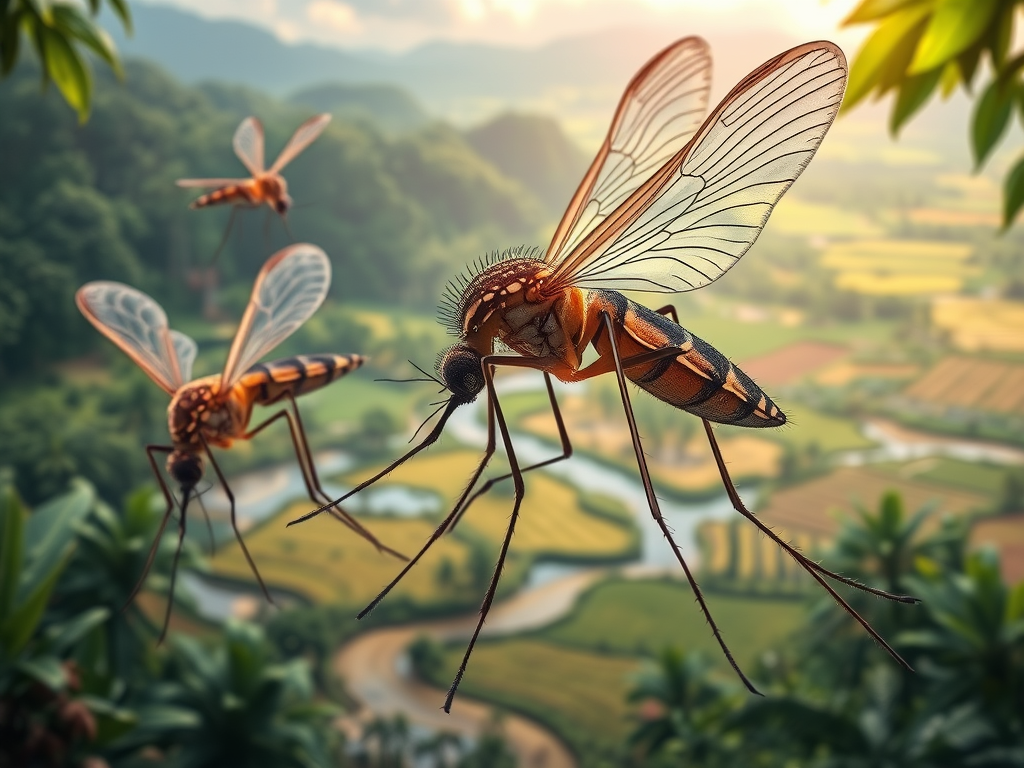
Anopheles darlingi mosquitoes—a major vector of malaria in South America—are evolving in response to insecticides, which may make them harder to kill and malaria more difficult to control, according to a new study led by Harvard T.H. Chan School of Public Health.
The study will be published March 26, 2026, in Science. It is the first study to sequence a large number (>1000) of complete genomes of Anopheles mosquitoes in the Americas, where there are more than 600,000 cases of malaria annually, mostly in Brazil, Colombia, and Venezuela.
“Malaria remains stubbornly persistent in South America, and there is a risk that dangerous drug-resistant strains of the malaria parasite could evolve in the Americas and then spread elsewhere,” said corresponding author Jacob Tennessen, research scientist in the Department of Immunology and Infectious Diseases. “Our study plays a major role in revealing the evolutionary dynamics of a primary malaria vector, providing new insights into Anopheles darlingi biology that could help improve methods for blocking disease transmission.”

Prior studies on Anopheles darlingi population genetics have used sets of genetic markers but not the whole genome. For this study, the researchers generated whole genome sequences for 1,094 adult female Anopheles darlingi mosquitoes from 16 locations—including forests, wetlands, grasslands, farming and mining areas, and cities—across six South American countries: French Guiana, Brazil, Guyana, Peru, Venezuela, and Colombia.
The study found that Anopheles darlingi are evolving to evade insecticides—a novel result. “Insecticide resistance has only been sporadically documented in Anopheles darlingi, which have not been subject to intensive insecticide-heavy campaigns like those elsewhere in the world,” Tennessen said. “We were not expecting to see resistance-related genes evolving as much as we did, and in so many different countries. Resistance may be driven by agricultural insecticides rather than those used for vector control specifically.”
The researchers also found extensive genetic divergence among Anopheles darlingi mosquitoes across the continent—for example, between those in Guyana versus Venezuela—and observed that the species is well poised to adapt to changes in its environment.
According to the researchers, the study is a milestone for vector biology in the Americas and provides a template for future studies of other Anopheles species in the region. While the study findings contribute to a knowledge base that can inform malaria control efforts, “this was basic research rather than an applied study,” said senior author Daniel Neafsey, associate professor of immunology and infectious diseases. “Additional research is required before any policy changes are implemented.”
Other authors included the Neafsey Lab’s Raphael Brosula, Angela Early, Margaret Laws, and Katrina Kelley, and Harvard Chan’s Nicholas Arisco and Marcia Castro.



Leave a Reply