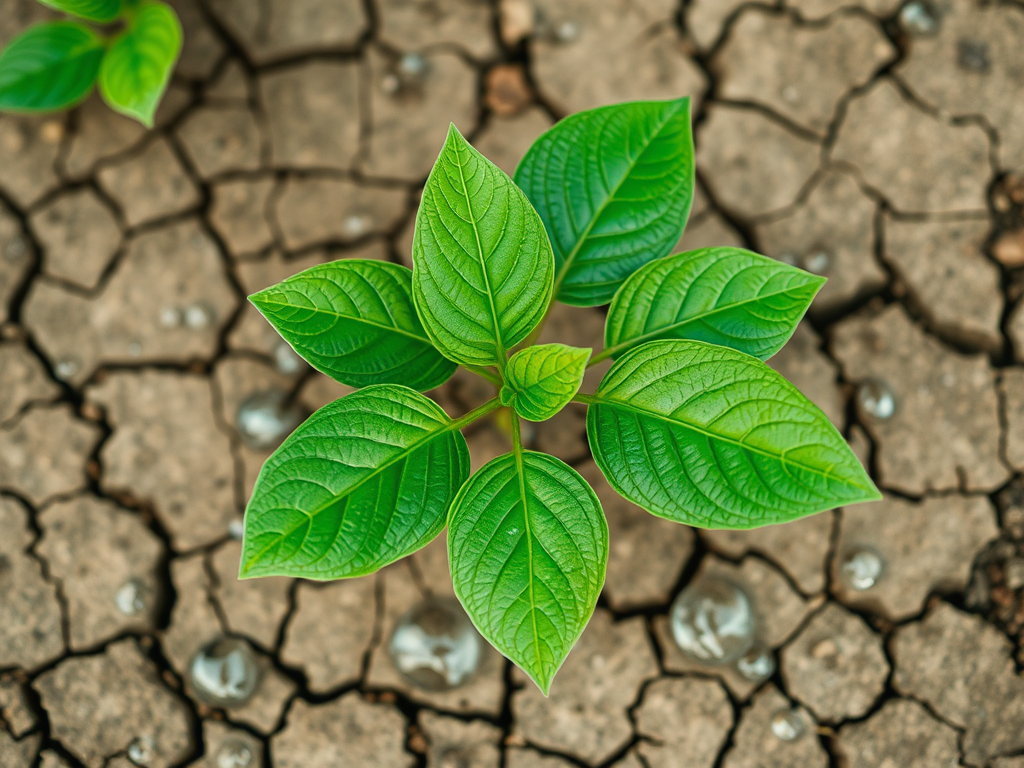
Plants need water, light and air to thrive. But when they transport water from the soil up to their leaves, they defy gravity. Scientists describe this astonishing phenomenon as “negative water potential”, a form of negative tension that enables herbs, shrubs and trees to draw water from the soil.
Nevertheless, plants do not constantly extract water from the soil. For decades, researchers have sought to understand what limits a plant’s water uptake. Now, a team of researchers led by Andrea Carminati, Professor of Soil Physics at ETH Zurich, and Tim Brodribb, Professor of Plant Physiology at the University of Tasmania, has found a surprisingly simple explanation for this puzzle: suction in plants is not constrained by the plant’s own properties but by the way water moves through the soil.
The researchers have published their findings in the journal Science.

Capillary forces within soil pores
Most water in the soil exists in pores of varying sizes. These pores exert a capillary force that holds water. “The soil physicist community has made great progress in determining the best time to irrigate,” says Carminati. They discovered that when the soil water potential falls below -1.5 megapascals, plants are unable to extract water fast enough to meet their needs. In other words: “When soil dries, capillary and viscous forces in the pores increase – and plants find it harder to draw water from the soil,” says Carminati.
But how do plants sense this and how do they regulate their tension? To answer these questions, Carminati sought collaboration with Tim Brodribb. The Professor of Plant Physiology at the University of Tasmania is an expert in plant water relations.
Sensitive valves
Plants have special structures on the underside of their leaves known as stomata that function as an interface for gas exchange. These are small valves that the plant opens and closes in response to fluctuating environments. “Stomata are super sensitive,” says Brodribb. When they are open, carbon dioxide from the air can flow into the leaf while water can escape into the atmosphere as vapour.
When the plant closes its stomata, it conserves water. This prevents it from dying of thirst. However, when the stomata are closed, the plant faces starvation because less carbon dioxide enters its leaves, meaning it produces fewer new sugar molecules. As a result, it grows more slowly. “Ultimately, the behaviour of these tiny valves determines how much carbon from the atmosphere enters the land plant biomass,” says Brodribb.
Unsuccessful breeding programmes
A plant requires considerable energy to draw water from soil pores. For example, the cell walls of the tubes through which water rises in shoot stems or tree trunks are thickened. “This enables them to withstand the tension in the vascular system and not collapse,” says Brodribb. Further up in the leaves, dissolved substances in plant cells generate osmotic pressure, which keeps cells turgid despite the high tension in neighbouring vascular tissues.
The agricultural industry has long attempted to breed plants that store more solutes in their cells, hoping this would help them absorb water more efficiently from the soil and thus better withstand drought, explains Brodribb. Although a substantial amount of money has been invested in such breeding programmes, these hopes have never been realised. “Our results explain this failure: the limiting factor lies not in the plants but in the soil,” says Brodribb.
Intersecting perspectives
Carminati highlights the importance of adopting an interdisciplinary approach to their research project. As a soil physicist, he and his team initially focused their attention on the underground aspects before, in collaboration with Brodribb, gradually shifting their focus upwards. “The physics of capillarity not only predicts the extent to which soil pores empty but also what occurs high up in the leaves,” says Carminati.
Brodribb, on the other hand, shifted his perspective in the opposite direction: starting with studies of plant cells, his focus gradually moved further downwards – to the tips of the roots. ”Our analysis using model calculations of water potential is a very fundamental step in understanding how plants function,” says Brodribb.


Leave a Reply