
A Hell Planet May Represent an Entirely New Planetary Class: L 98-59 d looks less like a weird one-off and more like a category problem for astronomy. Researchers say the world may be the first recognized member of a broader class of gas-rich, sulfur-heavy planets sustained by long-lived magma oceans. Its strange chemistry matters because it suggests small planets can evolve into forms that standard labels do not capture, widening the known menu of worlds beyond rocky, water-rich, or gas-dominated types. (Oxford news)
Blue Ghost’s Moon Data Rewrites the Lunar Heat Map
Firefly Aerospace’s Blue Ghost lander has delivered the first major scientific payoff from NASA’s Commercial Lunar Payload Services program, and the results may upend a long-standing picture of the Moon’s interior. Data from its heat probe and magnetotelluric instrument suggest Mare Crisium, far from the Moon’s thorium-rich near-side hot spot, is nearly as thermally active as Apollo 17’s landing site. That challenges the idea that lunar heat is cleanly concentrated in one geologic province. At the same time, conductivity data imply the deep mantle may be cooler than expected, supporting a view that near-side volcanism was driven less by a superheated mantle than by thinner crust that allowed magma to break through more easily. The mission also signals that commercial lunar landers are beginning to produce serious, field-shaping science. (Science)
JWST Hit a Wall of Haze Around One of the Weirdest Known Planets: Kepler-51d, already famous as a bloated, ultra-low-density super-puff, just became even harder to explain. JWST observations suggest the planet is wrapped in an enormous haze layer that blocks a clear view of its atmospheric composition. Instead of solving the puzzle, the telescope sharpened the mystery, underscoring how some exoplanets remain stubbornly outside current formation models. (ScienceDaily)
Astronomers Just Prioritized 45 Rocky Worlds for the Life Hunt: A new catalog narrows thousands of exoplanets down to 45 especially promising rocky worlds in habitable zones, plus 24 more in a stricter three-dimensional habitable-zone cut. The importance is not that these planets are likely inhabited tomorrow, but that the search for life needs triage. With telescope time limited, a sharper shortlist helps move astrobiology from dreamy abundance to strategic targeting. (Royal Astronomical Society):

Spin May Be the Best New Way to Tell Planets from Failed Stars: Giant planets and brown dwarfs can look frustratingly alike, but a new study suggests rotation speed may separate them cleanly. Directly imaged giant planets appear to spin significantly faster than comparable brown dwarfs, offering astronomers a new diagnostic for sorting ambiguous objects and a clue that the two populations may form or evolve differently. (Northwestern / CIERA news)
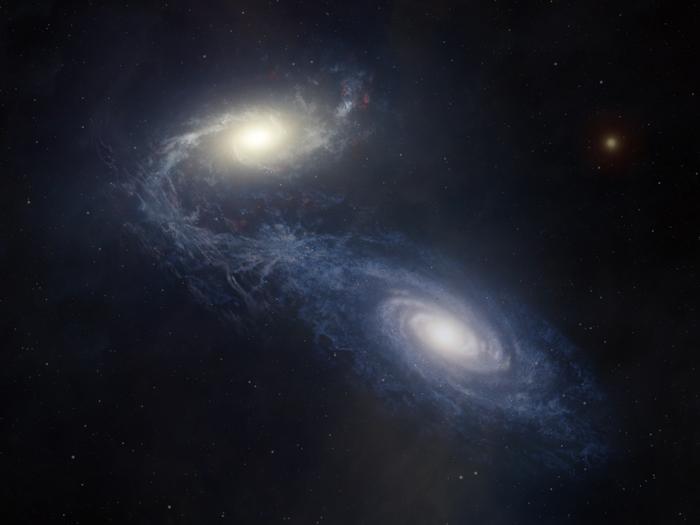
The Small Magellanic Cloud May Be a Wrecked Galaxy, Not a Standard One: The Small Magellanic Cloud has long served as a useful model for understanding dwarf galaxies. New work argues that its weird motion is best explained by a past direct collision with the Large Magellanic Cloud, leaving it dynamically scrambled rather than neatly rotating. If true, astronomers may need to rethink how often they have used this nearby galaxy as a normal template.(University of Arizona)
Hubble Accidentally Caught a Comet Breaking Apart in Real Time: NASA’s Hubble Space Telescope, after pivoting to a backup target, happened to catch comet C/2025 K1 (ATLAS) fragmenting into multiple pieces. That kind of timing is rare and valuable. Comet breakups expose internal structure and help researchers understand how solar heating and internal weakness tear apart ancient icy bodies from the solar system’s deep past. (NASA Hubble)
Fiber-Optic Cables Could Become Cheap Seismic Ears on the Moon: Los Alamos researchers say fiber-optic cables laid on or near the lunar surface could help detect moonquakes across broader areas than traditional seismometers alone. The appeal is practical as much as scientific: long stretches of cable could give future lunar missions a cheaper, wider seismic network for probing faults, impacts, and the Moon’s deep interior. (Los Alamos)
Dragonfly Just Took a Major Step Toward Titan: NASA’s Dragonfly mission has entered integration and testing, with engineers checking the rotorcraft’s core electronics and power systems. That may sound procedural, but it marks the shift from ambitious concept to increasingly real spacecraft. Dragonfly remains one of the boldest astrobiology missions ahead, aiming to explore Titan’s chemistry, geology, and habitability after a launch no earlier than 2028. (Johns Hopkins APL)
Physicists Proposed a New Way to Detect Gravitational Waves: A theoretical study suggests gravitational waves might leave measurable signatures in the light emitted by atoms by subtly altering spontaneous emission. This is not a replacement for LIGO-style detection, and it has not yet been demonstrated experimentally. But it points toward a possible new observational channel, which is exactly the kind of conceptual expansion a young field like gravitational-wave astronomy still needs. (Stockholm University)
DART Data Suggest Binary Asteroids Pelt Each Other with Debris: New analysis from NASA’s DART mission indicates binary asteroids can exchange material through slow, repeated debris transfer, a process researchers liken to cosmic snowballs. That finding matters because it reveals these systems as more geologically active than they appear and improves our understanding of how rubble moves on small bodies, which is directly relevant to planetary-defense planning. (University of Maryland)


Leave a Reply