There is a particular kind of American movie that arrives seeming to know, almost against the grain of the age, that audiences still want to be moved. Not instructed, not impressed in the abstract, not merely submerged in noise and velocity, but moved. Project Hail Mary belongs to that increasingly rare category. It is a film about extinction, about loneliness, about intelligence pressed into service against catastrophe, and yet it carries itself with a strange and disarming buoyancy. It believes, unfashionably and with considerable nerve, in wonder.
The premise has the blunt force of myth. A man wakes alone in deep space, disoriented, cut off from memory, cut off from Earth, cut off from any recognizable frame of human life. He is Ryland Grace, once a science teacher, now the unwilling custodian of a mission whose stakes are total. The sun is failing. Humanity, in one of those cruelly elegant twists that science fiction prefers, has discovered both the nature of the threat and the terrifying inadequacy of any ordinary response. So the story begins where many stories end: with one man already launched into the dark, already separated from the world he is meant to save.
What follows is both intimate and expansive. The film moves between the locked-room suspense of Grace’s isolation and the larger architecture of the crisis itself, slowly reconstructing the mission through flashbacks and revelations. This structure gives the picture a useful instability. We are always catching up, piecing together not just the mechanics of the disaster but the psychology of the man at its center. The suspense lies not only in whether he can solve the problem, but in whether he can fully become the person the mission requires.

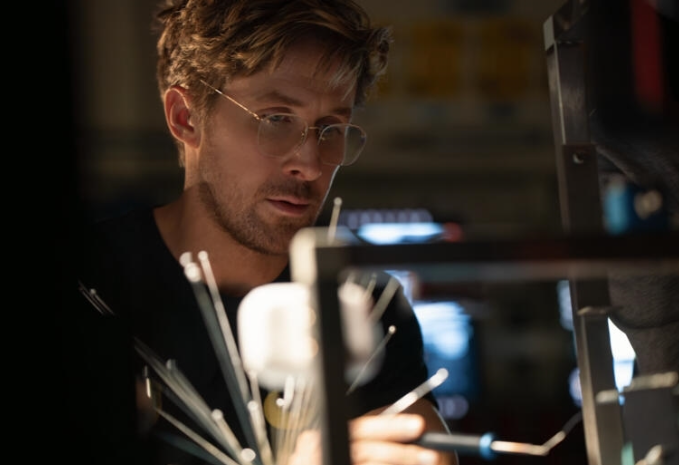
Ryan Gosling gives the film its pulse. There is a quality he has, when properly used, of seeming both ironic and entirely sincere at once, and that doubleness serves the material beautifully. Grace is frightened, funny, evasive, intelligent, sometimes petulant, and finally brave in a way that feels earned rather than assigned by screenplay logic. Gosling makes him human at every turn. He does not play the savior as a monument. He plays him as a man who finds himself, almost accidentally, in possession of a burden too large to refuse.
The film’s great gamble, and perhaps its grace note, is that it refuses to become merely a survival narrative in chrome and vacuum. It wants to be about contact. About reciprocity. About the possibility that even at the edge of annihilation, the universe might yield not just terror but companionship. Rocky, the alien engineer Grace encounters, gives the film its emotional center. What could have been a gimmick becomes instead the quiet argument of the movie: that intelligence is not only analytical but relational, that problem-solving may be inseparable from trust, and that friendship, even improbable friendship, may be one of the few forces equal to despair.
This could all have turned ponderous. Instead the film remains agile, often funny, and unexpectedly warm. Its science is elaborate but made legible, not flattened exactly, but translated into cinematic terms that preserve both complexity and momentum. There are moments when the tone edges toward sentiment or when the very accessibility of the storytelling softens the dread it has worked to establish. Yet even those moments seem part of the film’s larger wager. It would rather risk earnestness than retreat into detachment.
That choice feels, finally, like the source of its power. Project Hail Mary is not ashamed of feeling. It is not ashamed of suspense, or beauty, or the old-fashioned pleasure of watching competence mobilized against disaster. It is a large-scale studio spectacle with a surprisingly tender inner life. The visuals have sweep, the pacing rarely flags, and the emotional mechanics are calibrated with uncommon confidence. But what lingers is less the scale than the tone: the sense that in a ruined universe, intelligence and decency might still matter.
And that may be why the film lands the way it does. It understands that apocalypse is only half the story. The other half is whether anyone, waking in the dark, still chooses to answer it.
IMAGE CREDIT: Jonathan Olley.


Leave a Reply