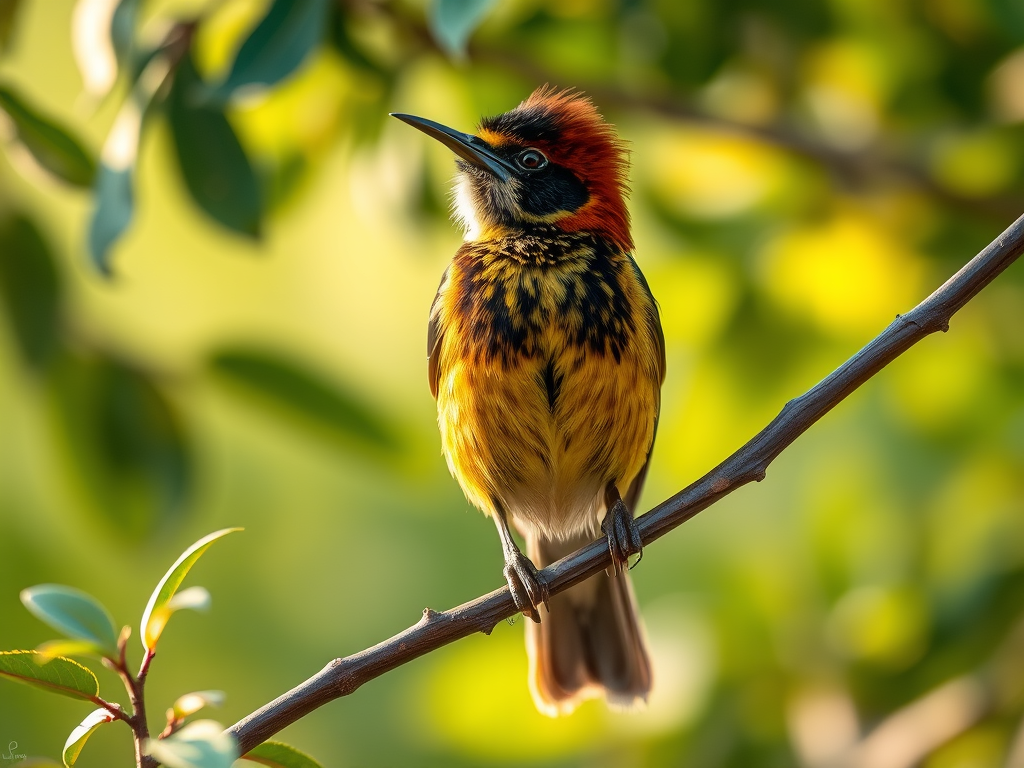
Teaching a Vanishing Song Back to the Regent Honeyeater: As regent honeyeaters have neared extinction in southeastern Australia, they have lost more than numbers: they have also begun to lose their song. With only a few hundred birds left in the wild, young males increasingly failed to hear and learn the species’ traditional warbling tune, sometimes copying other birds instead. Captive-bred honeyeaters faced the same problem, and recorded songs played over speakers did not solve it. Researchers found a better approach by placing young zoo-born birds with wild-born males that still sang the original song. In small groups, the young birds learned the correct tune so well that some later became tutors themselves, passing it on to the next generation. The work suggests conservation may need to preserve learned animal culture, not just bodies and genes. (New York Times)
Migratory Species Keep Sliding Backward: A new interim update to the UN Convention on Migratory Species delivers one of the bleakest conservation snapshots of the week. It says 49 percent of monitored migratory species populations protected under the treaty are now declining, up from 44 percent just two years ago, while 24 percent face extinction. Shorebirds were hit especially hard, with 18 species moving into higher-risk categories. The report does point to some gains, including recoveries for species such as the saiga antelope, scimitar-horned oryx, and Mediterranean monk seal, and notes progress in mapping flyways and corridors. But the larger message is that habitat loss, fragmentation, and overexploitation are still outrunning international protections. With CMS COP15 opening in Brazil on March 23, the report raises pressure for governments to move from monitoring to stronger coordinated action. (EurekAlert!)
Kenya’s Lions Are Yielding Ground to Cattle: A study highlighted this week adds a revealing twist to human-wildlife coexistence in Kenya’s Maasai Mara conservancies: lions are not simply competing with livestock in real time, they are actively avoiding places cattle use even after the animals are gone. Researchers found cattle density had the strongest effect on lion density, with goats and sheep contributing as well. That means livestock leave behind a sort of fear footprint, pushing predators away from parts of the landscape that should, on paper, still be usable habitat. The implications are practical. Rather than treating conflict only as a matter of nighttime corrals or direct encounters, the study suggests land-sharing plans need spatial zoning, including grazing-free areas, to preserve usable lion space. It is a reminder that coexistence is not just about whether wildlife survives, but whether it can still function normally. (The Wildlife Society)
Blue Crabs’ Biggest Predator May Be… Other Blue Crabs: A Smithsonian-led study out this week finds that juvenile blue crabs in the Chesapeake Bay face their deadliest threat not from fish, but from their own species. In mid-salinity parts of the bay, cannibalism by larger blue crabs is the top source of mortality for young crabs, according to a new PNAS paper. The work also identifies a critical escape hatch: shallow-water habitat. These areas appear to offer juveniles a refuge from larger crabs, much as seagrass protects them earlier in life from fish predators. That gives the research a conservation edge beyond its grisly headline. Shallow habitats are under pressure from shoreline alteration, erosion, and broader estuarine change, so losing them could amplify crab losses in ways managers have underestimated. For a species central to Chesapeake ecology and fisheries, that is an important warning. (Smithsonian Magazine)
Bull Sharks May Keep Company on Purpose: A new Animal Behaviour study, covered today by BBC Wildlife’s Discover Wildlife, pushes back on the old image of sharks as largely solitary drifters. After analyzing six years of underwater observations from 184 bull sharks at Fiji’s Shark Reef Marine Reserve, researchers concluded the animals were not mixing randomly. Instead, they showed active social preferences, repeatedly associating with particular individuals and engaging in recognizable interaction patterns such as following, joining, and parallel swimming. The study does not suddenly make bull sharks “social” in the primate sense, and the reserve’s tourism-linked feeding regime remains controversial because provisioning can alter natural behavior. But the work still matters. It suggests shark social lives may be richer than commonly assumed and shows how long-term tracking at protected sites can reveal behavior impossible to detect in brief field studies. That is important zoology, not just shark myth-busting. (Discover Wildlife)
Bumblebee Queens Can Survive Floods by Breathing Underwater: One of the most striking animal-physiology stories of the week comes from a lab accident that turned into a discovery. Science News reports that hibernating queens of the common eastern bumblebee can survive submersion for days by breathing underwater and shifting into anaerobic metabolism. Researchers submerged queens for eight days and found oxygen in the water declined while carbon dioxide continued to be released, showing the insects were still exchanging gases. Lactic acid spikes indicated they were also supplementing with oxygen-independent energy pathways. The finding helps explain how queens can survive flooded soils during winter diapause. It also raises a fresh climate question: as heavy rainfall events become more common, repeated flooding may strain the energy reserves queens need to emerge, found colonies, and reproduce. A remarkable survival trick, in other words, may still have limits. (Science News)
Ultrasound Could Become a New Tool for Saving Hedgehogs: Researchers at Oxford say the declining European hedgehog may someday get help from an unexpected source: ultrasound. A study released March 11 found that hedgehogs can hear frequencies from 4 to 85 kHz, with peak sensitivity around 40 kHz, demonstrating for the first time that they hear in the ultrasonic range. That opens the possibility of designing ultrasonic deterrents that push hedgehogs away from roads before they are hit by cars. Given estimates that traffic can kill up to a third of hedgehogs in some local populations, that could be meaningful if the approach works outside the lab. The team also used micro-CT scans to build a detailed 3D model of the hedgehog ear, revealing anatomical features not previously seen. The technology is not ready yet, but the study offers a plausible new conservation engineering idea. (EurekAlert!)
Extreme Weather Is Shrinking Young Birds Before They Fledge: A long-running Oxford dataset has produced a timely warning about what climate extremes are doing to young birds. Using 60 years of observations on more than 80,000 great tits in Wytham Woods, researchers found that cold snaps during the first week after hatching and heavy rain later in nestling development both reduce body mass at fledging, a key measure tied to survival. On their own, those weather hits can cut fledging mass by up to 3 percent. But when intense heat and heavy rain coincide, the damage becomes much worse, with mass dropping by up to 27 percent, especially in broods laid later in the season. Earlier breeding appears to buffer some of the risk, though that adaptation carries tradeoffs of its own. The study shows how climate change threatens wildlife not only through averages, but through timing and extremes. (EurekAlert!)
Cardinals’ Gut Microbes May Record Their Stress History: A new study on wild northern cardinals suggests the microbiome could become a subtle but powerful conservation tool. Phys.org reports that mild social or environmental stressors altered the composition of cardinals’ gut microbes, and those shifts tracked with stress hormone levels, beak coloration, and body condition. Importantly, overall microbial diversity did not simply collapse; instead, the microbiome seemed to encode individual responses to life in the wild. Researchers argue that this makes gut microbes a kind of biological record of what an animal has experienced, potentially offering conservationists a sensitive way to gauge resilience, rehabilitation outcomes, or the hidden effects of urbanization and disturbance. The work does not mean microbiome tests will suddenly replace field ecology. But it does point toward a future in which wildlife health can be monitored through physiological signatures that are less obvious than wounds or visible decline. (Phys.org)
Ravens Don’t Just Follow Wolves. They Remember the Landscape: A study in Yellowstone is changing the old picture of ravens trailing wolves to carcasses like feathered opportunists with no long-term plan. Tracking 69 ravens and 20 wolves over two and a half years, researchers found only one clear case of prolonged raven following. Instead, ravens were repeatedly flying to areas with a history of wolf kills, using spatial memory to target productive hunting landscapes rather than individual predators. Some birds traveled up to 155 kilometers in a day along highly directional routes. The implication is bigger than a Yellowstone natural-history curiosity. It suggests ravens combine short-range cues with large-scale cognitive maps, remembering where prey is most likely to appear even when no kill is visible. That reshapes how scientists think about scavenger intelligence, navigation, and the ecological information animals extract from predator behavior. (Phys.org)
Spain’s ‘Firefighting Donkeys’ Are a Low-Tech Conservation Story: One of the most interesting conservation pieces this week is also one of the least futuristic. National Geographic profiles Doñana’s “Firefighting Donkey Battalion,” a group of 18 rescued donkeys that graze through fire-prone vegetation near Spain’s Doñana National Park, clearing weeds and shrubs that would otherwise become fuel. The animals work along managed firebreak lines for hours a day from March through November. The approach is both ecological management and cultural revival, restoring older grazing practices to confront a modern wildfire crisis intensified by heat, drought, and rural abandonment. According to the story, Doñana National Park has not recorded a wildfire in nine years while the program has been in place. For a park that shelters birds, Iberian lynx, and other sensitive species, the idea is compelling: conservation technology does not always have to mean satellites and sensors; sometimes it is strategic grazing. (National Geographic)




Leave a Reply