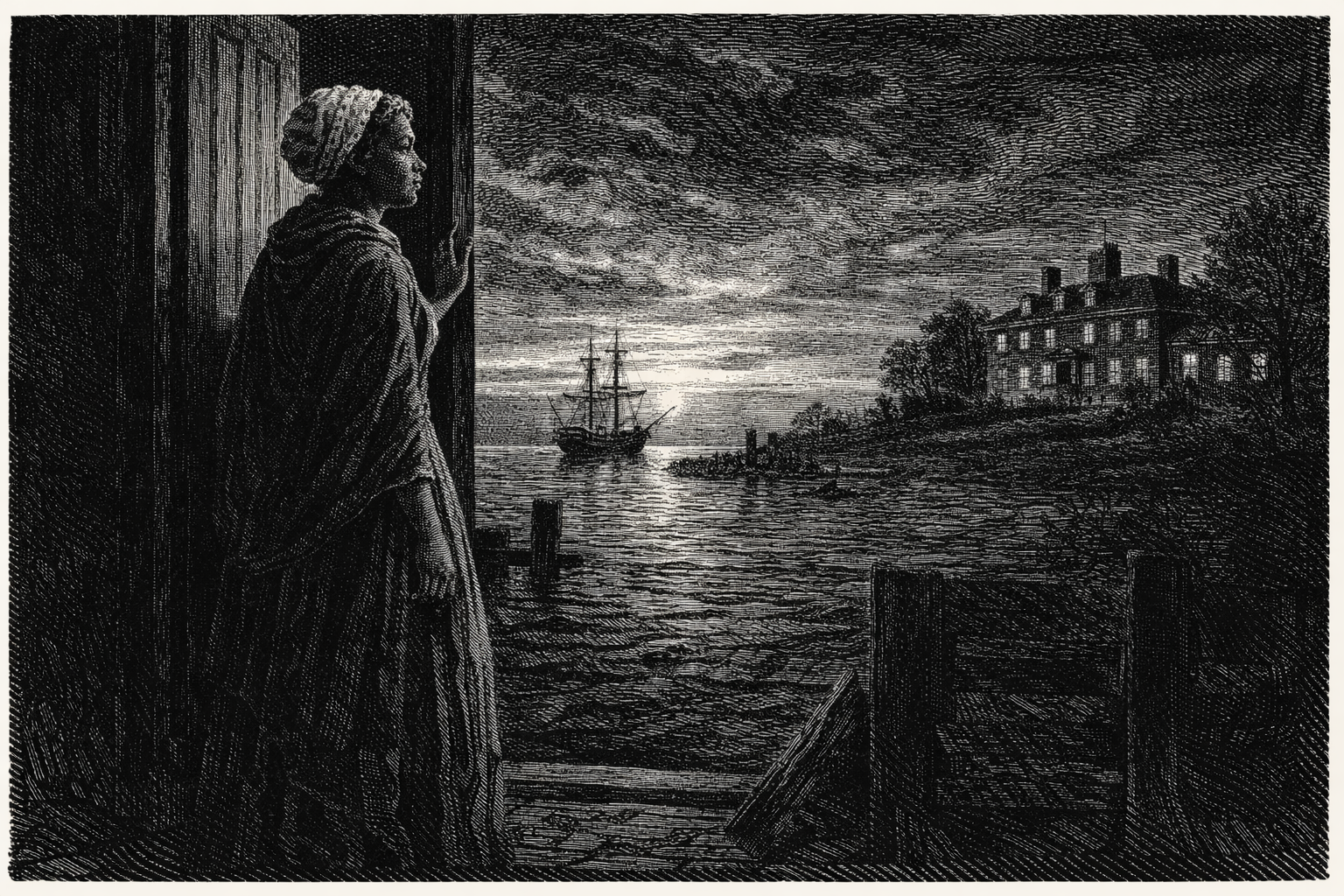
In May 1796, as President George Washington and his wife Martha prepared for an evening dinner at their Philadelphia residence, an enslaved woman named Ona Judge made a decision that would define her life. While the household bustled with preparations, Judge walked out the door, boarded a ship called the Nancy, and sailed toward an uncertain freedom in New Hampshire. She was twenty-two years old, and she would never return to bondage.
Ona Maria Judge was born around 1773 at Mount Vernon, the Virginia plantation that served as the Washington family’s seat of power. Her mother, Betty, was an enslaved seamstress, and her father was Andrew Judge, a white English tailor employed by the Washingtons. This parentage granted Ona no special status—under Virginia law, children followed the condition of their mother.

From childhood, Judge was trained in domestic skills, becoming accomplished in needlework, sewing, and the intimate duties required of a personal attendant. By her teenage years, she had become Martha Washington’s body servant, a position that placed her at the very center of elite American life. She traveled with the Washingtons to New York and then Philadelphia as George Washington assumed the presidency, witnessing the birth of the new nation from within the household of its most celebrated figure.
Yet proximity to power offered no protection from the fundamental violence of slavery. Judge remained property, subject to sale, gift, or bequest at her enslavers’ discretion.

The Breaking Point
In 1796, Judge learned that Martha Washington intended to give her as a wedding present to Elizabeth Parke Custis, Martha’s granddaughter. Custis was known for her unpredictable temper, and the prospect of serving her—and being separated permanently from any possibility of freedom—proved unbearable.
Philadelphia offered unique conditions for escape. Pennsylvania’s gradual emancipation law meant that enslaved people brought into the state could claim freedom after six months of residency. Washington, aware of this provision, systematically rotated his enslaved workers back to Virginia before the deadline, deliberately circumventing the law while publicly maintaining his reputation as a man of principle.
Judge understood these machinations. She also understood the free Black community of Philadelphia, which had grown into a vibrant network of churches, mutual aid societies, and antislavery activists. When she decided to flee, this community helped her reach the waterfront and board a vessel bound north.

A President’s Pursuit
Washington’s response revealed how personally he took Judge’s escape. This was not merely the loss of property but an affront to his authority and reputation. He deployed Treasury Secretary Oliver Wolcott to locate her and dispatched agents to New Hampshire after learning her whereabouts from a family acquaintance who had spotted her in Portsmouth.
The president instructed his agents to seize Judge and return her by ship—essentially kidnapping her from a free state. When Joseph Whipple, the customs collector in Portsmouth, met with Judge, she made her position unambiguous. She would return voluntarily only if the Washingtons would guarantee her freedom. Washington refused, unwilling to negotiate with someone he considered his property and concerned about setting a precedent that might encourage other escapes.
A second attempt to capture Judge in 1799, orchestrated by Washington’s nephew Burwell Bassett, also failed when Judge was warned and went into hiding. George Washington died later that year, but Martha Washington’s heirs maintained legal claim to Judge for decades.

Freedom with Want
Judge married Jack Staines, a free Black sailor, and bore three children. Life in New Hampshire was difficult. The family lived in poverty, and Judge never learned to read or write. Her children died before her, and she spent her final years dependent on charity.
Yet when interviewed in 1845 and 1847 by abolitionists who recorded her story, Judge expressed no regret. Asked whether she was not sorry she had left the Washingtons, given her subsequent hardships, she replied that she was free, and that freedom was worth more than any comfort slavery could provide. “No,” she declared, “I am free, and have, I trust, been made a child of God.”

Legacy
Ona Judge died in 1848, having lived as a fugitive for fifty-two years. She never obtained legal freedom—the Fugitive Slave Act meant she could theoretically be seized until her death. Yet she died on her own terms, having chosen her own husband, raised her own children, and determined her own fate.
Her story illuminates the contradictions at the heart of American founding mythology. The man celebrated for liberating a nation kept human beings in bondage and pursued them relentlessly when they sought the same liberty he championed. Judge’s flight stands as testimony to the courage of enslaved people who, facing impossible odds, chose freedom anyway.




Leave a Reply