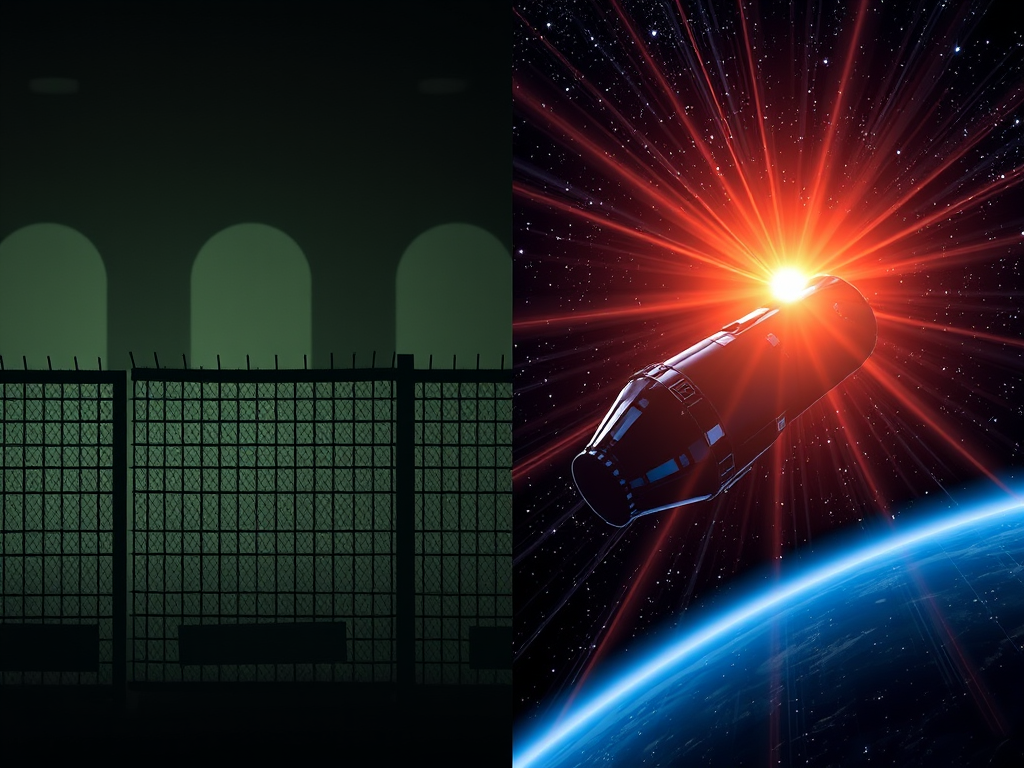
At Least 2 Measles Cases Confirmed at Texas Immigrant Detention Center: At least two detainees at the South Texas Family Residential Center in Dilley, Texas, have confirmed measles infections, according to the Department of Homeland Security (DHS). DHS said it has stopped all movement within the facility and that ICE Health Services Corps is taking active steps to control the outbreak. The detention center was already under national scrutiny after holding 5-year-old Minnesota resident Liam Conejo Ramos and his father, Adrian Conejo Arias, despite an active asylum case; they were released after a judge’s order, and the measles-related movement halt reportedly followed shortly after their departure. The report situates the detention-center cases within a broader surge in US measles activity this year, with major outbreaks in multiple states. (CIDRAP)
Artemis II’s Biggest Unknown – Surviving Space Radiation Beyond Earth’s Shield: Jeremy Hansen has trained for deep-space failures—from simulated spacecraft accidents to cave and underwater confinement—but he can’t rehearse the mission’s biggest uncertainty: radiation beyond NASA’s protective magnetosphere. On the Artemis II lunar flyby, the Orion capsule will cross the Van Allen belts, then face sudden solar particle storms and the constant drizzle of galactic cosmic rays that can damage DNA, immunity, and cognition. The expected dose is modest—about a whole-body CT scan—but the risk climbs for longer Moon and Mars missions. Researchers will fly personalized bone-marrow “organ chips” made from each crew member’s cells alongside the crew, comparing them with Earth controls to spot stress and aging signals. Engineers lean on shielding and a cramped storm shelter, while biologists explore countermeasures from antioxidants to radiation-resistant proteins and even torpor. (Science)
Waymo’s $16B Robotaxi War Chest: Alphabet’s self-driving unit Waymo says it has raised $16 billion in new funding at a reported $126 billion valuation, a huge vote of confidence in driverless ride-hailing at scale. The company frames the round as proof that “large-scale autonomous mobility has arrived,” and the cash is meant to accelerate fleet growth and expansion to new markets. The announcement lands as robotaxis move from “demo” to daily infrastructure: Waymo says its service now delivers hundreds of thousands of rides per week in the U.S. The competitive backdrop is tightening—rivals are chasing similar ambitions—so the key near-term questions are operational: how fast Waymo can add vehicles, how smoothly it can launch in new cities, and how it handles safety scrutiny as volume rises. (Tech Xplore)
Predictive Math Designs Better Robotic Joints: A new design approach aims to improve “rolling joints”—components that help robots move smoothly and apply forces precisely—by optimizing their geometry computationally. Rather than tweaking one part at a time, the framework tunes multiple joint elements together so the resulting mechanism matches a target force profile or task requirement (think: a gripper’s squeeze, or a humanoid limb’s load). The work, published in PNAS, is pitched as a bridge between elegant math and real hardware: you specify what you want the joint to do, and the algorithm helps shape the joint to deliver it. If it generalizes, this could speed iteration in robotics labs and reduce the trial-and-error that often separates promising designs from reliable, manufacturable parts. (Tech Xplore)
Robots Scout Lava Tubes for Moon and Mars Bases: ScienceDaily reports on a three-robot system designed to explore lava tubes—natural tunnels that could become high-value real estate for future lunar or Martian habitats because they offer shielding from radiation and temperature swings. The concept is teamwork: a “lead” robot navigates and maps, while others support sensing, communications, and route planning as the team descends into rugged, GPS-denied environments. The larger scientific payoff is situational awareness—high-resolution maps, hazard identification, and site assessment—without putting astronauts at risk. The engineering payoff is equally direct: lava tubes are a stress test for autonomy, localization, and mobility, especially where terrain is steep, loose, and unfamiliar. It’s a reminder that space “robots” are increasingly scouts and surveyors first, explorers second. (ScienceDaily)
MBARI’s Robotic DNA Sampler Targets Waterway Threats: A new robotic sampler from the Monterey Bay Aquarium Research Institute (MBARI) is built to collect environmental DNA (eDNA)—genetic traces shed by organisms—so researchers can detect pathogens, parasites, and invasive species in aquatic systems more quickly and at larger scale. The emphasis is pragmatic robotics: affordability, reliability, and the kind of repeatable deployment that turns monitoring from occasional surveys into ongoing surveillance. By automating collection, the system aims to lower barriers for agencies and researchers tracking ecosystem health and emerging biological threats across waterways. The story also spotlights a quiet robotics trend: sampling and sensing are becoming “productized” field operations, not bespoke expeditions. If eDNA is the microscope for whole ecosystems, this kind of robot is the lab tech—collecting consistently, cheaply, and often enough to spot change before it becomes crisis. (Phys.org)
Bubble Bots – Microrobots That Home In on Tumors: Caltech describes “bubble bots”—tiny, bubblelike microrobots designed to autonomously move through the bladder and deliver therapy to tumors in mice. A core challenge in medical microrobotics is balancing effectiveness, biocompatibility, and cost; the pitch here is that simpler can be better if the physics and chemistry are tuned correctly. The team frames the advance as a step toward scalable microrobots for drug delivery, with the broader promise of miniature agents that can sense biomarkers, manipulate small targets (like clots), or concentrate drugs where they’re needed most. The news also underscores a design philosophy shift: rather than building ever-more complex micro-machines, researchers are increasingly looking for minimal, body-friendly “actuators” that can still be steered, imaged, and made in large numbers. (California Institute of Technology)
NASA Opens a New Robotics Funding Lane for Mars Mobility: NASA’s ROSES-2025 Amendment 43 introduces a program element (STRIDE) that solicits proposals from U.S. industry to conduct design studies of advanced robotic surface and aerial mobility systems aimed at Mars operations—specifically, systems that can transport and/or deploy science payloads and traverse realistic Martian environments. The stated goals include identifying what “level of development” commercial robotic systems need before they can credibly operate in Mars-like conditions, mapping capability gaps, and pushing the broader landscape of robotic exploration forward. Read one way, it’s NASA trying to de-risk a pipeline: encourage Earth-and-Moon-relevant commercial mobility now, then pressure-test what it would take to graduate those platforms into Mars logistics later. For robotics teams, this is a signal about what NASA wants next: mobility + payload handling + operational realism. (NASA Science)
Perseverance’s AI-Guided Trek Speeds Up Mars Exploration: SpaceDaily reports that Perseverance has completed a landmark AI-guided traverse across the rim of Jezero crater, using onboard autonomy to plan drives and reduce the stop-start cadence that traditionally slows rover operations. The practical win is time: more ground covered per Martian day can translate into more science targets reached before hardware ages out. The deeper win is operational independence—autonomy that helps a robot choose safe routes in rough terrain without waiting for Earth-based planning cycles. This is where “robotics” in planetary science is headed: not just better wheels, drills, or cameras, but better decision loops under uncertainty. As missions aim for more ambitious terrain (deltas, crater rims, potential biosignature sites), the value of reliable autonomy rises. Faster navigation becomes, indirectly, faster geology and faster astrobiology. (SpaceDaily)
Ancient “Beach” Evidence Adds a New Layer to Mars Habitability: Another SpaceDaily report highlights evidence interpreted as an ancient beach along a shoreline in Jezero crater—an idea that, if supported, refines what kind of water environment once existed there. Shorelines matter because they’re interfaces: places where sediment can sort, concentrate organics, and preserve environmental history in layered deposits. For Mars exploration, the point isn’t just poetic (“a beach on Mars”), it’s tactical: identifying depositional settings that could best preserve signs of past life and readable climate records. The rover is effectively doing planetary fieldwork—turning textures, stratigraphy, and chemistry into a story about water depth, energy, and duration. This also shows why robotic mobility and sampling strategy are inseparable from science return: the hypothesis lives or dies on whether the rover can reach the right outcrops, image them well, and interrogate them with instruments at the right scale. (SpaceDaily)
Tesla Pivots Hard Toward Humanoid Robots, Ars Says: Ars Technica reports that Tesla is killing off the Model S and X—flagship EVs that were once category-defining—framing the move as part of a pivot to focus on humanoid robotics instead. The piece positions the decision as a sharp reallocation of attention and resources: the legacy models have fallen behind competitors in range, tech, and freshness, and Tesla’s narrative is increasingly about what comes after cars. For robotics watchers, the interesting part is not whether humanoids are “next year” ready, but what it means when a major manufacturer treats robotics as a top-line corporate bet, not a side lab. If Tesla truly prioritizes humanoids, it will pressure the field on cost targets, manufacturing approaches, and deployment venues. If it doesn’t, this becomes another case study in robotics hype cycles colliding with production reality. (Ars Technica)
Samsung’s Ballie Home Robot Reportedly Shelved: Another Ars Technica item says Samsung has indefinitely shelved Ballie, the small rolling home robot it has teased publicly, with Bloomberg cited as the source of the report. Consumer home robotics has long been a graveyard of “great demos” that struggle to become durable products—because real houses are messy, expectations are high, and the use-cases must be compelling enough to justify cost. A shelving decision, if accurate, is less about one robot and more about the recurring mismatch between marketing-friendly companionship narratives and the hard economics of building, supporting, and updating an autonomous product that lives in people’s homes. The broader question Ballie raises is the same one the category keeps failing: what daily task is so valuable that a home robot becomes as normal as a phone or smart speaker? Until that answer is crisp, “launches” remain fragile. (Ars Technica)



Leave a Reply