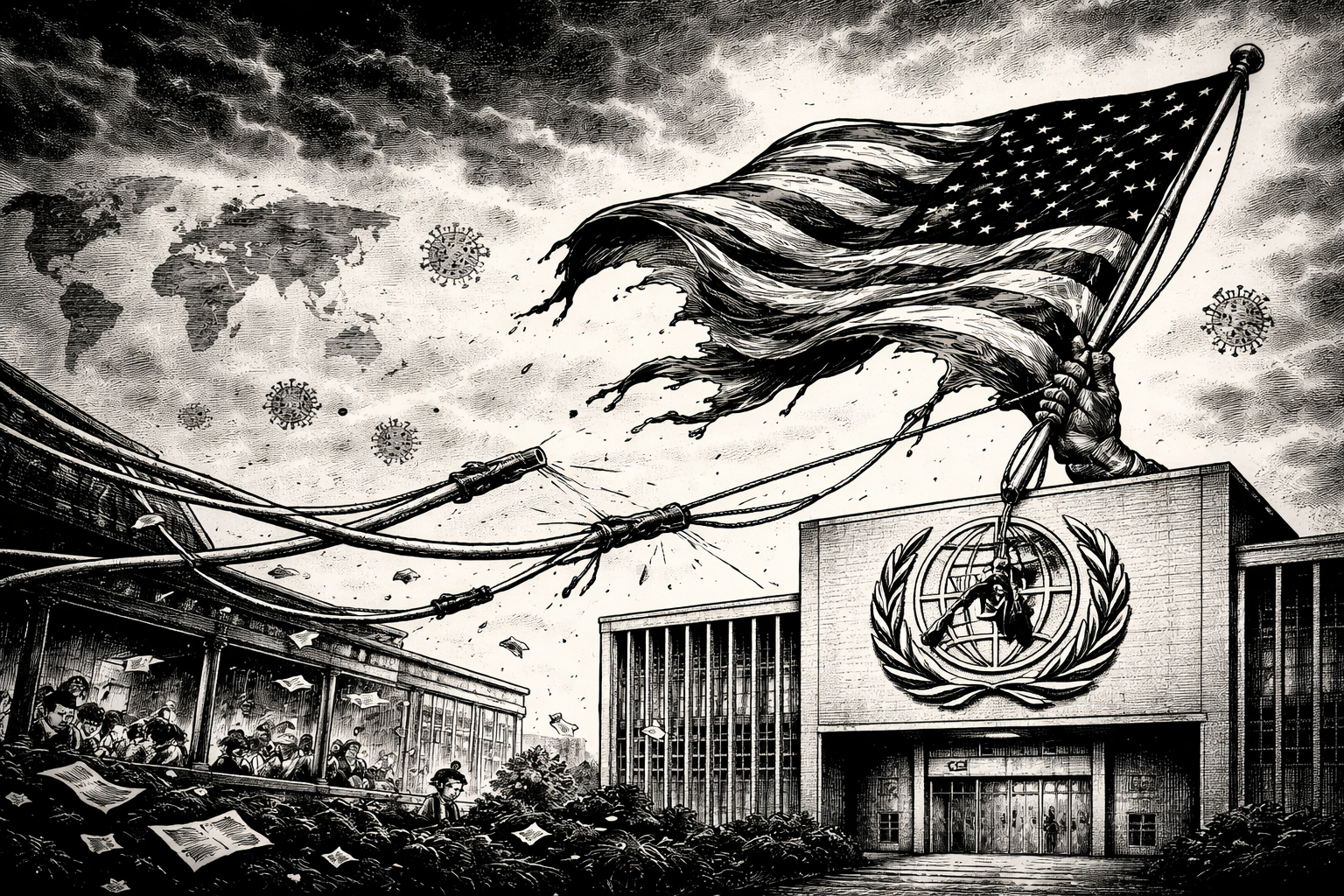
On January 22, 2026, the United States formally completed its withdrawal from the World Health Organization, ending a relationship that stretches back to the agency’s founding in 1948—and opening a messy new chapter in global health diplomacy that is less a clean exit than a contested separation with unpaid bills, blurred lines of cooperation, and high-stakes consequences for disease surveillance and outbreak response.
The U.S. was not a latecomer to the WHO. American officials helped shape the postwar vision of a standing international health body under the United Nations, and the United States became one of the earliest members when WHO launched in 1948.
But the relationship was never purely symbolic. Over decades, the U.S. became central to WHO’s operations—financially, technically, and politically. The U.S. has historically been the WHO’s largest funder, contributing through both assessed dues and voluntary donations, while also supplying technical expertise through agencies like the CDC and NIH.
That funding footprint is part of why this withdrawal matters: when the biggest check-writer leaves the room, the room changes—what gets funded, what gets staffed, and who sets the agenda.
The trigger: COVID grievances, reform demands, and sovereignty messaging
The current break traces back to President Donald Trump’s critique of WHO’s performance during COVID-19. The administration’s position—reiterated in official statements—argues that WHO mishandled early pandemic response, failed to demonstrate independence from member-state political influence, and did not enact “urgently needed reforms.”
This 2026 exit follows a year-long notice period: the Trump administration issued notice in January 2025, and federal officials marked January 22, 2026 as the date the withdrawal was “completed.”
Public health experts, however, view the move less as reform leverage and more as strategic self-harm—an act that reduces U.S. visibility into outbreaks while shrinking America’s influence in the world’s most important health coordinating body. One expert called it “penny-wise and billion-dollar-foolish.” Another described it as among the most damaging executive decisions for public health in modern memory.
Can the U.S. actually “leave”? The legal fight over dues and the WHO constitution
Here’s where the story gets unusually technical: WHO’s constitution does not include a standard withdrawal clause, a deliberate design choice rooted in the idea that fighting disease requires near-universal membership.
Yet the United States has a unique carve-out. When Congress ratified U.S. membership in 1948, it reserved a right to withdraw with one year’s notice, but conditioned that right on the U.S. meeting its financial obligations for the relevant fiscal period. WHO leadership has pointed to this language in arguing that member states are not required to treat the U.S. departure as legally effective until outstanding dues are paid.
And those unpaid dues are the accelerant. Reporting differs on totals—partly because accounts separate assessed dues from other promised or expected funding—but multiple outlets describe significant arrears for 2024 and 2025, ranging from more than $130 million to roughly $260 million depending on what is counted. The Trump administration disputes that it is obligated to pay prior to departure, while WHO leadership argues the congressional condition makes payment central to the legality of withdrawal.
This isn’t just bean-counting. The money dispute feeds directly into questions of legitimacy—whether the withdrawal is merely operational (the U.S. stops participating) or also recognized as legally complete by WHO member states. The issue is scheduled for debate at the WHO Executive Board meeting in early February 2026, with potential spillover into the World Health Assembly later in the year.
What changes immediately: influence, intelligence, and the flu-vaccine pipeline
The most consequential losses are not dramatic overnight shutdowns; they’re the slow erosion of coordination and trust. One key area is disease intelligence: WHO convenes systems and committees that synthesize global data—especially for respiratory threats like influenza—into actionable guidance. Without formal membership, the U.S. risks losing early insight into how raw data are gathered and interpreted, and it loses its “seat at the table” when recommendations are formed.
That matters for the annual flu shot. WHO’s global strain-tracking and vaccine-composition recommendations are a central reference point for manufacturers. U.S. scientists may still access public datasets and maintain informal relationships, but informal channels don’t replace official coordination—especially when companies must make high-stakes manufacturing decisions on tight timelines.
The administration says it plans to shift toward “direct, bilateral” health partnerships rather than relying on WHO as a hub. Critics argue that bilateral deals cannot realistically replicate WHO’s near-universal surveillance network—particularly when outbreaks emerge in places where data-sharing is politically sensitive or diplomatically strained.
In practice, the U.S. has already stepped back from official participation in WHO committees, governance structures, and technical working groups—exactly the channels where global norms are shaped and where early warning signals are converted into shared action.
The global ripple: budget cuts, power vacuums, and credibility damage
WHO’s leadership has been preparing for a future less dependent on dominant donors, but the U.S. exit still creates a budget shock and an influence vacuum. Analysts warn that other powers—some with very different public-health priorities and geopolitical aims—will have more room to shape WHO agendas in America’s absence.
There are also basic capacity issues. WHO supports low- and middle-income countries with technical guidance, outbreak response, and health-program assistance. If those functions shrink, the result is not contained to faraway places. Weaker surveillance and response capacity abroad increases the odds that outbreaks expand undetected, cross borders, and arrive at U.S. airports and hospitals later—when containment costs more and the human toll is heavier.
The withdrawal also carries reputational consequences. Global health is built on trust: a belief that countries will share information quickly, act transparently, and invest in the systems that protect everyone. When the U.S. exits the premier coordinating body for health emergencies, partners may become more skeptical of American motives and more reluctant to treat U.S.-led initiatives as stable or durable.
A strategic gamble with pandemic-sized stakes
In the end, the U.S. withdrawal is not a single policy switch—it’s a strategic reorientation: less multilateral governance, more ad hoc deals, and a bet that America can stay safe while stepping away from the world’s central outbreak-coordination infrastructure.
Supporters of the move frame it as a necessary protest against bureaucratic failure and political capture—an attempt to force reform and reassert national control. Critics argue it does the opposite: it surrenders influence, reduces visibility into emerging threats, and creates exactly the conditions in which misinformation, delayed reporting, and fragmented response are more likely.
What happens next depends on two unresolved questions. First, whether the U.S. will settle the dues dispute—because without payment, WHO member states may treat the legal status of the departure as contested even if the practical reality is already changing. Second, whether bilateral data-sharing can meaningfully substitute for a system designed to gather near-universal information and translate it into coordinated action.
The next pandemic—or even the next severe flu season—will test whether this was discipline or delusion. And the cruelest part of global health is timing: you can feel clever for years, right up until the week you are proven wrong.



Leave a Reply