In a limestone cave on the Indonesian island of Sulawesi, a pig stands motionless while three human-like figures interact with it—one reaching toward its head, another positioned near its snout holding what appears to be a stick-like tool. The scene is weathered, partially obscured by mineral deposits, but unmistakable in its intent: this is a story, frozen in red pigment on stone. And according to research published in Nature in July 2024, it was painted at least 51,200 years ago, making it the oldest known example of visual storytelling in the world.
“We didn’t expect it to be that old,” archaeologist Maxime Aubert told me in a recent interview. The Griffith University researcher, who has spent years developing uranium-series dating techniques for rock art, recalled his team’s initial surprise when dates from Sulawesi sites began pushing back the timeline of human artistic expression by tens of thousands of years. “When we started dating them and realized, ‘That’s at least 40,000 years old,’ it was a huge surprise.”
But for those of us interested in the future of storytelling, the more profound surprise lies not in the dates themselves but in what they reveal about an impulse that appears hardwired into human consciousness. Understanding where narrative began may be essential to understanding where it’s going.

The Birth of Narrative Composition
The Leang Karampuang panel represents more than artistic skill—it represents something fundamentally new in the archaeological record: composition. Unlike isolated handprints or single animal figures, this scene arranges multiple figures in spatial relationships that invite the viewer to infer action. As the Nature paper notes, such scenes “allow a story to be told through images in a manner that does not require the producer of the art to be present to convey the narrative to an audience.”
This distinction matters enormously. A single painted animal is representation; a scene of figures interacting is storytelling. The Sulawesi artists had crossed a cognitive threshold—they were encoding not just objects but events, relationships, and meaning into a medium that could persist beyond their own lifetimes.
The anthropologist Claude Lévi-Strauss argued in the twentieth century that human thought operates through binary oppositions—nature/culture, human/animal, life/death—and that myths serve as sophisticated logical tools for processing these fundamental tensions. The Sulawesi scenes seem to confirm this intuition at the deepest possible time depth. The paintings feature human-like figures alongside animals, some potentially depicted as therianthropes—composite human-animal beings that blur categorical boundaries. These artists weren’t merely documenting hunts; they were working through the conceptual relationship between humans and the natural world, using visual narrative as a thinking tool.
“This enigmatic scene may represent a hunting narrative,” Aubert and his colleagues write, “while the prominent portrayal of therianthropic figures implies that the artwork reflects imaginative storytelling (for example, a myth).”

Challenging Eurocentric Timelines
For decades, the prevailing narrative placed the birth of sophisticated art in Upper Paleolithic Europe—the caves of Lascaux, Chauvet, Altamira. The Indonesian findings force a fundamental rethinking.
“It’s about where and whose eyes look,” Aubert explained when I asked about resistance to Asian dates among some European researchers. “In France, for example, cave art became part of national identity. Children learn, ‘Our caves have the oldest art; we invented this or that.’ Yet DNA shows that the people who made Western European art 40,000 years ago aren’t the ancestors of most people living there now.”
The reframing matters for our understanding of storytelling’s origins. If narrative composition emerged independently in Southeast Asia along human migration corridors—in regions where seafaring and demographic “bottlenecks” amplified cultural exchange—then storytelling isn’t a European inheritance diffused outward. It’s a fundamental human capacity that arose wherever the conditions were right.
Aubert suggests population density plays a crucial role. “Rock art correlates with population density,” he told me. “Signaling systems emerge when more people live together. Like traffic lights: small villages don’t need them; cities do. Rock art can also serve identity—shared symbols that form connections.” The implications extend far beyond prehistory: storytelling may intensify precisely when human communities grow complex enough to require it.

The Survival of Story Across Deep Time
Perhaps no tradition better demonstrates storytelling’s capacity for persistence than the Aboriginal Australian Dreamtime narratives. Research by linguist Nicholas Reid and geographer Patrick Nunn has identified at least 21 Aboriginal stories that accurately describe coastal flooding events from 7,000 to 10,000 years ago—stories preserved across 400 generations without written language.
“It’s quite gobsmacking to think that a story could be told for 10,000 years,” Reid has observed. The mechanism, he suggests, involves “kin-based responsibilities to tell the stories accurately” that provide “cross-generational scaffolding” keeping narratives true across millennia.
Even more remarkably, the Gunditjmara people of southeastern Australia preserve creation stories about Budj Bim, a volcanic god whose teeth became lava. Recent argon dating confirms volcanic eruptions in that landscape occurred approximately 36,900 years ago—making this potentially the oldest surviving account of a geological event anywhere on Earth.
The Aboriginal example offers a crucial insight for anyone thinking about storytelling’s future: the stories that persist are those embedded in systems of social accountability, transmitted through multiple channels (song, dance, painting, ceremony), and tied to specific places and responsibilities. Story survival isn’t passive—it requires active cultural infrastructure.

From Cave Walls to Neural Networks
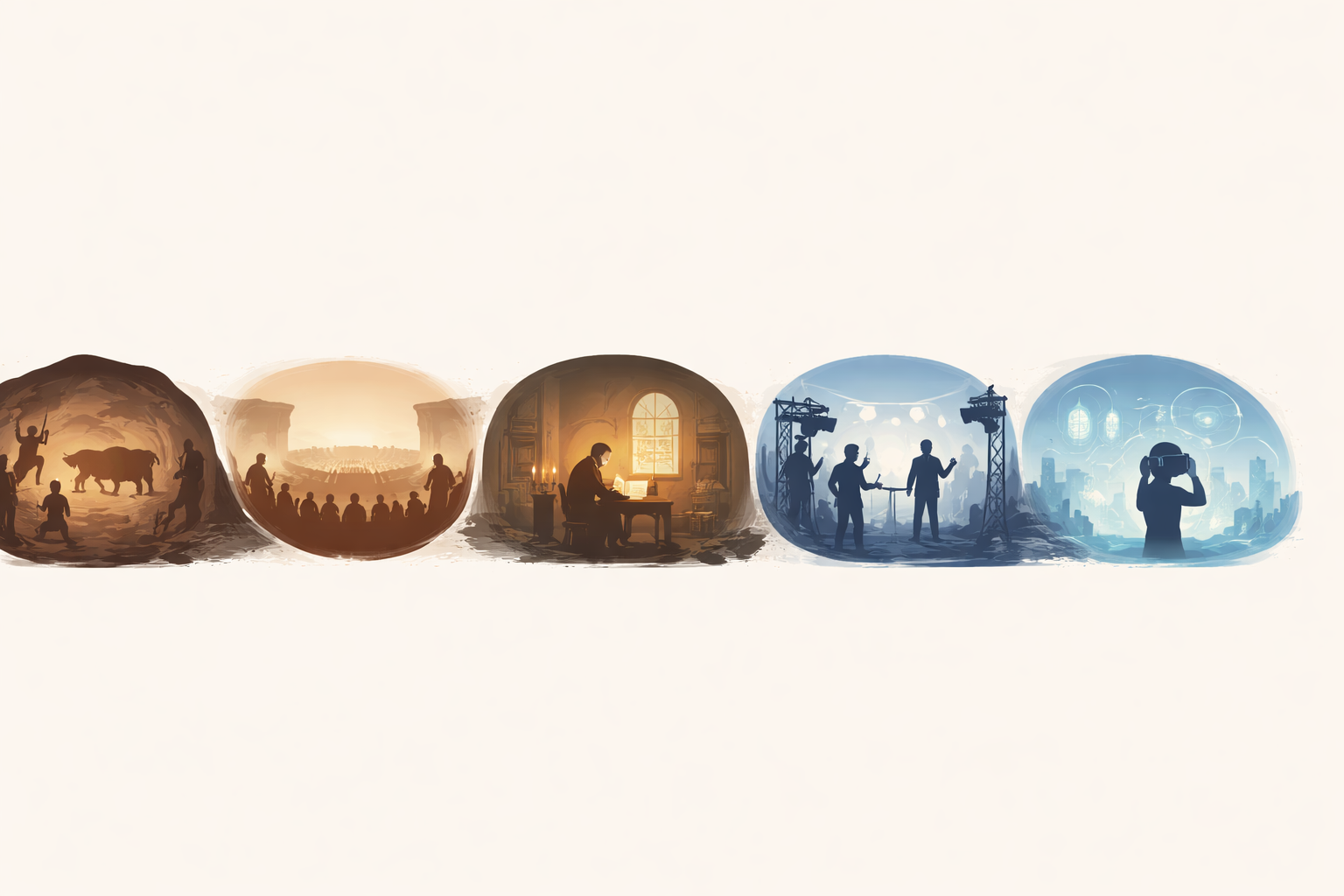
The arc from Sulawesi to Silicon Valley is shorter than it might appear. The fundamental challenges of storytelling—how to compose scenes that convey meaning without the creator present, how to encode information that persists across time, how to navigate the boundary between human and non-human agents—remain central to contemporary narrative technology.
When George Lucas opens his billion-dollar Museum of Narrative Art in Los Angeles in September 2026, the galleries will begin with prehistoric cave art before tracing visual storytelling through illuminated manuscripts, comic books, and cinema to the present day. “Stories are mythology,” Lucas has said, “and when illustrated, they help humans understand the mysteries of life.” The museum’s arc—from cave paintings to Star Wars—implicitly argues for continuity in the human storytelling impulse across all its technological transformations.
That continuity faces its most significant test with generative AI. Contemporary language models can now produce narratives with sophisticated plot structures, character development, and emotional beats. Yet the Sulawesi evidence suggests that storytelling’s core function may lie not in the generation of novel content but in the composition of meaning—the arrangement of elements to invite inference, to process contradiction, to navigate the tension between what we are and what we imagine.
Lévi-Strauss proposed that myths don’t belong to individual authors but emerge from collective social processes—they are “thought by themselves” through cultures over time. In this light, AI-generated narratives might represent not a break from human storytelling but an extension of it: stories arising from the accumulated patterns of countless human minds, filtered through new technological substrates.

What the Oldest Stories Tell Us About Tomorrow
Aubert’s work continues. “We have a paper under review at Nature on Sulawesi rock art that could change the picture,” he told me, hinting at findings that may push the dates even further back. The team is also working with AI researchers to analyze hand stencils—potentially extracting demographic information about the artists themselves from the outlines of hands pressed against stone 50,000 years ago.
The intersection of ancient evidence and emerging technology suggests a future where understanding storytelling’s deep history becomes essential to designing its next iterations. If the impulse to compose narrative scenes emerged alongside human cognition itself—if it represents, as Lévi-Strauss argued, the fundamental architecture of human thought—then AI systems designed to tell stories will succeed or fail based on how well they recapitulate these ancient patterns.
The Leang Karampuang artists faced the same problem every storyteller faces: how to arrange elements in space and time so that meaning persists beyond the moment of creation, beyond the presence of the creator. They solved it with red ochre and rock. We’re solving it with code and silicon. But the problem remains the same, and the oldest surviving solutions may still have something to teach us about the newest ones.
In the end, understanding where storytelling began isn’t merely an archaeological curiosity—it’s reconnaissance for the future. The 51,200-year record suggests that narrative composition is neither an invention nor an accident but something closer to a necessity: a cognitive technology as fundamental to human existence as language itself, and one likely to persist in whatever forms our successors take.

WORDS: Marc Landas
Endnotes
- Oktaviana, A.A., et al. “Narrative cave art in Indonesia by 51,200 years ago.” Nature 631 (2024): 814–818.
- Lévi-Strauss, C. Structural Anthropology. Basic Books, 1963.
- Aubert, M. Interview with the author, 2025.
- Reid, N. and Nunn, P. “Aboriginal Memories of Inundation of the Australian Coast Dating from More than 7000 Years Ago.” Australian Geographer 46.3 (2015): 11–47.
- Matchan, E.L., et al. “Early human occupation of southeastern Australia: New insights from 40Ar/39Ar dating of young volcanoes.” Geology 48.4 (2020): 390–394.
- Lucas Museum of Narrative Art. Press release, November 12, 2025.
- Lucas, G. San Diego Comic-Con International panel, July 2025.



Leave a Reply