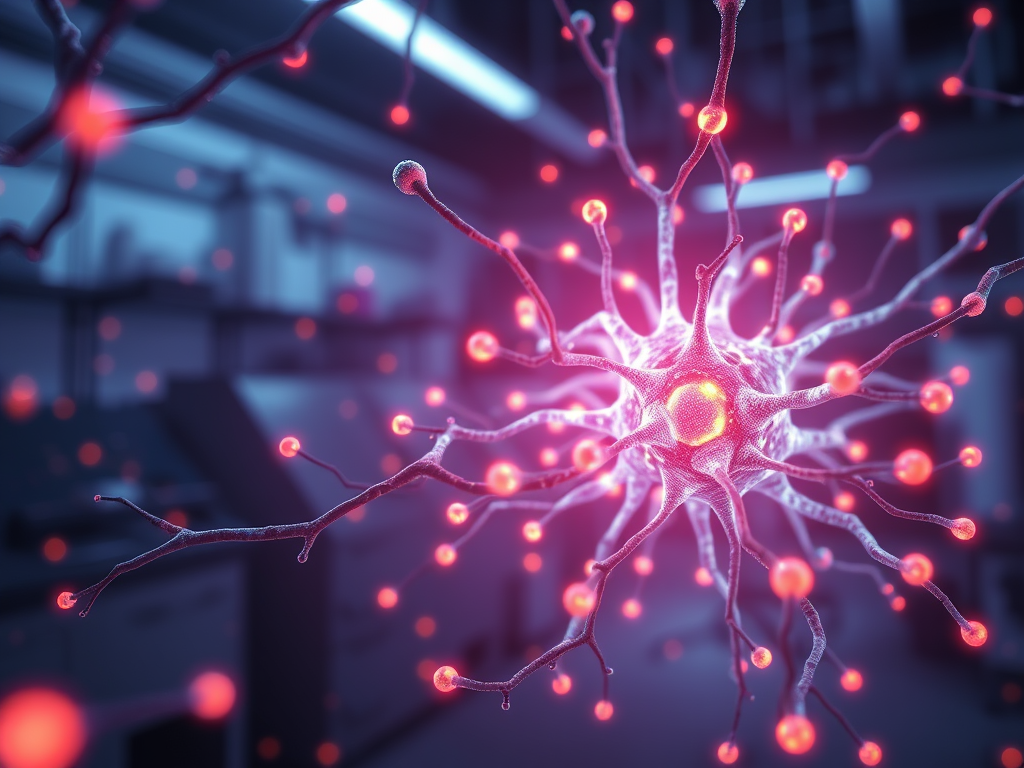
New “glue sniffer” protein captures fleeting chemical signals between neurons, potentially transforming our understanding of conditions from Alzheimer’s to autism
Every second, billions of neurons in your brain engage in an elaborate conversation—firing electrical pulses, releasing chemical messengers, and coordinating the symphony of activity underlying every thought and memory. Until now, scientists could only hear half of this dialogue. A breakthrough from researchers at the Allen Institute and HHMI’s Janelia Research Campus is about to change that.
The team has engineered a molecular sensor called iGluSnFR4—affectionately pronounced “glue sniffer”—that can detect the whisper-quiet incoming chemical signals neurons receive from their neighbors. These signals, carried by the neurotransmitter glutamate, have been maddeningly difficult to capture because they are both incredibly faint and vanishingly brief. The findings, published December 23 in Nature Methods, represent a paradigm shift in how researchers can study the brain.
“It’s like reading a book with all the words scrambled and not understanding the order of the words or how they’re arranged,” said Kaspar Podgorski, a lead author on the study and senior scientist at the Allen Institute. “I feel like what we’re doing here is adding the connections between those neurons and by doing that, we now understand the order of the words on the pages, and what they mean.”
Glutamate is the brain’s most abundant excitatory neurotransmitter, responsible for over 90 percent of excitatory synaptic connections in the human brain. It plays a critical role in learning, memory, and cognition. When a neuron fires, it releases glutamate across the synaptic gap to signal the next neuron. But a single action potential typically releases just a few thousand glutamate molecules, cleared from the synapse in less than one millisecond.
Compare that to calcium ions, which flood into neurons by the hundreds of thousands and linger for about 20 milliseconds—a relative eternity that makes them far easier to measure. This disparity explains why calcium indicators have dominated neuroscience research while glutamate imaging has lagged behind.
The iGluSnFR4 sensor comes in two variants. The “fast” version, iGluSnFR4f, deactivates quickly for tracking rapid synaptic dynamics. The “slow” version, iGluSnFR4s, maintains its signal longer for recording from large populations of synapses. Both can detect glutamate with single-vesicle sensitivity—capturing the release of individual packets of neurotransmitter molecules.
“Neuroscientists have pretty good ways of measuring structural connections between neurons, and in separate experiments, we can measure what some of the neurons in the brain are saying, but we haven’t been good at combining these two kinds of information,” Podgorski explained. “What we have invented here is a way of measuring information that comes into neurons from different sources, and that’s been a critical part missing from neuroscience research.”
The potential applications are vast. Disrupted glutamate signaling has been implicated in Alzheimer’s disease, Parkinson’s disease, Huntington’s disease, schizophrenia, autism, epilepsy, and depression. Excess glutamate can trigger excitotoxicity, essentially overstimulating neurons to death—a phenomenon linked to stroke and traumatic brain injury. Pharmaceutical companies could use the sensors to test how experimental drugs affect synaptic activity in real time, potentially speeding drug development.
Researchers screened over 3,000 variants through demanding assays, from cultured neurons to living mouse brains. They used two-photon imaging to visualize glutamate release in multiple brain regions. The sensors proved remarkably stable, maintaining sensitivity after an hour of continuous high-speed recording.
“The success of iGluSnFR4 stems from our close collaboration started at HHMI’s Janelia Research Campus between the GENIE Project team and Kaspar’s lab,” said Jeremy Hasseman, a scientist with Janelia Research Campus. “This was a great example of collaboration across labs and institutes to enable new discoveries in neuroscience.”
Each neuron integrates signals from up to 10,000 synaptic inputs. The pattern and timing of these inputs determines whether and when the neuron fires. With iGluSnFR4, researchers can finally observe these input patterns directly, potentially revealing computational principles underlying sensory perception and decision-making.
The sensors are now available through Addgene, reflecting the Allen Institute’s commitment to open science. As our understanding of glutamate’s role continues to deepen, tools like iGluSnFR4 may prove essential for unlocking neuroscience’s most persistent mysteries. The brain’s hidden conversations are finally becoming audible.
Sources:
- Aggarwal, A., Negrean, A., Chen, Y., et al. “Glutamate indicators with increased sensitivity and tailored deactivation rates.” Nature Methods (2025). DOI: 10.1038/s41592-025-02965-z
- Allen Institute News Release. “Scientists develop new way to ‘listen in’ on the brain’s hidden language.” December 23, 2025. EurekAlert.
- Cleveland Clinic. “Glutamate: What It Is & Function.” Health Information.
- National Center for Biotechnology Information. “Glutamate – Neuroscience.” NCBI Bookshelf.
- Institute of Medicine. “Overview of the Glutamatergic System.” Glutamate-Related Biomarkers in Drug Development for Disorders of the Nervous System. National Academies Press, 2011.



Leave a Reply