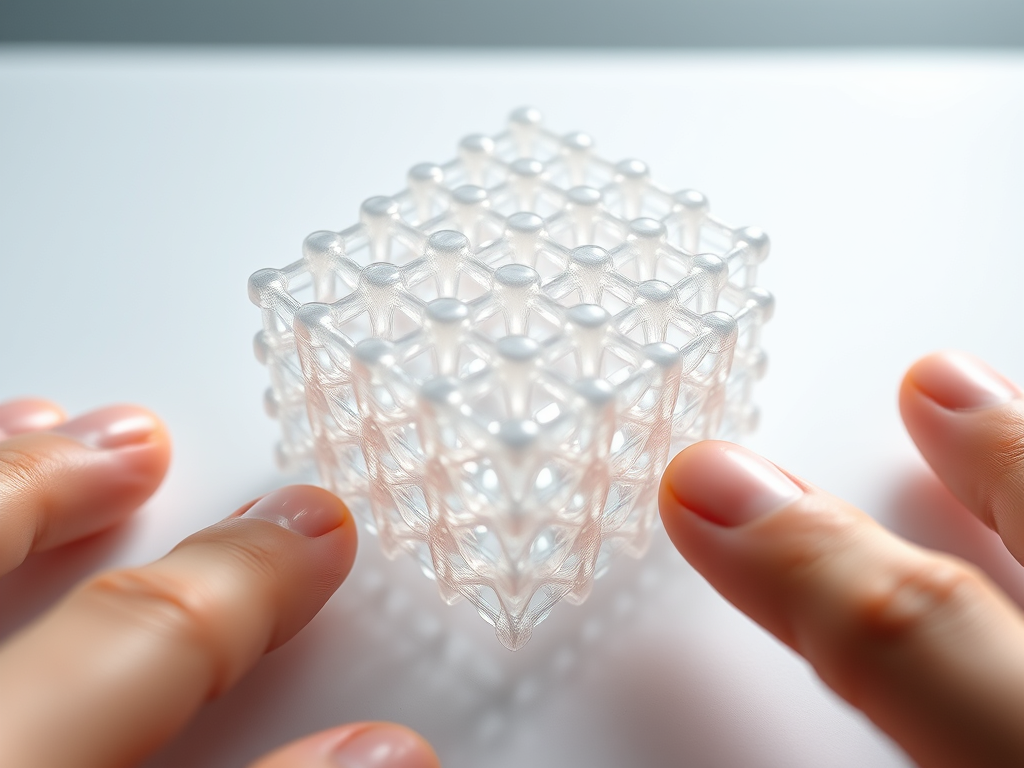
The rapid development of humanoid robots necessitates environmental perception for autonomous locomotion and dexterous manipulation. As one of the most fundamental perceptual modalities, tactile sensing provides critical physical feedback during contact-rich interactions. However, this sensing capability introduces a fundamental trade-off between compliance in physical interactions and high-fidelity response to mechanical stimuli.
The biomechanical intelligence of human fingertips offers a compelling paradigm to resolve this challenge. Multilayer 3D-achitected fingerpad withstands substantial deformation under compression with minimal strain-stiffening, while its surface fingerprint expands and strains adaptively to preserve tactile sensitivity throughout contact. This makes one wonder if there were just some designs to transfer compression into surface contact for improved sensory transduction.
Soft iontronics leverage elastic electronic-ionic contacts in hydrogel-based sensors to detect applied pressure, which has inspired various microstructure designs, including pyramids, hemispheres, and grooves, to tailor electrical responses under loading. However, conventional designs inevitably cause the strain-stiffening behaviors in compressive mechanics. This effect harms the compliance and limits the perceptive stroke for position-controlled machines or robots.
3D structural engineering offers a promising route to program compressive behaviors. Template-based conductive foams utilize porous compressibility to enhance deformation stroke but suffer from limited tunability and nonlinear transductions. It is still challenging to simultaneously program electrical responses and compressive mechanics.
To address the issue, a team of researchers led by Prof Guoying Gu from the School of Mechanical Engineering, Shanghai Jiao Tong University, proposed a 3D lattice iontronic tactile sensor comprising a hydrogel lattice encapsulated within an origami-inspired framework. The wide-range linearity (0-220 kPa) on both electrical responses and compressive mechanics has been proven to enable precise detection under extreme dynamic loading. Their study published in SmartBot highlights their main findings.

They cryo-printed PEDOT:PSS-PVA gyroid lattices and crosslinked frozen structures into free-standing hydrogels. They then encapsulated the hydrogel lattice sandwiched by metal-plate fabrics into a casted origami framework to form a 3D iontronic sensor. “The 3D fabrication technique is fundamental,” reports Prof. Gu. “Hydrogels are like jelly with softness and challenging to structuralize, where our cryogenic printing techniques promise the dimension-raising design and on-demand construction.” They conducted in-situ compression characterizations and found that the linear electrical responses are attributed to the linear expansion of the contact area between the gradually collapsing hydrogel lattice and electrodes under loading. “This 3D-architected sensor expands design spaces for reconciling electrical responses and mechanical behaviors.” says Prof. Gu.
They then applied the sensors as human-machine interfaces and facilitated accurate, stable, and timely control of sophisticated signal waveforms in robotic teleoperation by pressure input. They further integrated the sensors with robotic end-effectors and achieved the precise and safe detection of soft tissue elastic modulus as a deformable intelligent fingertip.
These findings thus present a novel tactile sensor that can simplify parameter calibration, dynamic monitoring, and data processing in decoding diverse tactile interactions. It also enables the recognition for physical properties of objects being touched by extending the perceptive compression stroke. This 3D-achitected sensor is anticipated to enable novel applications in wearable human-machine interaction, serving as an intelligent interface that translates touch into actionable data to aid in early lesion screening, such as Parkinsonism and localized scleroderma.
The authors are optimistic about the future implications of their design. “Unlike 2D-architected sensors, our 3D architectures fundamentally raise the dimensions of perception. Further structure designs are promising to transduce multi-axis deformation into decoupled multimodal signals. It’s a new way of thinking about tactile sensation that could equip soft robots with sensory capabilities,” says Prof. Gu.



Leave a Reply