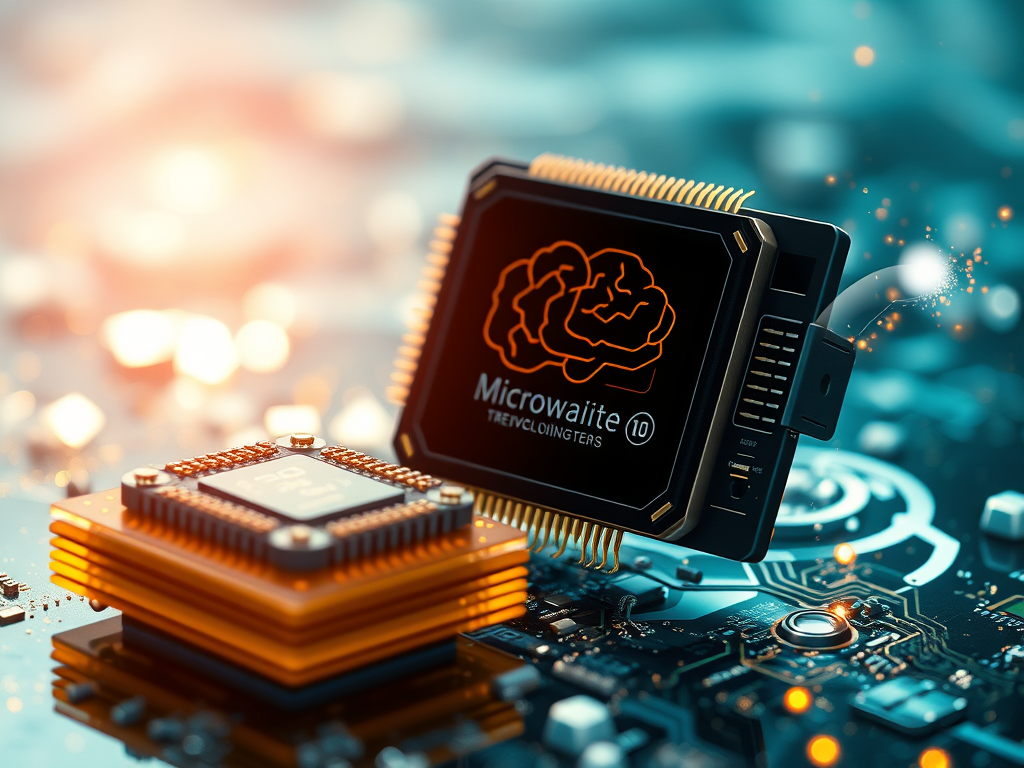
Cornell Engineers Create Revolutionary “Microwave Brain” Chip
Cornell University researchers have developed the world’s first “microwave brain” chip—a revolutionary silicon microprocessor that computes using microwave physics instead of traditional digital circuits. Published in Nature Electronics, this breakthrough technology processes ultrafast data and wireless communication signals simultaneously while consuming less than 200 milliwatts of power. Unlike conventional neural networks relying on digital operations and clock-timed instructions, this chip uses analog microwave behavior in the tens of gigahertz range, far exceeding most digital processors. The system performs real-time tasks including radar tracking, signal decoding, and data analysis. Researchers abandoned conventional circuit design, creating what they describe as a “controlled mush of frequency behaviors” that delivers high-performance computation. Applications include smartwatches, satellites, and secure wireless communications, potentially revolutionizing AI and communication device operations. (SciTech Daily)
Breakthrough Technology Rapidly Destroys “Forever Chemicals” in Water
Rice University researchers, collaborating with international partners, developed the first eco-friendly technology to rapidly capture and destroy PFAS (per- and polyfluoroalkyl substances) contamination in water. Published in Advanced Materials, the innovation uses a layered double hydroxide material made from copper and aluminum that captures PFAS over 1,000 times more effectively than existing materials. The breakthrough addresses one of humanity’s most persistent environmental threats—toxic “forever chemicals” used in products from Teflon pans to waterproof clothing since the 1940s. The material works approximately 100 times faster than commercial carbon filters, removing large amounts of PFAS within minutes. Testing in river water, tap water, and wastewater showed high effectiveness in both static and continuous-flow systems. The team also developed a thermal decomposition method eliminating more than half the trapped PFAS without releasing toxic byproducts. (Phys.org)
Cosmic Dust May Have Delivered Life’s Building Blocks to Earth
New research published in Monthly Notices of the Royal Astronomical Society reveals that amino acids—the molecular foundations of proteins and life—may have reached Earth on interstellar dust grains between 4.4 and 3.4 billion years ago. Scientists from Diamond Light Source synthesized amorphous magnesium silicate particles, a major cosmic dust component, and tested how amino acids like glycine and alanine could survive space’s harsh conditions. Only these two amino acids successfully adhered to silicate particles, forming crystalline structures that remained stable at temperatures well above their melting points. The study suggests an “astromineralogical selection mechanism” may have influenced which specific molecules reached early Earth. With Earth receiving approximately 40,000 tons of dust annually versus only 10,000 meteorites, cosmic dust likely represented the dominant source of organic carbon for early life. (Phys.org)
Earth Surpasses First Climate Tipping Point, Scientists Warn
The 2025 Global Tipping Points Report, released October 13 by over 100 scientists from 20+ countries, warns that preventing widespread coral reef die-off will now require extraordinary global effort. Lead author Nico Wunderling from Goethe University explains that tropical coral reefs face destruction from rising ocean temperatures, with sections of polar ice sheets potentially having already passed irreversible tipping points. The report defines climate-induced tipping points as warming levels beyond which Earth systems undergo self-reinforcing, often irreversible changes. Published ahead of the 30th World Climate Conference beginning November 10 in Belém, Brazil, the authoritative assessment addresses both risks and opportunities of negative and positive tipping points in Earth systems and human societies. Climate tipping points have gained attention in climate sciences over approximately 20 years, with this report marking unprecedented alarm levels. (SciTech Daily)
Molecular Qubits Enable Quantum Communication at Telecom Frequencies
Scientists from the University of Chicago, UC Berkeley, Argonne National Laboratory, and Lawrence Berkeley National Laboratory developed molecular qubits containing erbium that operate at telecom-band frequencies, published in Science. This breakthrough enables direct integration with existing fiber-optic networks and silicon photonic technologies by bridging optical and magnetic quantum properties. The erbium molecular qubits can interact at telecommunications frequencies, pointing toward future quantum networks—sometimes called the “quantum internet”—enabling ultra-secure communication channels, connecting quantum computers across long distances, and distributing quantum sensors with unprecedented precision. Using optical spectroscopy and microwave techniques, researchers demonstrated compatibility with silicon photonics used in telecommunications, high-performance computing, and advanced sensors. Their nanoscale size and chemical flexibility mean they could be embedded in unusual environments, supporting applications in quantum communication, sensing, and scalable quantum networks. (Phys.org)
Semiconductor Breakthrough Set to Supercharge 6G Networks
University of Bristol researchers achieved a radical breakthrough in semiconductor technology designed for next-generation 6G networks, published in Nature Electronics. The study details superlattice castellated field effect transistors (SLCFETs) using over 1,000 parallel channels with widths under 100 nanometers. Scientists discovered a “latch-effect” in Gallium Nitride that unlocked unprecedented radio frequency device performance in the W-band frequency range (75-110 GHz). Using ultra-precision electrical measurements and optical microscopy, researchers pinpointed this effect occurring in the widest of the 1,000+ fins and verified findings with 3D simulation modeling. The breakthrough enables futuristic applications including self-driving cars, instant remote healthcare diagnostics, remote surgery, virtual classrooms, and advanced industrial automation. Professor Martin Kuball notes these previously unimaginable technologies could become widely available within the next decade, transforming human experiences across healthcare, education, and virtual tourism. (Dataconomy)
Molecular Coating Purifies Quantum Light for Quantum Internet
Northwestern University engineers developed a novel strategy making quantum light sources more consistent, precise, and reliable by coating atomically thin tungsten diselenide semiconductors with a sheetlike organic molecule called PTCDA. Published in Science Advances, the coating transformed noisy signals into clean single-photon bursts, increasing photons’ spectral purity by 87 percent while shifting photon color in controlled ways and lowering photon activation energy—all without altering underlying semiconducting properties. Quantum technologies demand perfection: one photon at a time with identical energy, as even tiny deviations derail devices and threaten quantum computer performance. The breakthrough addresses quantum communication requirements for building quantum networks and ultimately a quantum internet. Because tungsten diselenide is atomically thin, its defects and emitters sit on the surface, leaving them exposed to unwanted atmospheric interactions that previously limited reliability for precise quantum operations. (Phys.org)
European Earth Observation Systems Combat Disease and Disasters
European initiatives are expanding access to Earth observation satellite data for practical applications including early warning systems for mosquito-borne diseases and rapid flood monitoring. Since 2020, the Early Warning System for Mosquito-Borne Diseases (EYWA) has tracked breeding grounds using high-resolution satellite images, as climate change spreads diseases affecting millions worldwide. Dr. Haris Kontoes from Greece’s National Observatory explains these diseases have increasingly impacted Europe over the past decade. EuroGEO promotes “co-design”—creating tools hand-in-hand with actual users by engaging them and building cooperation. The initiative includes creating permanent governance under a EuroGEO Secretariat, focusing on connecting existing programs rather than starting new pilots, making them sustainable, and breaking down silos between data, programs, and people. Integration across sectors improves data usability, with efforts underway making Earth observation services sustainable and accessible for broader societal benefit. (Phys.org)




Leave a Reply