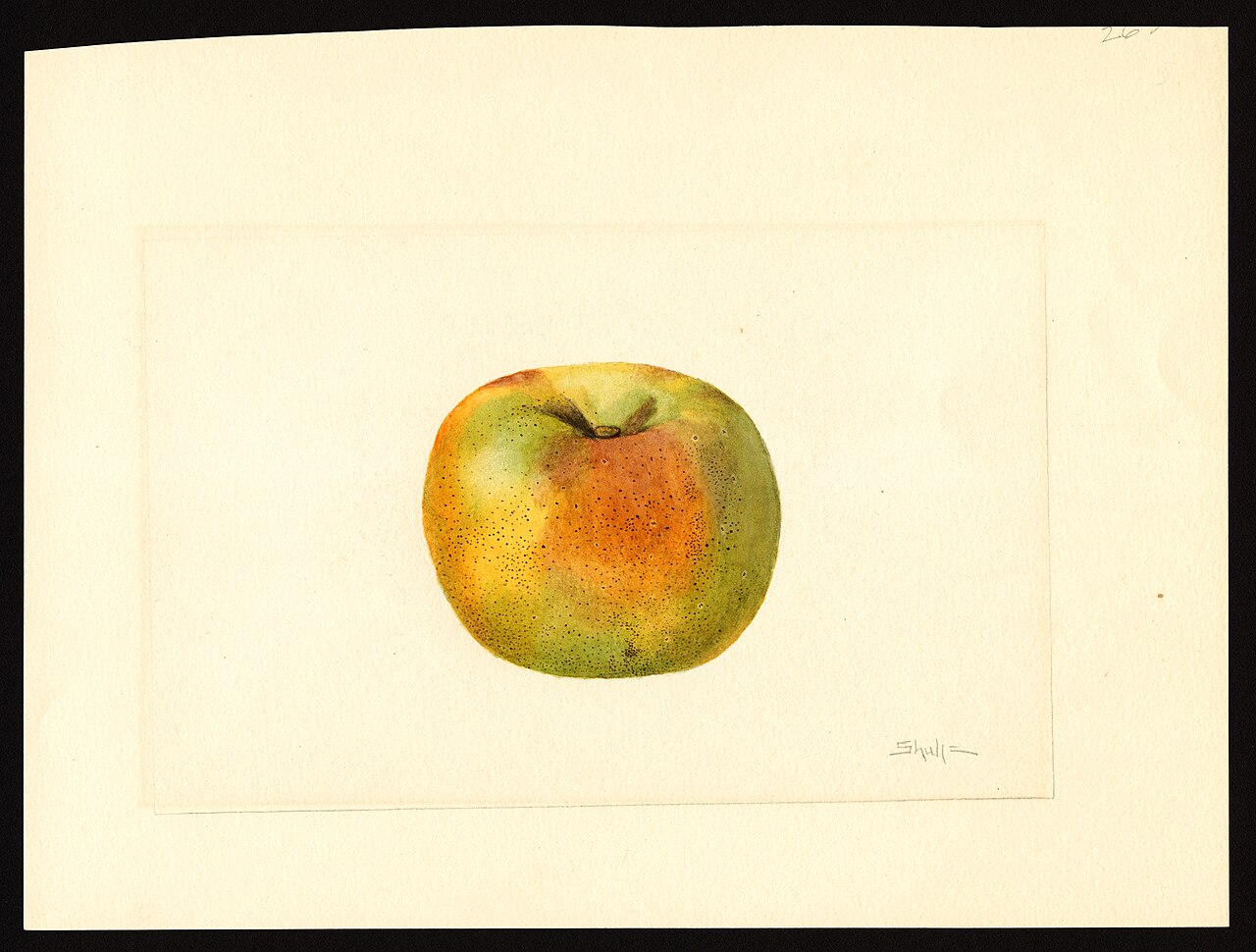
Few agricultural products are as tightly bound to New York City’s early rural identity as the Newtown Pippin. Born in the orchards of old Newtown—today’s Elmhurst, Queens—the apple became a culinary darling of colonial elites, an export prized in London drawing rooms, and a workhorse of American cider tradition. It also grew out of—and flourished within—systems of coerced labor in both New York and Virginia. Read as a symbol, the Newtown Pippin holds together Newtown’s agricultural success and the broader history of American slavery that helped make that success possible.

Origins in Newtown, Queens
Sometime around 1700, a wild apple seedling took root on Gershom Moore’s estate in Newtown, sprouting near what is now the intersection of Broadway and 45th Avenue in Elmhurst. Nobody planned it—apple seeds rarely breed true to their parents, and most seedlings produce bitter, worthless fruit. But this particular tree, this accidental “pippin,” bore something extraordinary: crisp green apples with a complex, wine-like flavor that actually improved after months in storage. Moore recognized what he had and began sharing cuttings with his neighbors.
Queens in the 1700s was Manhattan’s garden, a landscape of Dutch and English farms stretching from creek to creek, their orchards heavy with fruit destined for city markets. Newtown sat at the heart of this agricultural web, and the Pippin became its signature. Visit the Queens County Farm Museum today—New York City’s last working farm from that era—and you can still feel echoes of that world: weathered farmhouses, old orchard rows, and in the archives, troubling records that remind us who actually worked this land.

The Founders’ Favorite—and Their Enslaved Laborers’ Creation
The Newtown Pippin didn’t just feed colonial New York; it became a status symbol, a diplomatic gift, and a patriotic boast. Thomas Jefferson, ever the agricultural romantic, wrote dismissively from Paris that Europeans had “no apple to compare with our Newtown Pippin.” He planted dozens at Monticello. George Washington grew them at Mount Vernon, where the apple acquired its Southern alias, the “Albemarle Pippin” after Albemarle County, Virginia. Benjamin Franklin had barrels shipped to him in London. These men saw the apple as proof of American exceptionalism—superior breeding from superior soil.
But here’s what they didn’t write about: who actually tended these celebrated orchards. At Monticello alone, enslaved workers planted, pruned, and harvested up to fifty Newtown Pippin trees over several decades. Every autumn, they gathered the fruit. Every winter, they pressed cider—hundreds of gallons annually. Jefferson kept meticulous notes about apple varieties and cider quality, but the people who made it possible appear only as property listings: George Granger, “reserved to take care of my orchards”; his wife Ursula, who bottled the cider; Jupiter Evans, who supervised the entire operation until his death in 1800.
These weren’t unskilled laborers following simple instructions. Making fine cider required expertise—knowing when to pick, how to store, which apples to blend, when to rack the fermenting juice. The enslaved workers who produced Monticello’s renowned ciders developed and passed down this knowledge through generations, though their names rarely made it into the agricultural treatises of the day.

London Loves a Rebel Apple
The Pippin’s strangest chapter might be its conquest of British high society. The apple that wouldn’t grow in England’s damp climate became London’s most coveted import, commanding triple the price of local varieties. The pivotal moment came in 1838 (though some sources say 1834), when Andrew Stevenson, the American minister to Great Britain, presented the young Queen Victoria with a basket of Albemarle Pippins from his wife’s Virginia estate.
Victoria was smitten. Parliament, in an almost unprecedented move, lifted import duties specifically for this American apple—and only this apple. The exemption lasted nearly a century, creating a lucrative transatlantic trade that made Virginia planters rich. Ships packed with barrels of Pippins crossed the ocean each winter, the apples growing sweeter and more aromatic during the voyage.
Think about the layers of irony here: An apple discovered in Queens, cultivated by enslaved Africans in Virginia, shipped to the heart of the British Empire that America had rejected, where it was savored as the finest fruit money could buy. Each barrel that arrived in London represented hundreds of hours of enslaved labor—planting, grafting, picking, packing—transformed into profit for plantation owners and pleasure for British aristocrats.

New York’s Own History of Bondage
We tend to think of slavery as the South’s sin, but New York built its early prosperity on enslaved labor too. In 1703, 42% of New York City households owned slaves—higher than Boston or Philadelphia, second only to Charleston. Queens County was no exception. Walk through the Queens County Farm Museum today and you’re walking where at least 14 enslaved people—Dick’r, Titus, Jane, Stephen, Mary, Amy, Bob, Jimm, Hanna, George, Ned, Ben, Phebe, and Percilla—lived and labored through the long 18th century. They planted. They harvested. They pressed cider. They built the agricultural foundation that made apples like the Newtown Pippin possible.
New York’s path to abolition was tortuously slow. The state passed a gradual emancipation law in 1799 that freed no one immediately. Children born to enslaved mothers after July 4, 1799, had to serve as indentured servants until age 28 (men) or 25 (women). Full emancipation didn’t arrive until July 4, 1827—making New York one of the last Northern states to end slavery. By then, the Newtown Pippin had been famous for a generation, its success built quite literally on the backs of the enslaved.
The apple that wouldn’t grow in England’s damp climate became London’s most coveted import, commanding triple the price of local varieties.
After Freedom: Newtown’s Black Community Stakes Its Claim
The year after emancipation, Newtown’s free Black community did something remarkable: they bought land and built a life. In 1828, James Hunter and his wife deeded two acres to formerly enslaved residents who had already been using a plot at Corona Avenue and 90th Street (then called Dutch Lane) as a burial ground since 1818. They founded the United African Society of Newtown, converted a blacksmith’s shop into a church, and created one of New York’s first free Black congregations—later known as St. Mark’s A.M.E. Church.
This wasn’t just about Sunday worship. In collaboration with Peter Remsen, the community established an African Free School on the same site, understanding that literacy meant liberation. They buried their dead with dignity in their own ground—over 300 people by 1886. They owned shops and homes. They voted. They insisted on their place in Newtown’s story, even as that story was increasingly written without them.
Today, their burial ground lies beneath asphalt and concrete, forgotten under a former auto repair shop parking lot. In 2011, construction workers discovered an iron coffin containing Martha Peterson, a young Black woman who died of smallpox in 1850. The discovery briefly made headlines, but the site remains unprotected, unmarked, awaiting development. The church moved to Corona in the 1920s, but the bodies—save for twenty moved to Mount Olivet Cemetery—remain.

The Pippin’s Decline and Grassroots Revival
By the mid-20th century, the Newtown Pippin had nearly vanished from commerce. Granny Smith apples—prettier, more uniform, less prone to russeting—conquered the market. The Pippin requires patience: picked in October, it doesn’t reach peak flavor until January. It looks homely, often lopsided and spotted. Modern supermarkets had no room for an ugly apple that needed three months of storage to taste good.
But New Yorkers wouldn’t let their native apple disappear entirely. Starting in the 2000s, a coalition emerged: NYC Parks, the New York Restoration Project, Slow Food NYC, and others. They’ve distributed hundreds of Pippin saplings to community gardens, schools, and public spaces across the five boroughs. These aren’t just trees; they’re living historical markers, each one a chance to tell this complicated story.
When schoolchildren in Elmhurst bite into a Newtown Pippin from a tree planted in their schoolyard, what should we tell them? That this is Newtown’s apple, yes. That Jefferson and Washington prized it, sure. But also that enslaved people—in these very fields and far to the south—made this apple famous through their skill and sweat. That free Black New Yorkers claimed their piece of Newtown’s agricultural legacy even as the world tried to erase them. That every piece of fruit carries history in its flesh.

Why This Apple Matters Now
The Pippin offers something invaluable: a living link between past and present that refuses simple narratives. You can hold this apple in your hand. You can taste what Jefferson tasted, what Queen Victoria savored, what enslaved workers perfected through generations of careful cultivation. But you can’t separate the sweetness from the bitter history.
The Newtown Pippin stands as proof that Northern prosperity depended on slavery as surely as Southern plantations did. When we plant these trees in Queens today, we’re not just reviving an heirloom variety. We’re planting memory. We’re insisting that the agricultural workers—free and enslaved, remembered and forgotten—who built New York’s wealth be recognized. We’re acknowledging that under Elmhurst’s concrete lies not just Newtown’s rural past but the bones of its Black community, literally and metaphorically buried by development.
This is what makes the Pippin perfect for public history: It’s tangible enough to taste, complex enough to provoke real conversation, and resilient enough to grow in a Brooklyn community garden or a Queens schoolyard. Every spring when these trees bloom, they offer a chance to tell the whole truth about New York’s agricultural heritage—the pride and the pain, the innovation and the exploitation, the sweetness earned through others’ suffering.
Plant a Newtown Pippin, and you plant a question: How do we honor history that’s both remarkable and terrible? The answer might be exactly this—growing something beautiful from complicated roots, tending it carefully, and never forgetting the full story of how it came to be.
Works Cited
- Monticello (Thomas Jefferson Foundation). “Apples Grown at Monticello” (includes Jefferson’s “no apples to compare” quotation); “Cider at Monticello” (on Albemarle/Newtown Pippin plantings and enslaved labor in orchard and bottling); “The Site of the Vegetable Garden” (on terraces built with slave labor).
- National Park Service. Fruitful Legacy (context on 19th-century American fruit culture and the Albemarle Pippin’s export prominence).
- Albemarle CiderWorks / Peter J. Hatch. “A Pippin a Day Made Queen” (background on Albemarle/Newtown Pippin history and British duty exemption tradition).
- Queens County Farm Museum / NYC Parks. “Queens Farm Park Highlights” (documented presence of 14 enslaved individuals on the Adriance homestead) and related history pages.
- Elmhurst/Queens (historical overview). Elmhurst page (summary of Newtown free Black community, United African Society burial ground, and abolition timeline).
- Newtown Historical Society. “Newtown Pippin – Queens County, NY” (local history synthesis on origin and cultural status).
- Slow Food & Civic Revival. Newtown Pippin restoration announcements and program descriptions (NYRP/Slow Food NYC partnerships distributing saplings in NYC).
- Apples and People (Museum project). “Apples for the Wealthy” (on enslaved labor’s role in 19th-century American orchards and cider).
- Horticultural References. Orange Pippin variety profile (storage qualities and culinary/cider uses); The Apples of New York (classic early 20th-century pomology).
- General Queens Agricultural Context. Historic House Trust and Queens County Farm Museum sites (continuity of farming and market-garden heritage).


Leave a Reply