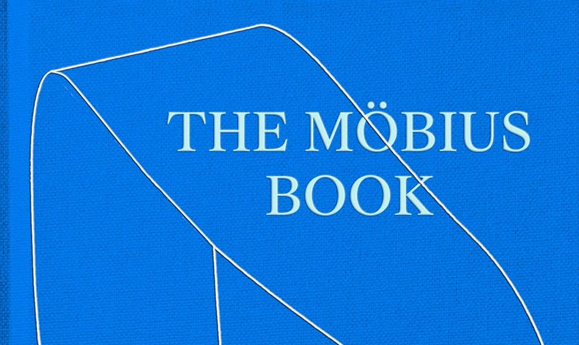
There is something almost mathematical about heartbreak, the way it bends experience back on itself until you cannot tell where the pain begins and the story ends. Catherine Lacey understands this geometry. In The Möbius Book (Farrar, Straus and Giroux, $27 (240p) ISBN 978-0-374-61540-6), she has constructed something that is both confession and performance, memoir and fiction, a work that loops back on itself with the precise inevitability of its namesake strip—that curious object with only one surface, which appears to have two sides but does not.
The book arrives in our hands as two books, really, printed from opposite ends and meeting in the middle like lovers walking toward each other across the Great Wall of China, which is an image Lacey herself invokes when thinking of Marina Abramović and Ulay’s ceremonial goodbye. There is the memoir, spare and surgical, documenting Lacey’s six years with the writer Jesse Ball—whom she calls only “The Reason”—and their dissolution. There is the novella, featuring two women named Marie and Edie who spend a Christmas night dissecting their own romantic failures while blood seeps mysteriously from beneath a neighbor’s door. You may read either first. The structure insists it does not matter, though of course it does.
What Lacey has done is create a work that demonstrates, rather than merely argues, that the line between what happened and what we make of what happened cannot be drawn with any precision. The memoir bleeds into the fiction. Images transform: Lacey’s memory of nudists at a dangerous beach becomes Edie’s story of a man drowning. Ball’s manipulations—the weight comments, the rage, the hand broken against a wall—appear refracted through both women’s experiences. The expensive Japanese teacup that Ball bought for Lacey, which she later asked him to smash with a hammer, becomes a kind of organizing symbol for the entire enterprise. We perform our lives, even as we live them.

This is not autofiction in any conventional sense, though critics have reached for that term like a life preserver. Lacey is after something more ambitious and more honest: an acknowledgment that we are all, always, writing fiction about ourselves and about others, that we cast each other as characters in stories we only half-consciously construct. Ball told Lacey he knew her better than she knew herself. Her friends projected their own desires onto her choices. She found herself becoming the person she thought deserved the teacup, then destroying that person along with the cup.
The prose itself mirrors this uncertainty. Lacey writes with the controlled opacity of someone who has learned not to trust easy revelations. “Hope is visible in the objects in our homes,” she tells us, and we believe her even as we recognize the statement’s deliberate grandiosity. There is something almost religious in her approach to language, befitting a writer who lost her childhood faith but never quite stopped looking for transcendence. The blood outside Marie and Edie’s apartment door might be paint, they decide. Everything might be something else.
Critics have noted the book’s formal innovations, its resistance to the Venn diagram thinking that would cleanly separate invention from reality. But the real achievement here is emotional rather than technical. Lacey has found a way to write about damage without performing damage, to examine manipulation without perpetuating it. She takes control of her story precisely by acknowledging that control itself may be an illusion.
The result is a work that feels both confessional and constructed, both urgent and artful. It asks whether we write to heal or whether we heal by learning to write differently. It suggests that the difference may not matter. Like its titular strip, the book has only one surface, though it appears to have two. You finish it and find yourself at the beginning again, which is perhaps where all the best breakup stories leave us: changed, but ready to go around once more.




Leave a Reply