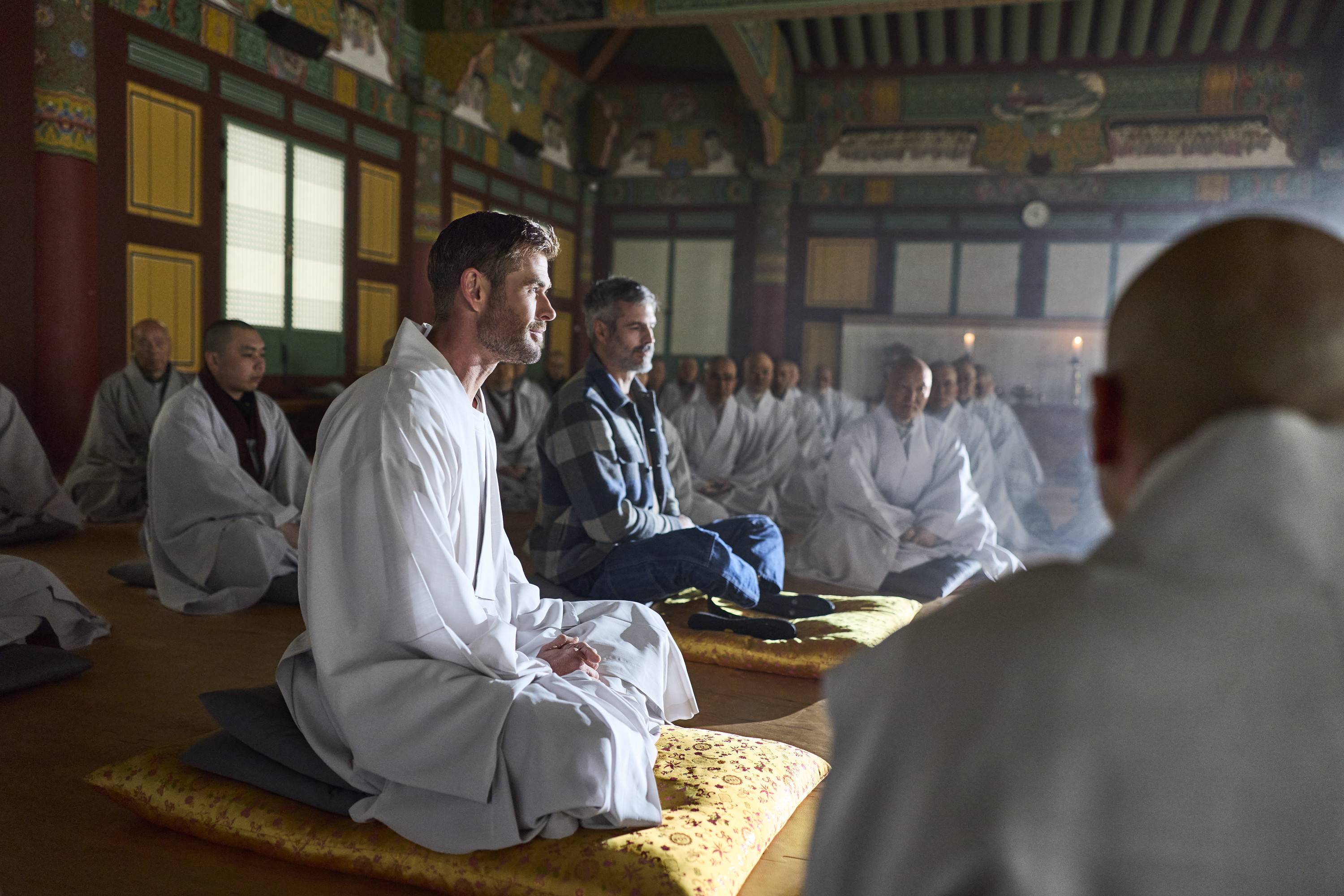
As part of LIMITLESS: LIVE BETTER NOW—the bold new three-part series from National Geographic, streaming today on Disney+ and Hulu—Chris Hemsworth takes on some of life’s most universal challenges: pain, fear, and cognitive decline. In the “Pain” episode, filmed in South Korea, Hemsworth teams up with returning expert Dr. BJ Miller, a renowned hospice and palliative care physician, to explore both ancient healing traditions and cutting-edge science. Together, they unpack how pain works, how the mind can shape our experience of it, and when it’s critical to listen to the body’s warning signs. SCINQ spoke with Dr. Miller about his role in guiding Hemsworth through this journey, the science behind pain, and the non-pharmaceutical strategies we can all use to live—and feel—better.
How did you first get involved with the show, and what’s your backstory?
I was brought in through Peter Attia, who connected me with Darren Aronofsky, one of the producers of the first season. That came out of my work as a hospice physician, focusing on end-of-life care. The first season centered on helping Chris come to terms with the fact that he’s mortal. That collaboration went well, which led to my involvement in this season. Another part of my medical work is pain management—my own and my patients’—so my background in hospice and palliative care made for a natural fit.
How was Chris Hemsworth’s “ordeal” designed?
A lot of groundwork was laid before I came on board. Multiple production teams and researchers dug into the science of pain. Physiologically, we know there are three main receptor types—temperature, mechanical (pressure), and chemical—that feed into the pain experience. That gave us three avenues to create controlled, painful stimuli.
We also know pain is influenced by emotional state, so we built experiments involving friends and social interaction. Finally, pain has a “meaning-making” component—the stories we tell ourselves about it shape our experience. That’s what led us to the monastery, working with monks on reframing pain through the mind.
You touched on this earlier, but what exactly is pain?
At its simplest, pain is an obnoxious stimulus. More precisely, it’s a complex experience involving multiple parts of the nervous system. It’s not just a receptor firing when you touch something hot—emotional, social, historical, and existential factors all shape the way pain is processed in the brain.
What are some non-pharmaceutical ways to address pain constructively?
First, determine whether the pain signals an actual threat. Sometimes that’s obvious; sometimes you need a medical evaluation to be sure. If it’s a threat, you need to respect it and stop what’s causing it.
If it’s not a threat—just an unpleasant sensation—you can work on modulating it. That might mean improving sleep, socializing your pain by talking about it, distracting yourself with an activity, or reframing the story around it. In the episode, we saw how a victorious fighter experienced pain differently than if he’d lost—the narrative changed the sensation.
Was there ever a point where you thought Chris wouldn’t make it through?
No. I knew the challenges weren’t going to physically harm him, and I also knew he’s tough and persistent. I never doubted he’d finish.
For people with chronic pain, activity often lessens the discomfort. Is that similar to Chris distracting himself during the episode? And is it like using menthol patches, where nerves can’t process two sensations at once?
Yes, they’re similar. Menthol, camphor, or capsaicin from chili peppers work by introducing a new sensation that competes with or overrides the pain signal. It’s not just distraction—it’s a nervous system “hijack.” There’s no single magic bullet for pain, but combining approaches—stimulating the body in different ways, reframing the story, and drawing on social support—can meaningfully shift the experience.
So how you frame pain can change how much it hurts?
Yes, that’s one major way to modulate pain—but it’s just one tool among many.
At what point should someone stop trying to push through pain and acknowledge something’s wrong?
That’s the million-dollar question. Before distracting yourself or reframing the experience, you have to know whether the pain signals a real injury. If you ignore that and keep going, you could cause real harm. Sometimes the answer is clear; other times, you need medical input. The last thing we want is for someone to “tough it out” when they’re actually injuring themselves.


Leave a Reply