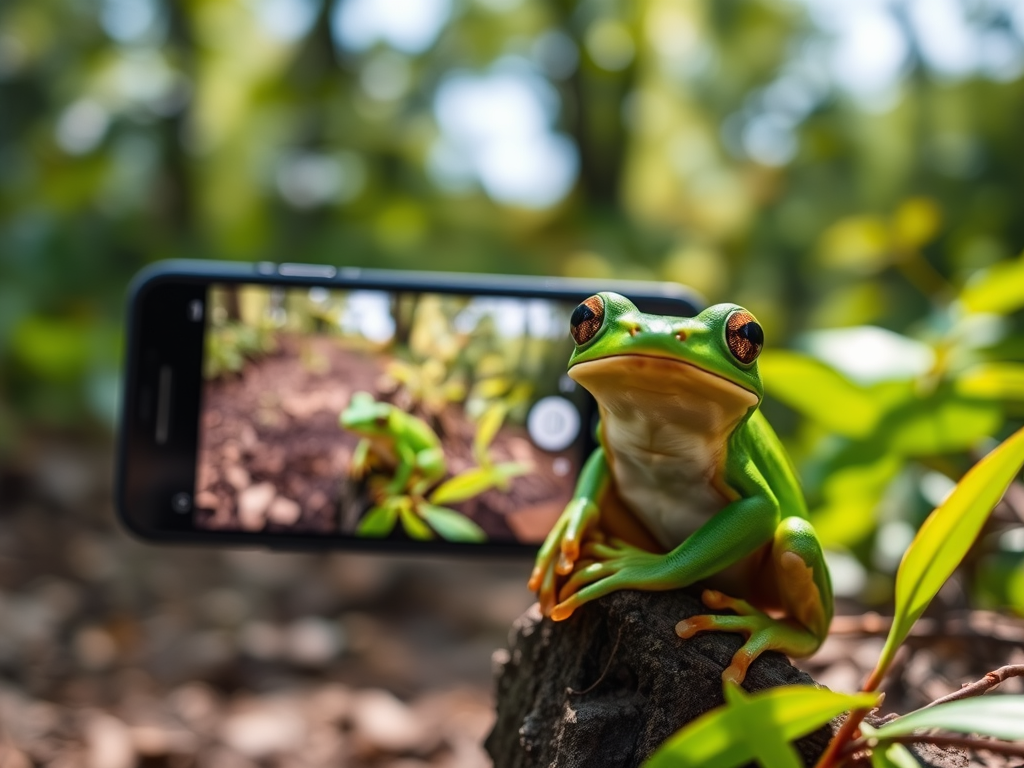
A frog croaks from a walking trail. A hiker snaps a photo and uploads it to iNaturalist. That single act — one person, one amphibian and one click — feeds into a growing global dataset that scientists now use to map shifting species ranges, detect invasive threats and even discover new species.
An international study led by researchers at the University of Florida Institute of Food and Agricultural Sciences (UF/IFAS) shows how iNaturalist, the global technology platform through which everyday people share wildlife photos via a website and an app, is doing far more than connecting users with nature. It’s rapidly becoming a cornerstone of scientific research.
“The scientific use of iNaturalist has grown tenfold in five years, closely tracking the platform’s data growth,” said Brittany Mason, lead author and data management analyst at the UF/IFAS Fort Lauderdale Research and Education Center (FLREC). “This suggests that increasing observations, especially in less-documented geographic areas and lesser-studied species groups, can further expand its research applications.”
“Until now, the scientific value of iNaturalist has been recognized in isolated case studies, like how a user rediscovered a century-lost Vietnamese snail, how the data are used to provide high-resolution maps of plants or how iNaturalist is becoming critical for early detection of invasive species,” said Corey Callaghan, senior author of the study, and an assistant professor of global ecology at FLREC.
Those examples remained somewhat isolated until now.
“This study is the first to systematically assess the full scope of how iNaturalist data are being used in research,” said Mason.
To do this, the research team assessed how technology is being used and which geographic areas and scientific questions the data are being used for. The findings
emphasize how platforms like iNaturalist allow anybody armed with a smart phone to gather data and help scientists.
“Millions of people are now directly shaping how we understand and conserve biodiversity,” said Callaghan. The study reveals several trends in shaping and enhancing the future of biodiversity science.
Sign up for the Daily Dose Newsletter and get every morning’s best science news from around the web delivered straight to your inbox? It’s easy like Sunday morning.
First, the dominant use of iNaturalist in species distribution modeling and range mapping points to the platform’s utility in tracking how organisms are spread across the planet. Second, the use of images uploaded to iNaturalist is on the rise in scientific research, providing new insights into species behavior, coloration and habitat preferences. Third, the exponential rise in scholarly articles using iNaturalist data suggests that as participation grows — particularly in underrepresented regions and among lesser-studied species groups — so, too, will its impact on science.
Launched in 2008, the platform is a non-profit organization and allows users to upload photographs or audio recordings of plants, animals, fungi, and other organisms, along with data on time and place.
A community of contributors vet observations, and those verified as “Research Grade” are shared with the Global Biodiversity Information Facility, an international database working as a clearinghouse for all biodiversity records.
The study shows that everyday people contributing their observations through iNaturalist are making meaningful contributions to scientific knowledge. “Millions of people are helping scientists track biodiversity in ways that would be impossible through traditional scientific fieldwork alone.” said Carrie Seltzer, the iNaturalist head of engagement, who was not associated with the study.
Those meaningful contributions come from 128 countries and 638 groups of species, illustrating the truly global impact on biodiversity research. Research topics range from conservation planning and habitat modeling to education, machine learning and species discovery. Authors also noted the platform is also being used by conservation agencies like the International Union for Conservation of Nature to assess the status of threatened species and track the spread of invasive organisms.
“By contributing observations and identifications, everyday citizens become key players in tackling one of the planet’s most pressing challenges: biodiversity loss,” said Callaghan. “Now, an important frontier remains to really understand how iNaturalist data can be strategically paired with other biodiversity data to continue to inform biodiversity and conservation work in the future.”
IMAGE CREDIT: NASA.



Leave a Reply