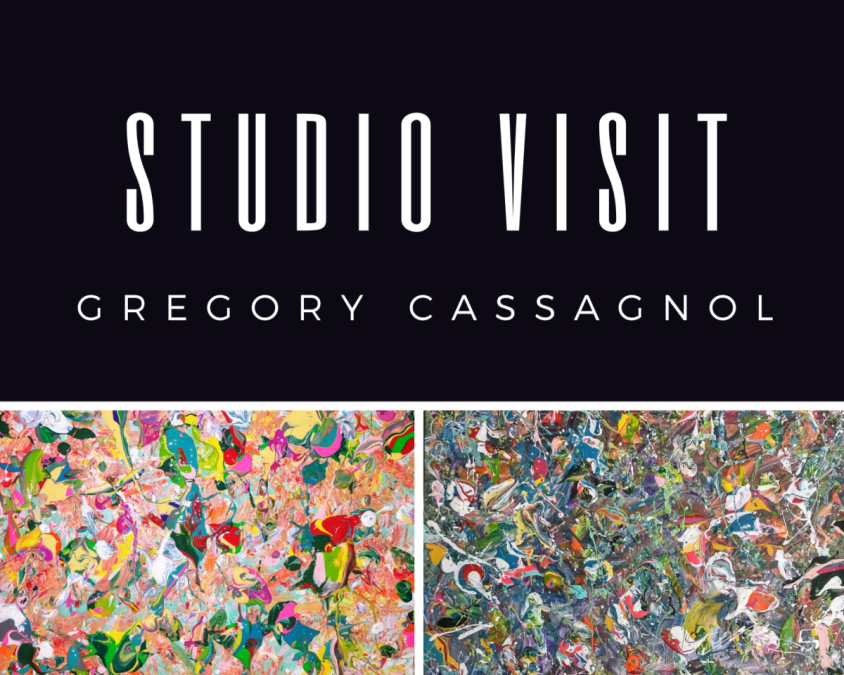
Gregory Cassagnol’s journey into visual art is anything but linear. A natural storyteller from a young age, he initially made his mark through writing, only to rediscover a hidden talent for painting decades later. In this expansive conversation, Cassagnol reflects on the pivotal moments that shaped his creative evolution—from an unexpected encounter with a rebellious high school art teacher to the deeply emotional catalyst of his mother’s passing. What emerges is a portrait of an artist guided by vision, emotion, and a deep connection to spirituality and space. With abstract expression as his language, Cassagnol discusses how color, texture, and memory form the backbone of his work, while also exploring his creative process, evolving style, and the expansive possibilities he envisions for the future.

You started off as a writer, and now you’ve transitioned into visual arts. Can you describe your artistic journey so far?
That’s actually a funny story. My journey into visual art began way back in 1985, though it’s something I rarely talk about. I was a freshman at Regis High School, getting into trouble for being mischievous. We had this rebellious art teacher—Father Lavin, I think his name was. He was 75 years old, had one lung, smoked in class, drank wine, and taught art. He was definitely the faculty rebel. One day, he gave me some oil and watercolor paint and two canvases and told me he wanted to see what I could come up with. Over the next month, during art class, he let me work on my paintings while he taught the others. When I finished, I showed him what I’d done—it was all abstract because I couldn’t draw from life—and he loved it. He said he saw another mode of expression in me. At that time, I was known as a strong writer, even at 14, but that experience planted a seed. I didn’t pursue art then, mostly because of family pressures, but the idea stayed with me.
Later, during my senior year at NYU, I had to fulfill an art elective. I took another painting class, again leaned into abstract work, and the professor loved it—so much that she hung my piece in her office. That validation felt good, but again, I didn’t follow up. I went into writing, did some film and documentary work, and produced a little music. That was the extent of my creative expression for years. Then, four years ago, after my mother passed away, something clicked. I went out, bought tons of acrylic paint and 30 or 40 canvases, and just started painting again. I’ve been doing it steadily for the past five years.

How do you approach your creative process?
It’s a bit strange, honestly, but you know me—I’ve always been a little different. I usually just grab a canvas when I have the time. A lot of my paintings come from visions I’ve had since I was a kid. It’s all abstract, and most of it is rooted in spirituality. I’ve always been fascinated by space and extraterrestrial life, and I feel like my work channels visions from those realms—or a mix of spiritual and cosmic influences. When an image pops back into my mind, it feels like my tools move on their own. Sometimes, I’ll pause a piece mid-process and not return to it for years. One of my recent textured works started three years ago and was only finished when the original vision came back to me—something I first saw when I was eight.
Are there recurring themes or ideas you explore in your work?
Definitely. Spirituality, space, the creation of life—those are big ones. I try to imagine what life looks like at a molecular level, or what the fabric of time and matter might appear like if we could see it. I think of my paintings as snapshots from other galaxies or dimensions, often tied to a specific emotion or resonance. Ninety-nine percent of my work is about spirit and where we fit in the larger universe.

Color plays a big role in your work. Can you talk about its importance—and texture too?
Color is everything to me. I associate colors with emotions, something I picked up in early childhood. I remember being asked, “What color do you see when you’re mad? When you’re happy?” That stuck. I naturally align feelings and moments with specific colors. Texture does the same—it tells stories. Think about how people say someone has a hardened heart or cold emotions—those are textures and colors in my mind. I may not always be able to express feelings clearly in words, but I can with paint.

Are there colors you find yourself using more than others?
Oh, for sure—pink practically runs away from me at art stores because I use it so much! I love all shades of pink, green, orange, yellow—especially yellow when I’m in a good mood. Purple, metallics like silver and gold, neon colors too. I actually have a kind of method to it. Certain colors come in only at later layers depending on the emotion I’m trying to convey.
Speaking of layers, how many do you usually use?
It really depends on the vision. Some works have seven to nine layers. Rarely do I stop at one—it’s like life. Emotions and experiences are layered. My work tries to reflect that.

Has your style changed much over time?
I don’t think I have one fixed style. Even my first piece had three or four different techniques. What’s changed is that I’ve learned how to mix techniques more effectively to match the vision I see. For instance, in my live piece “Future Is Now,” I ran out of black paint and used sponges instead of brushes to prime the canvas—and it worked beautifully. I do a lot of pouring too, but my pours are deliberate, not chaotic. What might look like random splashes often includes tiny, intentional brushstrokes. Over time, I’ve just become better at translating what I see in my head onto canvas.
Do any artists or movements influence your work?
Honestly, I try not to be influenced by anyone. People have compared some of my work to Jackson Pollock’s, but I was doing that style before I even knew who he was. I’ve always made a point to shut out outside influences. If I’m working on a film, I won’t watch films. If I’m painting, I try not to look at other painters’ work too much. I want what I create to come from me, as purely as possible.

That reminds me of something Toni Morrison once said—she couldn’t read while writing because it would get too much in her head.
Exactly. That’s how I feel too.
At this point, what’s more challenging for you: writing or painting?
Right now, probably painting—just because I’ve done so much more writing in my life. But honestly, both are still challenging. I haven’t done creative writing in a while, mostly business writing. And when I approach a canvas, I still get those butterflies. It’s never automatic. Music, strangely, feels easier for me, even though it might be the thing I have the least formal skill in. It just feels more open, less restricted.

Do you see yourself exploring new materials or media in your visual work?
I’d like to. I’ve tried a paste-up once, during my “Futures Now” installation. It was right after October 7th, and I grabbed some newspapers and used them in the piece. I liked it, but seeing other artists do great paste-ups kind of pushes me away from it—I want to try something different. Lately, I’ve been thinking about working with fabric and canvas together, maybe doing a collage-like approach with those materials.
Have you thought about collaborating with other artists?
Absolutely. I’d love to. It just has to make sense. Since I don’t have one set style, that could either be amazing or a total disaster, depending on the chemistry. But I’m always open to that kind of creative exchange. It helps fuel ideas.

Final question: Where do you see your work going over the next five years?
Two things: clarity and size. I want to go bigger—wall-sized pieces. I’ve started using unstretched canvas to give myself the freedom to scale up. I also want to sharpen my textures—to really capture what I see in my mind with more precision. And honestly, I want to learn how to take better photos of my work. That’s a weird but real goal. It’s frustrating when a picture can’t do the piece justice. So yeah, bigger canvases, tighter textures, and better documentation.
Last one, I promise—do you paint in silence or with music?
Almost always with music. When the music’s on, you see more color in the work—that usually means I’m in a better mood. You know me, I’m a dancer, so I’ll be painting, dancing, maybe with some wine or a little weed. It all becomes part of the flow. But even without it, I can still sit down and get to work. Music just helps bring those visions to the surface.
IMAGE CREDIT: Gregory Cassagnol.
Sign up for the Daily Dose Newsletter and get the morning’s best science news from around the web delivered straight to your inbox? It’s easy like Sunday morning.

Leave a Reply