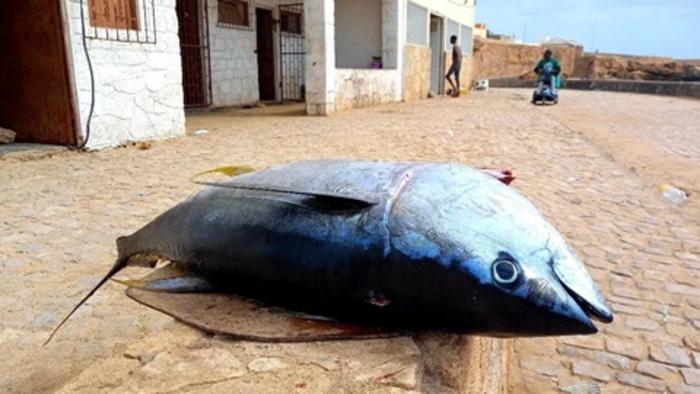
Fish stocks along the West African coast have declined significantly over the past five decades, threatening food security and the livelihoods of the fishing communities that depend on them, according to a study by the Institute of Environmental Science and Technology of the Universitat Autònoma de Barcelona (ICTA-UAB) in collaboration with Fundação Maio Biodiversidade (FMB).
Small-scale fisheries play a vital role in providing food and livelihoods for millions of people around the world, particularly in low-income countries in Africa. However, there is limited statistical data on the composition, abundance, and distribution of the fisheries’ resources, which is crucial for effective management.
New research, recently published in the journal Marine Policy, documents changes in the catches of small-scale fisheries, highlighting a significant decline not only in volume of catches, but also in the size of fish for key local species.
Scientists compiled official catch landing data and combined it with local ecological knowledge from local fishermen and fishmongers on Maio island, in Cabo Verde, designated a UNESCO Biosphere Reserve since 2020.
“Monitoring of fish landings in West African countries is limited and under-represents catches at the local level, especially from artisanal fisheries, creating data gaps that hinder effective management,” says Thais Peixoto Macedo, ICTA-UAB researcher and lead author of the study, who explains that traditional fishers’ accounts revealed trends that are poorly captured in official records. “The findings in this area show us trends that are likely to occur on other islands of the archipelago or other West African coastal areas and should be taken into account in marine resource management plans.”
Local communities believe that certain fishing practices, such as spearfishing with scuba gear and semi-industrial fishing with purse seines and night lights, are major contributors to the decline of fish stocks. In the case of semi-industrial fishing, they report that vessels fish within the three-nautical-mile zone and in marine protected areas reserved for artisanal fishing.
Sign up for the Daily Dose Newsletter and get every morning’s best science news from around the web delivered straight to your inbox? It’s easy like Sunday morning.
The most reported depleted species include groupers (dusky grouper, island grouper and the African hind) and small pelagic fish such as mackerel and bigeye scad. “According to local fishermen, the decline of small pelagic fish due to semi-industrial coastal fishing is negatively affecting artisanal catches of large pelagic species, such as yellowfin tuna and albacore, an important commercial species for local and international markets”, says Benalsy Varela, FMB staff who contributed to the study. Spiny and slipper lobsters, particularly targeted to supply more tourist-intensive islands, were also considered depleted.
The research highlights a phenomenon known as “Shifting Baseline Syndrome”, where people gradually adjust their perception of what is healthy or natural to a new reality, forgetting past conditions and accepting it as the ‘new normal’. Younger fishermen reported smaller catches and fish sizes than older generations, but a larger proportion of the younger group believe that fish stocks are not in decline.
IMAGE CREDIT: Thais Peixoto Macedo /ICTA-UAB



Leave a Reply