Plants in the shade of other plants receive more light than scientists had previously believed. A team of researchers from Utrecht University and Wageningen University & Research (WUR) describe how, in a recent article in the scientific journal Plant Cell & Environment. Their conclusions not only advance research into the functioning of photosynthesis in shady conditions, but may also benefit greenhouse horticulture. “When you have a better understanding of how different colours of light affect photosynthesis and plant growth, you can help growers develop smart ways to supplement natural sunlight with coloured light.”
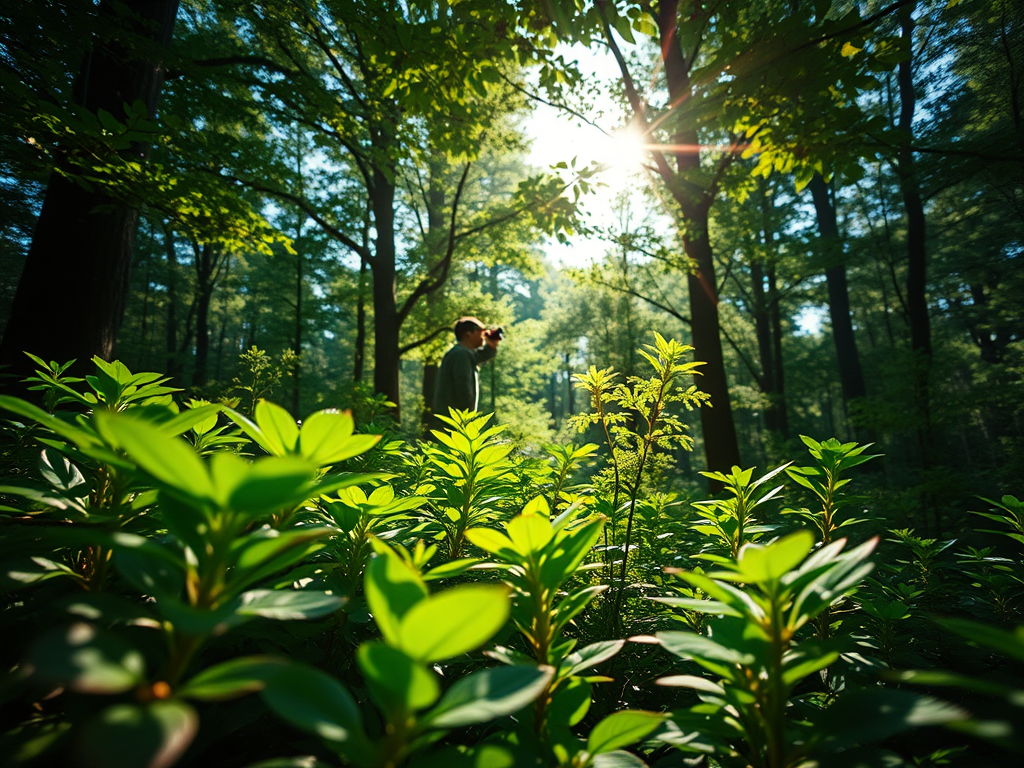
“The effect occurs in plants shaded by other plants”, explains Utrecht University environmental scientist Hugo de Boer, who initiated the study. This is because plants only capture some of the sunlight for photosynthesis; the process plants use to convert sunlight and CO2 into glucose. Some of the light also passes through their leaves, mostly in the form of green light. You can see that yourself when you look up into a woodland canopy: the leaves look a bit like green filters above you. The same effect occurs with light beyond the visible part of the red colour spectrum, in the frequency range of 700 to 750 nm. We call that colour ‘far-red’. “Plants that grow in the shadow of other plants therefore receive a larger proportion of green and far-red light than plants that grow in full sunlight. Our research shows that plants have a special way of using the far-red part of the colour spectrum for photosynthesis.”
“Until now, researchers have seldom considered the possibility that plants utilise far-red light for photosynthesis”, says WUR PhD candidate Tinko Jans. That is because previous experiments with monochromatic light have shown that plants mainly use light from the visible wavelengths (400 to 700 nm) for photosynthesis, and that light with shorter or longer wavelengths contributes little to the process. “But when you combine far-red light with a small amount of visible light, it does in fact contribute considerably to photosynthesis. So we’ve developed a new method for measuring and modelling how additional far-red light contributes to photosynthesis.”
Sign up for the Daily Dose Newsletter and get every morning’s best science news from around the web delivered straight to your inbox? It’s easy like Sunday morning.
Scientists and horticulturalists have known for some time that plants can use the far-red part of the colour spectrum to identify nearby plants from the shadows they cast. Jans: “Many plants react to a relative increase in far-red light by growing straight up, to win the competition for light. This shade avoidance response also helps horticulturalists, because it allows them to grow more plants closer together. Recent developments in LED technology have given a major stimulus to research into plants’ shadow reaction and the use of far-red light in horticulture.”
“In earlier experiments we also studied the shade avoidance response”, De Boer adds. “In addition to showing morphological changes, our shade plants started growing much quicker when we tried to fool them by installing LED lamps to supplement far-red light. To our astonishment, our plants were perfectly capable of using the additional far-red light for photosynthesis.”
The researchers conducted a large number of photosynthesis measurements using different colours and intensities of light. De Boer: “But it turned out to be much more difficult to quantify the colour effect on photosynthesis, because the available mathematical models and measurement methods were based on the assumption that plants only use light from the visible spectrum. So we adapted a commonly used photosynthesis model to quantify the colour effect using combined measurements of photosynthesis and the full light spectrum that reaches the leaf.”
Leave a Reply