Christian Bök, an experimental poet and scholar, discusses the intricate relationship between science and poetry in this interview. As a pioneering figure in avant-garde poetry, Bök has dedicated his career to exploring the intersection of scientific principles and poetic expression. From his groundbreaking work “Crystallography”, which uses mineralogy as both metaphor and framework, to “Eunoia”, a tour de force composed under strict vowel constraints, and finally to his ambitious “Xenotext” project—where he engineered bacteria to “write” poetry—Bök demonstrates how scientific rigor can enhance rather than inhibit creative expression.
In this wide-ranging conversation, Bök traces his journey from a scientifically-inclined student to an innovative poet, discusses the historical divide between scientific and literary cultures, and makes a compelling case for why poetry should engage more deeply with scientific advancement in our modern era. His insights reveal not just the technical challenges of his work, but also the philosophical implications of bringing together these seemingly disparate fields.

Marc Landas: When did you first become interested in the intersection of science and literature, particularly poetry? You have a strong background in experimental poetry, so where did you see the synergy?
Christian Bök: When I was an undergrad, I took classes on the history of poetry and developed my craft in response to the canon I was studying. But over time, I realized I was trying to be the poet I thought I “should” be, instead of the poet I “could” be.
I’ve always had a personal interest in the sciences. In high school, I did well in my science classes, and most people assumed I’d end up as an engineer or scientist, not a literature major. Now, with three degrees in English literature, I’ve spent most of my life immersed in the English literary tradition. But in grad school, I discovered a hidden history in literature—something they don’t teach you as an undergrad—and it made me a bit resentful.
It was during that time I realized I had a unique path to explore. I kept coming back to images from mineralogy and crystallography in my writing, so I decided to fully explore those motifs, which eventually led to my first book, “Crystallography”. The book assumes that a poem is like a crystal and pushes that metaphor to its limits.

The word “crystallography” literally means “lucid writing,” which I think is a beautiful metaphor for poetry itself. So I dove into the history and science of crystallography, borrowing its vocabulary, metaphors, and motifs for my poetry. I suggested that poetry’s rigorous, structured language mirrored the discipline of crystallography, and that idea became my first critically received book, giving my career as a poet a start.
In grad school, I also studied the historical relationship between science and poetry. In many ways, poetry and science are opposites. Scientists strive for precision and clarity, aiming to use language as literally as possible, free of metaphor. Ideally, scientific language has one meaning per word, completely transparent and clear in its explanation.
But that’s not entirely true. These disciplines interpenetrate one another. Many poets, especially since the Romantic period, have viewed poetry and science as opposed, and much criticism has targeted the scientific imagination. This idea of two separate “cultures,” as C.P. Snow put it, has created a longstanding intellectual divide, reflected in university structures where humanities and science departments rarely interact. My doctoral dissertation was an attempt to bridge this divide, exploring how poetry and science could converge and enrich each other.
In the avant-garde, where I work, experimentalism often resembles scientific experimentation. You’re testing language’s capacities beyond communication, seeing what language can do for art. In my own work, I approach language as if it were an alien technology—a UFO to reverse-engineer, turning every linguistic act into something that defies expectations, like anti-gravity.
I feel there’s a lack of poetry responding to key scientific advancements, despite science being, along with the economy, our most significant cultural pursuit. Take the Moon landing: 50 years ago, humans set foot on an alien world, yet there’s no canonical poem about it. This oversight is disappointing, especially as our future depends on getting science right. Poetry should have a voice here—it’s not something we should leave solely to technocrats.
Marc Landas: In a 2007 interview, you mentioned that poets are often aware of science but keep their distance. Nearly 20 years later, has anything changed? Are more poets engaging seriously with science?
Christian Bök: There are some, yes, and they’re people I admire. In Canadian literature, for instance, Christopher Dewdney’s work is informed by the intersection of science and poetry. He’s an excellent poet, especially in his early career. Poets like him inspired people in my circle. I could name a few Canadian peers, like Adam Dickinson and Ken Hunt, who explicitly engage with the scientific imagination in their poetry, making it accessible to the poetic community.
The advent of AI, for example, has inspired a new generation of writers exploring its artistic potential. Sasha Stiles is one who comes to mind, along with others who take inspiration from these tools. But they’re still a minority. Although science is possibly the most crucial thing we collectively do now, poetry still says little about it. That narrow focus misses opportunities, I think, for poets to explore a largely untouched realm and contribute something new.

Marc Landas: “Crystallography” was your first attempt to bring science and poetry together. You used it as a metaphor and a kind of literal framework. How did writing that prepare you to write “Eunoia”?
Christian Bök: “Eunoia” was my second book, written with a Herculean constraint. Each chapter tells a story—five in total—each one beautiful and musical, and each using only one vowel throughout. Chapter one uses only A, the second only E, and so on.
The book was inspired by the French literary group Oulipo, made up of mathematicians and writers who sought to remove inspiration from writing by applying scientific rigor. They believed one key to creativity lay in imposing rigorous, seemingly impossible constraints.
One such constraint they suggested was the univocal lipogram—writing with only one vowel. Most of them thought producing any significant work under this constraint was impossible. But I noticed that no one had done a true analysis of that claim, so I set out to test it. My work is often about exploring language under challenging conditions, seeing what can be said or discovered creatively within them.
They weren’t wrong—it’s almost impossible to create meaning with this constraint. But after seven years of intense effort, I managed to complete a work that showed language at its limits. Even under conditions that should stifle expression, language persisted, saying things that were beautiful, funny, poetic. It gave me optimism about language’s resilience, even under duress.

Marc Landas: Reading it, I could almost feel your exhaustion as the book went on. By the letter U, it felt like you were tired, and the brevity of that chapter reflected it. The first two chapters—A and E—struck me as especially strong. I noticed that in E, your choices seemed guided by the constraints, almost like a form of auto-writing.
Christian Bök: Absolutely. I can’t just say anything; I have to follow the path allowed by the words within the constraint. And you’re right—the U chapter has the smallest vocabulary. Words using U alone are far fewer than those using A or E, for example, which makes it a harder puzzle but also gives me fewer pieces to work with.
Each chapter represents the best I could say under those conditions. Many have attempted variations, but I’ve seen almost all of them. To create my work, I had to explore every option, understand what was possible, and find the best expressions. You reach a point where, given enough constraint, it’s less about expressing yourself and more about uncovering something inherent to the language itself. “Eunoia” is a statistically improbable combination of words, each chapter using only one vowel. Because no one had attempted it before, you end up discovering things about language you’d never noticed.
Each vowel has a distinct personality, almost like a voice. My literary training would tell me vowels aren’t really characters, but the book convinced me otherwise. The E chapter, for example, has a lyrical, elegiac quality, while O is playful, even obscene. It’s possible the resonance comes from the sounds and frequencies of the vowels themselves.

Marc Landas: Even though you consciously chose words in “Eunoia”, the language itself seemed to guide you. In “Xenotext”, you took that further. You started with bacteria, and it “wrote” back to you. In “Xenotext”, you had to reconcile the scientific method with poetry. How did that compare to your dissertation theories, and how did you balance the technical and poetic demands?
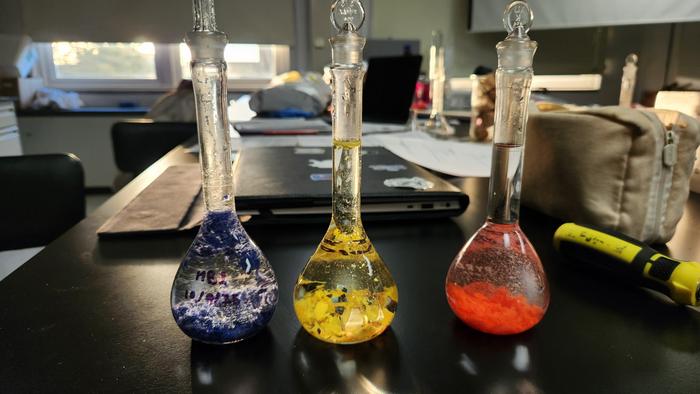
Christian Bök: There wasn’t much conflict in my approach. I assumed I needed to learn a new skill set for this experiment. For your readers: I designed a poem to translate into a genetic sequence, built the gene in a lab, and implanted it in a bacterium. The bacterium “reads” it and builds a protein that encodes another poem responding to mine. So, I engineered a bacterium to archive my poem and “write” a poem in response.
I had to design the experiment myself, so I immersed myself in genetic and protein engineering. Even as an English major, I believe I can understand anything written in English, given the effort. It took years of self-study to understand the science well enough to troubleshoot problems and ask informed questions.
Scientists wouldn’t solve problems for me; they’d test, but I had to lead the experiment. It was labor-intensive but necessary, and it taught me a lot.
Marc Landas: What benchmarks did you set?
Christian Bök: Ideally, we’d implant the poem into an extremophile bacterium, verify it’s stable in the genome, and confirm it produces a viable, detectable protein. Then, the protein needs to glow in the dark—an extra proof of success. We’re close to achieving this, and I’ll be announcing results soon.
Marc Landas: How do you view the bacteria in this process? Are they collaborators or mediums?
Christian Bok: Some might say I’m imposing my will on the genome, making the bacterium a repository for my poem. But I see it as a collaboration. This extremophile bacterium feels almost like a deity, something we’re only beginning to understand. It’s a dialogue; I can only do what it allows.
Marc Landas: How did DNA constraints shape your poem?
Christian Bök: The constraints were incredibly challenging. Imagine encoding each letter to another letter—there are billions of possible pairings, but not all yield meaningful text. I designed tools to navigate this, and after years of effort, I managed to create two mutually encoded poems. The hardest part, though, was designing a gene sequence that could produce a viable protein.
Marc Landas: So, does science limit or expand creative possibilities in poetry?
Christian Bök: Science always sides with creativity and imagination. Poets used to be the people with the most imagination. But now, scientists, especially physicists, make the wildest claims. We live in an era where science shapes the future, and poetry should be part of that discourse. We can bring a unique perspective to it.
IMAGE CREDIT: Christian Bök

Leave a Reply