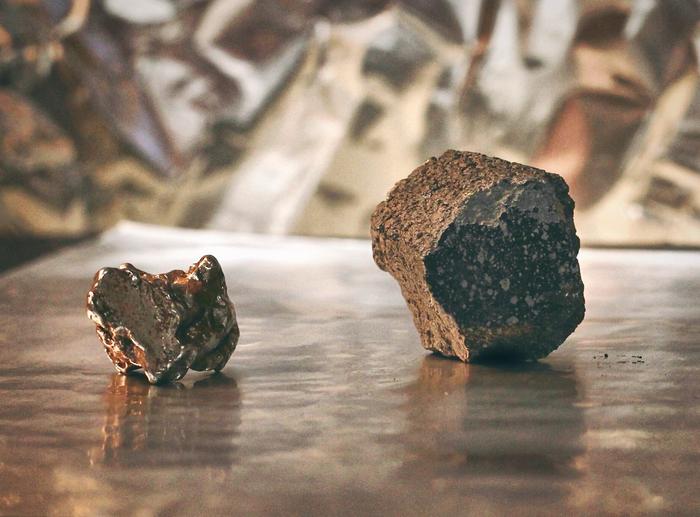
Researchers have used the chemical fingerprints of zinc contained in meteorites to determine the origin of volatile elements on Earth. The results suggest that without ‘unmelted’ asteroids, there may not have been enough of these compounds on Earth for life to emerge.
Volatiles are elements or compounds that change into vapour at relatively low temperatures. They include the six most common elements found in living organisms, as well as water. The zinc found in meteorites has a unique composition, which can be used to identify the sources of Earth’s volatiles.
The researchers, from the University of Cambridge and Imperial College London, have previously found that Earth’s zinc came from different parts of our Solar System: about half came from beyond Jupiter and half originated closer to Earth.
“One of the most fundamental questions on the origin of life is where the materials we need for life to evolve came from,” said Dr Rayssa Martins from Cambridge’s Department of Earth Sciences. “If we can understand how these materials came to be on Earth, it might give us clues to how life originated here, and how it might emerge elsewhere.”
Planetesimals are the main building blocks of rocky planets, such as Earth. These small bodies are formed through a process called accretion, where particles around a young star start to stick together, and form progressively larger bodies.
But not all planetesimals are made equal. The earliest planetesimals that formed in the Solar System were exposed to high levels of radioactivity, which caused them to melt and lose their volatiles. But some planetesimals formed after these sources of radioactivity were mostly extinct, which helped them survive the melting process and preserved more of their volatiles.
Sign up for the Daily Dose Newsletter and get every morning’s best science news from around the web delivered straight to your inbox? It’s easy like Sunday morning.
In a study published in the journal Science Advances, Martins and her colleagues looked at the different forms of zinc that arrived on Earth from these planetesimals. The researchers measured the zinc from a large sample of meteorites originating from different planetesimals and used this data to model how Earth got its zinc, by tracing the entire period of the Earth’s accretion, which took tens of millions of years.
Their results show that while these ‘melted’ planetesimals contributed about 70% of Earth’s overall mass, they only provided around 10% of its zinc.
According to the model, the rest of Earth’s zinc came from materials that didn’t melt and lose their volatile elements. Their findings suggest that unmelted, or ‘primitive’ materials were an essential source of volatiles for Earth.
“We know that the distance between a planet and its star is a determining a factor in establishing the necessary conditions for that planet to sustain liquid water on its surface,” said Martins, the study’s lead author. “But our results show that there’s no guarantee that planets incorporate the right materials to have enough water and other volatiles in the first place – regardless of their physical state.”
The ability to trace elements through millions or even billions of years of evolution could be a vital tool in the search for life elsewhere, such as on Mars, or on planets outside our Solar System.
“Similar conditions and processes are also likely in other young planetary systems,” said Martins. “The roles these different materials play in supplying volatiles is something we should keep in mind when looking for habitable planets elsewhere.”
IMAGE CREDIT: Rayssa Martins/Ross Findlay
.




Leave a Reply