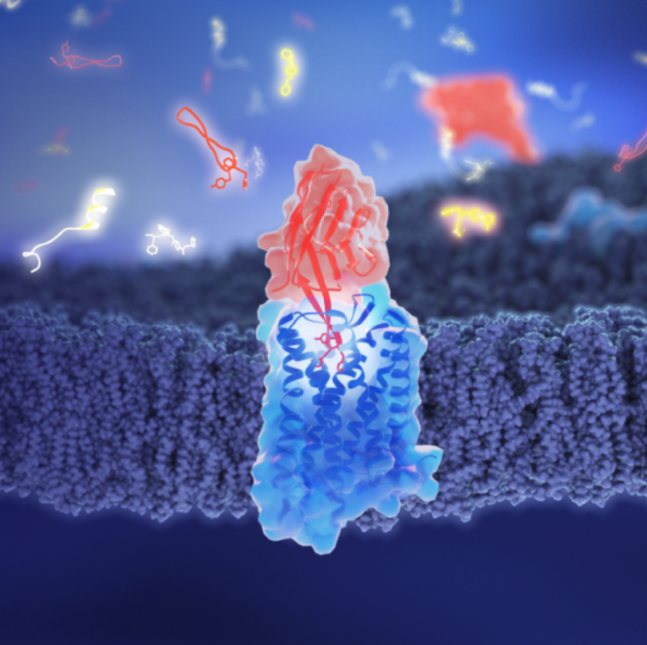
Opioid drugs are highly effective at relieving pain but come with severe drawbacks. Their side effects range from dizziness to potentially fatal respiratory depression. Their illegal use contributes to nearly half a million deaths worldwide each year. Researchers from the University of Geneva (UNIGE) have discovered a molecule, called nanobody NbE, which binds tightly and durably to the cell receptors that usually bind to opioids, thereby blocking the drugs’ activity. Moreover, the scientists were able to create even smaller molecules that retain the same properties, which could prove far more effective than current treatments in mitigating the harmful effects of opioids. These findings are published in the journal Nature Communications.
Opioids are a large family of pharmaceuticals that include morphine, fentanyl and tramadol. These powerful drugs are mainly used as painkillers, but also trigger a euphoric effect by interacting with nerve cells in the brain. However, they are very addictive and produce dangerous side effects. Diverted from their original use, natural and synthetic opioids have become the deadliest drugs in the United States, and this global health crisis is now threatening Europe.
“We need to urgently develop new molecules to better mitigate the side effects for patients and manage the risks of opioid-related overdoses”, explains Miriam Stoeber, associate professor in the Department of Cell Physiology and Metabolism at UNIGE Faculty of Medicine, who initiated and coordinated the project. “To understand how a molecule works, we need to know how it affects the brain cells. In our study, we used tiny natural proteins derived from llama antibodies, called nanobodies, designed to bind specifically to the target receptor on the cell’s surface.”
The strong binding power of nanobody NbE
UNIGE researchers have found that NbE, one of the nanobodies under study, has the unique ability to bind so tightly and durably to specific opioid receptors that it prevents opioids from binding to these same receptors, therefore blocking the drug’s activity. “To determine how NbE binds to its target, we used high resolution structural biology methods, thanks to the new Dubochet Centre for Imaging”, describes Andreas Boland, assistant professor in the Department of Molecular and Cellular Biology at UNIGE Faculty of Science, and co-last author of the study.
“We identified a unique binding mode where only a small portion of the nanobody is responsible for its correct receptor selectivity. Knowing precisely which part of the nanobody is at stake allows us to imagine new ways to induce the same effects with pharmaceuticals.”
Sign up for the Daily Dose Newsletter and get every morning’s best science news from around the web delivered straight to your inbox? It’s easy like Sunday morning.
Small molecules, large effects
While significantly smaller than antibodies, nanobodies remain quite large. They can be costly to produce and may not fully reach the target tissue in the body. In collaboration with the Prof. Steven Ballet team from the University of Brussels, the UNIGE research team synthesised in vitro a set of even smaller molecules mimicking the key part of NbE responsible for the selected binding to opioid receptors. “By durably blocking opioid receptors, our new molecules have the potential to reverse or reduce the deleterious side effects of opioids. In case of overdose, they could provide a better, longer lasting option than naloxone, the treatment currently in use. We will now refine their structure to improve even further their efficiency and facilitate their delivery to the targeted nerve cells in the brain”, concludes Miriam Stoeber.
IMAGE CREDIT: UNIGE




Leave a Reply