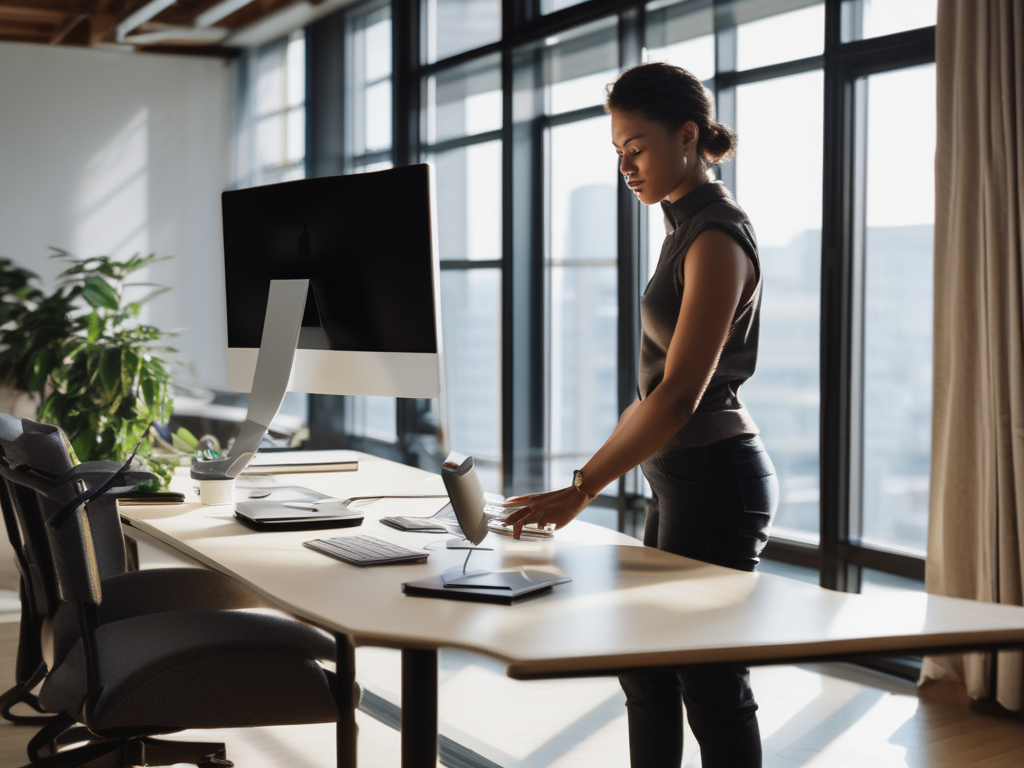
It might be an exaggeration to claim that “sitting is the new smoking,” but significant research indicates that people who are sedentary face more health challenges than their active counterparts.
Office workers who spend most of their eight-hour workdays seated, for example, more often experience symptoms such as daytime exhaustion, hypertension and musculoskeletal discomfort than those who are less sedentary. Although devices such as standing desks have been found to alleviate physical symptoms and increase worker productivity, questions remain regarding the best use of the primary types of workstations—stand-biased, sit-stand or traditional—for increasing workers’ physical activity and preventing health problems.
To answer these questions, a team of researchers from the Texas A&M University School of Public Health measured the computer usage and activity levels of 61 office workers for 10 days to evaluate any discomfort and develop possible remedies.

The study, published in IISE Transactions on Occupational Ergonomics and Human Factors, was conducted by Tricia Lynn Salzar, DrPH, Kaysey Aguilar, PhD, Matthew Lee Smith, PhD, Adam Pickens, PhD, Gang Han, PhD, Mark Edward Benden, PhD, and doctoral student Grace Anderson.
“What makes our research unique is our use of computer utilization as a possible indicator of, and proxy for, work productivity in all three workstation types,” Aguilar said.
For the study, which was conducted from 2019 to 2020, the team monitored 79 full-time, adult office workers at a major university. Participants were placed in three study groups according to the type of workstation they used (stand-biased, sit-stand or traditional), with those using traditional seated workstations serving as the control group.
Sign up for the Daily Dose Newsletter and get every morning’s best science news from around the web delivered straight to your inbox? It’s easy like Sunday morning.
Stand-biased workstations were defined as having a fixed work surface at approximately standing elbow height in conjunction with a drafting stool or chair with an extended cylinder. Sit-stand workstations were defined as desktop units and those with a fully height-adjustable work surface paired with a traditional office chair.
The researchers gathered demographic data on workers and information on how they used office equipment such as footrests, monitor arms, keyboard trays or anti-fatigue mats at their workstation. They also collected data on the amount of time the workers spent standing at their workstation and their use of a sit-stand or stand-biased workstation. Participants were asked about discomfort in the neck, upper back, lower back, shoulder, wrist and hand, hips, knees, and ankles and feet.
To measure productivity, the team monitored participants’ workstation computer use through hidden and silent data-logging software. To monitor physical activity, participants used an activity sensor that ran for one workweek to quantify and measure the participants’ activity levels and energy expenditures. Each participant’s files were downloaded and aggregated to ensure a minimum of 10 workdays of computer use data, which were analyzed using statistical analysis software (SAS®).
“We found no significant difference in the number of keyclicks between the three groups, but the stand-biased group had a significantly higher word count and more errors than the traditional group,” Aguilar said. “In addition, the 24-hour activity data revealed that the stand-biased group had significantly more standing time, less sitting time and fewer transitions per hour compared to their traditional counterparts.”
In terms of discomfort, 65 percent of all participants reported having neck discomfort and 80 percent of the traditional workstation group reported discomfort of the lower back, compared to 51.7 percent of the stand-biased group.
Although the stand-biased and sit-stand groups stood more and sat less than the traditional group, the difference in outcomes was not statistically significant. In addition, while the traditional group transitioned from seated to standing postures significantly more often, the stand-biased group expended more energy.
“The bottom line is that the risk of health issues from sedentary work can be alleviated through alternative desk options, like sit-stand or stand-biased workstations,” Aguilar said. “These are win-win solutions because they benefit worker’s health while maintaining the high productivity employers expect.”
If you enjoy the content we create and would like to support us, please consider becoming a patron on Patreon! By joining our community, you’ll gain access to exclusive perks such as early access to our latest content, behind-the-scenes updates, and the ability to submit questions and suggest topics for us to cover. Your support will enable us to continue creating high-quality content and reach a wider audience.
Join us on Patreon today and let’s work together to create more amazing content! https://www.patreon.com/ScientificInquirer




Leave a Reply