Professor Takahiro Nemoto and his research group from the Department of Psychiatry and Neurology at Toho University Faculty of Medicine, in collaboration with Visiting Professor Janice Tsoh from the University of California San Francisco Department of Psychiatry and Behavioral Sciences, who was invited under the “FY2023 Japan Society for the Promotion of Science (JSPS) Invitation Fellowship Programs for Research in Japan (Long-term),” investigated the factors contributing to early self-discontinuation of psychiatric treatment among foreign residents.
The study revealed how patients’ language proficiency influences early self-discontinuation of treatment. One notable finding was that relying solely on observed Japanese conversational fluency is insufficient for young patients in mental health care, highlighting the need for proper language assessment and language support services to reduce treatment dropout.
These research findings were published in the international academic journal “BMJ Mental Health” on July 4, 2024.

Key Points of the Announcement
- The study analyzed the medical records of 196 foreign patients aged 18 and above who visited the psychiatric outpatient departments at Toho University Medical Center Omori Hospital, Kawasaki Municipal Hospital, and Saiseikai Yokohamashi Tobu Hospital between April 2016 and March 2019.
- Among all patients, 25.5% self-discontinued treatment within three months.
- It was assumed that Japanese conversational ability was the main factor behind self-discontinuation of treatment; however, the group that spoke Japanese and the group that did not had comparable dropout rates (26.5% and 22.2%, respectively).
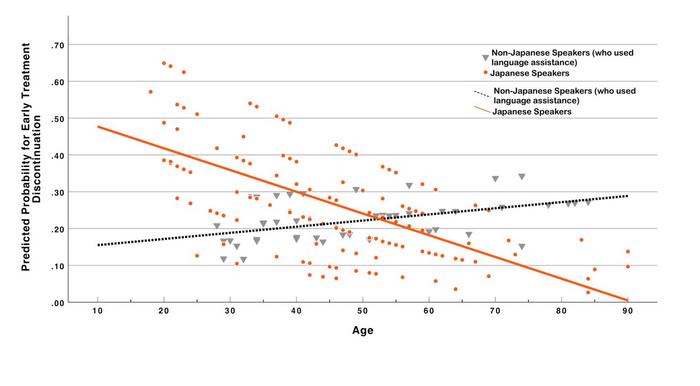
- Treatment dropout rates were higher among younger patients and those with disorders other than schizophrenia spectrum disorders or neurotic disorders. These tendencies were particularly noticeable among Japanese-speaking patients (Figure).
- Young foreign residents have a high risk of self-discontinuing treatment early even if they speak Japanese.
- In conclusion, providing mental health care to foreign residents requires assessing language proficiency and preferences, and offering appropriate language support, rather than relying on the observed Japanese conversational ability during consultations.
The graph illustrates the interaction between language and age on early treatment dropouts among foreign residents, represented with scatter plots and trend lines. Orange circles denote Japanese-speaking migrants, while grey triangles indicate non-Japanese-speaking migrants who used language support at their treatment visits.
Sign up for the Daily Dose Newsletter and get every morning’s best science news from around the web delivered straight to your inbox? It’s easy like Sunday morning.
The trend lines are depicted with orange and black dotted lines for Japanese and non-Japanese speakers, respectively. The horizontal axis represents age, and the vertical axis shows the predicted rate of early treatment dropout. The data reveals that younger Japanese-speaking migrants (shown in orange) had higher rates of dropping out of mental health treatment early. In contrast, this trend was not observed among non-Japanese speakers (shown in grey and black).
IMAGE CREDIT: BMJ Mental Health
If you enjoy the content we create and would like to support us, please consider becoming a patron on Patreon! By joining our community, you’ll gain access to exclusive perks such as early access to our latest content, behind-the-scenes updates, and the ability to submit questions and suggest topics for us to cover. Your support will enable us to continue creating high-quality content and reach a wider audience.
Join us on Patreon today and let’s work together to create more amazing content! https://www.patreon.com/ScientificInquirer




Leave a Reply