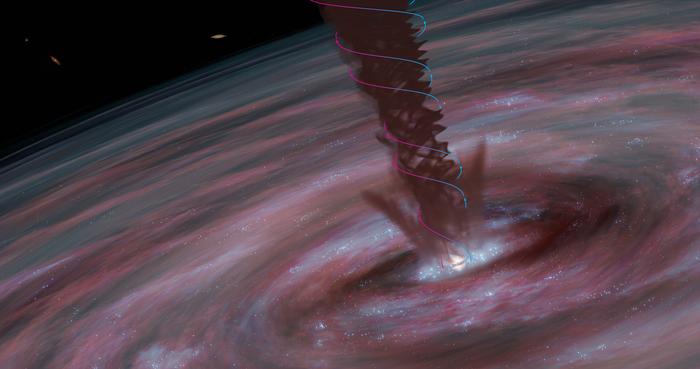
Supermassive black holes pose unanswered questions for astronomers around the world, not least “How do they grow so big?” Now, an international team of astronomers, including researchers from Chalmers University of Technology in Sweden, has discovered a powerful rotating, magnetic wind that they believe is helping a galaxy’s central supermassive black hole to grow. The swirling wind, revealed with the help of the ALMA telescope in nearby galaxy ESO320-G030, suggests that similar processes are involved both in black hole growth and the birth of stars.
Most galaxies, including our own Milky Way have a supermassive black hole at their centre. How these mind-bogglingly massive objects grow to weigh as much as millions or billions of stars is a long-standing question for astronomers.
In search of clues to this mystery, a team of scientists led by Mark Gorski (Northwestern University and Chalmers) and Susanne Aalto (Chalmers) chose to study the relatively nearby galaxy ESO320-G030, only 120 million light years distant. It’s a very active galaxy, forming stars ten times as fast as in our own galaxy.

“Since this galaxy is very luminous in the infrared, telescopes can resolve striking details in its centre. We wanted to measure light from molecules carried by winds from the galaxy’s core, hoping to trace how the winds are launched by a growing, or soon to be growing, supermassive black hole. By using ALMA, we were able to study light from behind thick layers of dust and gas”, says Susanne Aalto, Professor of Radio Astronomy at Chalmers University of Technology.
To zero in on dense gas from as close as possible to the central black hole, the scientists studied light from molecules of hydrogen cyanide (HCN). Thanks to ALMA’s ability to image fine details and trace movements in the gas – using the Doppler effect – they discovered patterns that suggest the presence of a magnetised, rotating wind.
While other winds and jets in the centre of galaxies push material away from the supermassive black hole, the newly discovered wind adds another process, that can instead feed the black hole and help it grow.
“We can see how the winds form a spiralling structure, billowing out from the galaxy’s centre. When we measured the rotation, mass, and velocity of the material flowing outwards, we were surprised to find that we could rule out many explanations for the power of the wind, star formation for example. Instead, the flow outwards may be powered by the inflow of gas and seems to be held together by magnetic fields”, says Susanne Aalto.
The scientists think that the rotating magnetic wind helps the black hole to grow.
Material travels around the black hole before it can fall in – like water around a drain. Matter that approaches the black hole collects in a chaotic, spinning disk. There, magnetic fields develop and get stronger. The magnetic fields help lift matter away from the galaxy, creating the spiralling wind. Losing matter to this wind also slows the spinning disk – that means that matter can flow more easily into the black hole, turning a trickle into a stream.
For Mark Gorski, the way this happens is strikingly reminiscent of a much smaller-scale environment in space: the swirls of gas and dust that lead up to the birth of new stars and planets.
“It is well-established that stars in the first stages of their evolution grow with the help of rotating winds – accelerated by magnetic fields, just like the wind in this galaxy. Our observations show that supermassive black holes and tiny stars can grow by similar processes, but on very different scales”, says Mark Gorski.
Could this discovery be a clue to solving the mystery of how supermassive black holes grow? In the future, Mark Gorski, Susanne Aalto and their colleagues want to study other galaxies which may harbour hidden spiralling outflows in their centres.
“Far from all questions about this process are answered. In our observations we see clear evidence of a rotating wind that helps regulate the growth of the galaxy’s central black hole. Now that we know what to look for, the next step is to find out how common a phenomenon this is. And if this is a stage which all galaxies with supermassive black holes go through, what happens to them next?”, asks Mark Gorski.
IMAGE CREDIT: M. D. Gorski/Aaron M. Geller, Northwestern University, CIERA, the Center for Interdisciplinary Exploration and Research in Astrophysics.
Leave a Reply