Today, optical microscopy is one of the most widely used methods in various multidisciplinary fields for inspecting objects, organisms, or surfaces on a small scale. However, its lateral resolution is fundamentally limited by the diffraction of light—a constraint that, with the use of conventional lenses, has become increasingly critical as the demand for higher resolutions grows.
The integration of a dielectric micro-sphere behind the last imaging lens of an optical microscope offers a promising solution to significantly enhance lateral resolution, a research area known as micro-sphere-assisted microscopy. However, in practice, the use of commercially available dielectric micro-spheres comes with substantial limitations. Cumbersome workflows are required for proper handling of the micro-spheres, and the sizes of commercially available dielectric micro-spheres are also limited. These challenges hinder the widespread application of micro-sphere-assisted microscopy as a cost-effective alternative to expensive microscopy solutions, such as scanning electron microscopy or atomic force microscopy.
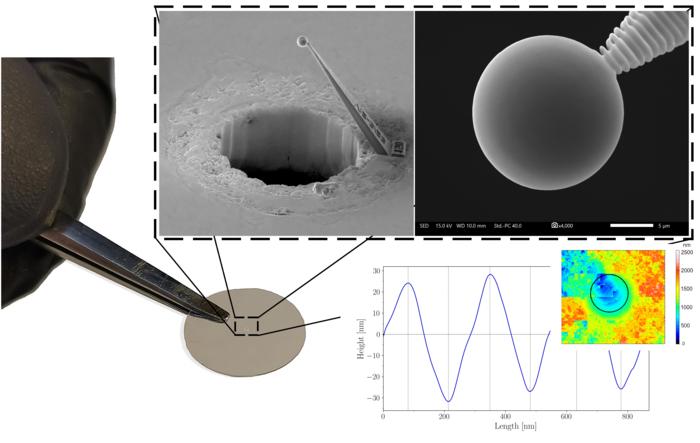
In a new paper published in Light: Advanced Manufacturing, scientists from the Institute of Electronic Structure and Laser – Foundation for Research and Technology-Hellas, the University of Helsinki, and Ruhr University Bochum have developed a new strategy for fabricating high-quality micro-spheres using laser-based 3D printing. This approach utilizes multi-photon lithography (MPL), which enables maskless production of true 3D structures at the micro- and nanoscale. Additionally, due to the nonlinear nature of MPL, its precision can be dramatically enhanced by locally refining the laser intensity throughout the printing process. By combining this sophisticated approach with an advanced hatching and slicing strategy, the team successfully fabricated a micro-sphere with a diameter of 20 µm, exhibiting almost perfect geometric quality (λ/8) and exceptional surface smoothness.

Ultimately, the micro-sphere was printed on a coverslip, which had a hole in its center processed by femtosecond laser ablation. The combination of this modified coverslip and the micro-sphere constitutes a 3D micro-device, enabling flexible manipulation of the sphere and its potential integration into any optical microscope.
The performance of the micro-sphere, when incorporated into the 3D micro-device, was evaluated using a Mirau-type coherence scanning interferometer (MCSI) and a calibration grid with a resolving power of λ = 0.28. As a result, the sphere’s optical properties surpassed the typical resolution limits of conventional lenses in visible light, while preserving the high axial resolution of MSCI.
Sign up for the Daily Dose Newsletter and get every morning’s best science news from around the web delivered straight to your inbox? It’s easy like Sunday morning.
Fabricated in just 8 minutes, including both the modification of the coverslip and the fabrication of the sphere, the 3D micro-device strongly indicates its applicability as a real-world solution. Moreover, the unique capabilities of MPL enable the exploration of innovative micro-optical structures and systems to further enhance the lateral resolution for both 2D and 3D optical microscopy. Looking towards the future, the scientists highlight the numerous possibilities for employing MPL in this field, emphasizing its high potential for cost-effectively developing custom-designed devices that improve resolution for any optical microscope.
IMAGE CREDIT: by Gordon Zyla, Göran Maconi, Anton Nolvi, Jan Marx, Dimitra Ladika, Ari Salmi, Vasileia Melissinaki, Ivan Kassamakov, and Maria Farsari
If you enjoy the content we create and would like to support us, please consider becoming a patron on Patreon! By joining our community, you’ll gain access to exclusive perks such as early access to our latest content, behind-the-scenes updates, and the ability to submit questions and suggest topics for us to cover. Your support will enable us to continue creating high-quality content and reach a wider audience.
Join us on Patreon today and let’s work together to create more amazing content! https://www.patreon.com/ScientificInquirer



Leave a Reply