Einstein’s theory of general relativity explains that gravity is caused by a curvature of the directions of space and time. The most familiar manifestation of this is the Earth’s gravity, which keeps us on the ground and explains why balls fall to the floor and individuals have weight when stepping on a scale.
In the field of high-energy physics, on the other hand, scientists study tiny invisible objects that obey the laws of quantum mechanics—characterized by random fluctuations that create uncertainty in the positions and energies of particles like electrons, protons and neutrons. Understanding the randomness of quantum mechanics is required to explain the behavior of matter and light on a subatomic scale.

For decades, scientists have been trying to unite those two fields of study to achieve a quantum description of gravity. This would combine the physics of curvature associated with general relativity with the mysterious random fluctuations associated with quantum mechanics.
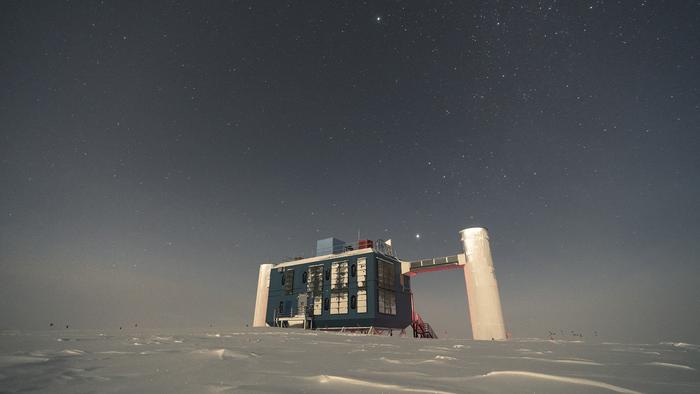
A new study in Nature Physics from physicists at The University of Texas at Arlington reports on a deep new probe into the interface between these two theories, using ultra-high energy neutrino particles detected by a particle detector set deep into the Antarctic glacier at the south pole.
Sign up for the Daily Dose Newsletter and get every morning’s best science news from around the web delivered straight to your inbox? It’s easy like Sunday morning.
“The challenge of unifying quantum mechanics with the theory of gravitation remains one of the most pressing unsolved problems in physics,” said co-author Benjamin Jones, associate professor of physics. “If the gravitational field behaves in a similar way to the other fields in nature, its curvature should exhibit random quantum fluctuations.”
Jones and UTA graduate students Akshima Negi and Grant Parker were part of an international IceCube Collaboration team that included more than 300 scientists from around the U.S., as well as Australia, Belgium, Canada, Denmark, Germany, Italy, Japan, New Zealand, Korea, Sweden, Switzerland, Taiwan and the United Kingdom.
To search for signatures of quantum gravity, the team placed thousands of sensors throughout one square kilometer near the south pole in Antarctica that monitored neutrinos, unusual but abundant subatomic particles that are neutral in charge and have no mass. The team was able to study more than 300,000 neutrinos. They were looking to see whether these ultra-high-energy particles were bothered by random quantum fluctuations in spacetime that would be expected if gravity were quantum mechanical, as they travel long distances across the Earth.
“We searched for those fluctuations by studying the flavors of neutrinos detected by the IceCube Observatory,” Negi said. “Our work resulted in a measurement that was far more sensitive than previous ones (over a million times more, for some of the models), but it did not find evidence of the expected quantum gravitational effects.”
This non-observation of a quantum geometry of spacetime is a powerful statement about the still-unknown physics that operate at the interface of quantum physics and general relativity.
“This analysis represents the final chapter in UTA’s nearly decade-long contribution to the IceCube Observatory,” said Jones. “My group is now pursuing new experiments that aim to understand the origin and value of the neutrinos mass using atomic, molecular and optical physics techniques.”
IMAGE CREDIT: Martin Wolf, IceCube/NSF
If you enjoy the content we create and would like to support us, please consider becoming a patron on Patreon! By joining our community, you’ll gain access to exclusive perks such as early access to our latest content, behind-the-scenes updates, and the ability to submit questions and suggest topics for us to cover. Your support will enable us to continue creating high-quality content and reach a wider audience.
Join us on Patreon today and let’s work together to create more amazing content! https://www.patreon.com/ScientificInquirer




Leave a Reply