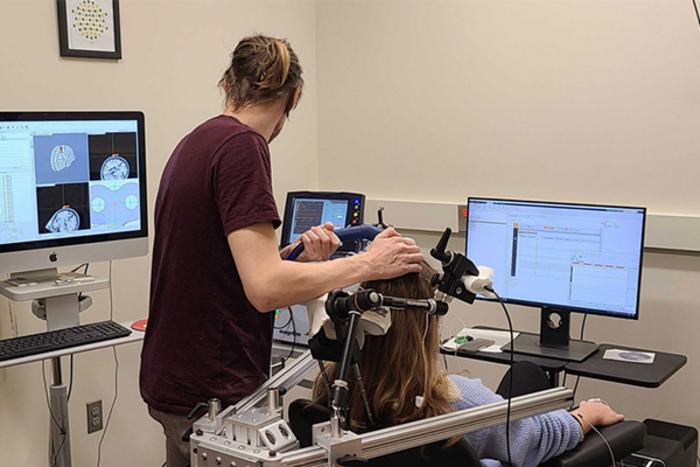
For the first time, researchers at the University of Minnesota Twin Cities showed that non-invasive brain stimulation can change a specific brain mechanism that is directly related to human behavior. This is a major step forward for discovering new therapies to treat brain disorders such as schizophrenia, depression, Alzheimer’s disease, and Parkinson’s disease.
The study was recently published in Nature Communications, a peer-reviewed, open access, scientific journal.
Researchers used what is called “transcranial alternating current stimulation” to modulate brain activity. This technique is also known as neuromodulation. By applying a small electrical current to the brain, the timing of when brain cells are active is shifted. This modulation of neural timing is related to neuroplasticity, which is a change in the connections between brain cells that is needed for human behavior, learning, and cognition.

“Previous research showed that brain activity was time-locked to stimulation. What we found in this new study is that this relationship slowly changed and the brain adapted over time as we added in external stimulation,” said Alexander Opitz, University of Minnesota biomedical engineering associate professor. “This showed brain activity shifting in a way we didn’t expect.”
This result is called “neural phase precession.” This is when the brain activity gradually changes over time in relation to a repeating pattern, like an external event or in this case non-invasive stimulation. In this research, all three investigated methods (computational models, humans, and animals) showed that the external stimulation could shift brain activity over time.
“The timing of this repeating pattern has a direct impact on brain processes, for example, how we navigate space, learn, and remember,” Opitz said.
Sign up for the Daily Dose Newsletter and get every morning’s best science news from around the web delivered straight to your inbox? It’s easy like Sunday morning.
The discovery of this new technique shows how the brain adapts to external stimulation. This technique can increase or decrease brain activity, but is most powerful when it targets specific brain functions that affect behaviors. This way, long-term memory as well as learning can be improved. The long-term goal is to use this technique in the treatment of psychiatric and neurological disorders.
Opitz hopes that this discovery will help bring improved knowledge and technology to clinical applications, which could lead to more personalized therapies for schizophrenia, depression, Alzheimer’s disease, and Parkinson’s disease.
In addition to Opitz, the research team included co-first authors Miles Wischnewski and Harry Tran. Other team members from the University of Minnesota Biomedical Engineering Department include Zhihe Zhao, Zachary Haigh, Nipun Perera, Ivan Alekseichuk, Sina Shirinpour and Jonna Rotteveel. This study was in collaboration with Dr. Jan Zimmermann, associate professor in the University of Minnesota Medical School.
This work was supported primarily by the National Institute of Health (NIH) along with the Behavior and Brain Research Foundation and the University of Minnesota’s Minnesota’s Discovery, Research, and InnoVation Economy (MnDRIVE) Initiative. Computational resources were provided by the Minnesota Supercomputing Institute (MSI).
IMAGE CREDIT: Opitz Lab, University of Minnesota Twin Cities.
.
If you enjoy the content we create and would like to support us, please consider becoming a patron on Patreon! By joining our community, you’ll gain access to exclusive perks such as early access to our latest content, behind-the-scenes updates, and the ability to submit questions and suggest topics for us to cover. Your support will enable us to continue creating high-quality content and reach a wider audience.
Join us on Patreon today and let’s work together to create more amazing content! https://www.patreon.com/ScientificInquirer



Leave a Reply