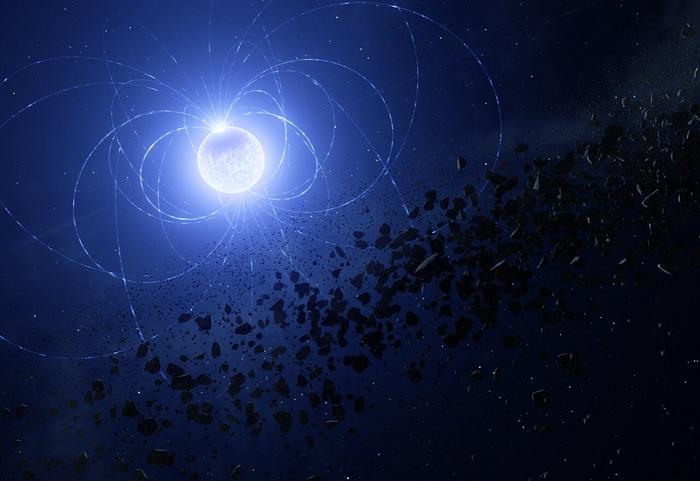
When a star like our Sun reaches the end of its life, it can ingest the surrounding planets and asteroids that were born with it. Now, using the European Southern Observatory’s Very Large Telescope (ESO’s VLT) in Chile, researchers have found a unique signature of this process for the first time — a scar imprinted on the surface of a white dwarf star. The results are published today in The Astrophysical Journal Letters.
“It is well known that some white dwarfs — slowly cooling embers of stars like our Sun — are cannibalising pieces of their planetary systems. Now we have discovered that the star’s magnetic field plays a key role in this process, resulting in a scar on the white dwarf’s surface,” says Stefano Bagnulo, an astronomer at Armagh Observatory and Planetarium in Northern Ireland, UK, and lead author of the study.

The scar the team observed is a concentration of metals imprinted on the surface of the white dwarf WD 0816-310, the Earth-sized remnant of a star similar to, but somewhat larger than, our Sun. “We have demonstrated that these metals originate from a planetary fragment as large as or possibly larger than Vesta, which is about 500 kilometres across and the second-largest asteroid in the Solar System,” says Jay Farihi, a professor at University College London, UK, and co-author on the study.
The observations also provided clues to how the star got its metal scar. The team noticed that the strength of the metal detection changed as the star rotated, suggesting that the metals are concentrated on a specific area on the white dwarf’s surface, rather than smoothly spread across it. They also found that these changes were synchronised with changes in the white dwarf’s magnetic field, indicating that this metal scar is located on one of its magnetic poles. Put together, these clues indicate that the magnetic field funneled metals onto the star, creating the scar [1].
Sign up for the Daily Dose Newsletter and get every morning’s best science news from around the web delivered straight to your inbox? It’s easy like Sunday morning.
“Surprisingly, the material was not evenly mixed over the surface of the star, as predicted by theory. Instead, this scar is a concentrated patch of planetary material, held in place by the same magnetic field that has guided the infalling fragments,” says co-author John Landstreet, a professor at Western University, Canada, who is also affiliated with the Armagh Observatory and Planetarium. “Nothing like this has been seen before.”
To reach these conclusions, the team used a ‘Swiss-army knife’ instrument on the VLT called FORS2, which allowed them to detect the metal scar and connect it to the star’s magnetic field. “ESO has the unique combination of capabilities needed to observe faint objects such as white dwarfs, and sensitively measure stellar magnetic fields,” says Bagnulo. In their study, the team also relied on archival data from the VLT’s X-shooter instrument to confirm their findings.
Harnessing the power of observations like these, astronomers can reveal the bulk composition of exoplanets, planets orbiting other stars outside the Solar System. This unique study also shows how planetary systems can remain dynamically active, even after ‘death’.
IMAGE CREDIT: ESO/L. Calçada
If you enjoy the content we create and would like to support us, please consider becoming a patron on Patreon! By joining our community, you’ll gain access to exclusive perks such as early access to our latest content, behind-the-scenes updates, and the ability to submit questions and suggest topics for us to cover. Your support will enable us to continue creating high-quality content and reach a wider audience.
Join us on Patreon today and let’s work together to create more amazing content! https://www.patreon.com/ScientificInquirer



Leave a Reply