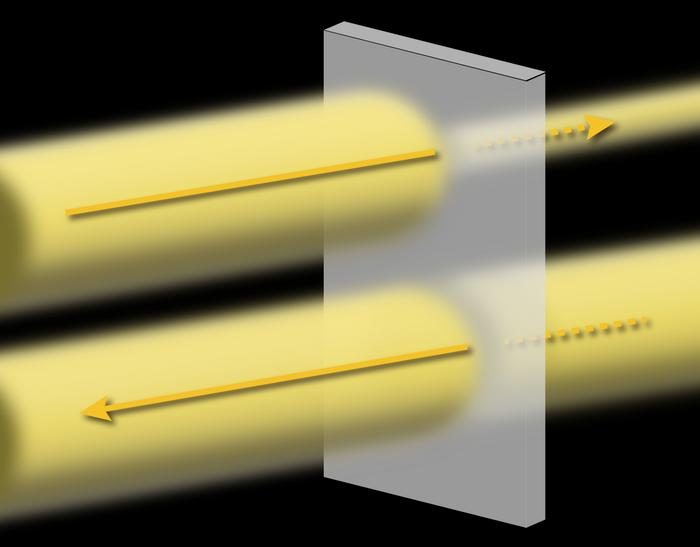
At the heart of global internet connectivity, optical communications form an indispensable foundation. Key to this foundation are optical isolators, created by combining multiple components. The result is a complex structure that transmits light in only one direction, to prevent damage to lasers and minimize noise by avoiding the reversal of light.
However, some magnetic materials have an optical diode effect – an unconventional nonreciprocal absorption of light manifested by the material itself. This effect leads to a change in transmittance depending on the direction in which the light travels. If this phenomenon can be enhanced, it is expected that optical isolators can be made more compact and efficient.

A team of researchers led by Associate Professor Kenta Kimura of the Graduate School of Engineering at Osaka Metropolitan University investigated the phenomenon of nonreciprocal optical absorption in the magnetoelectric antiferromagnet LiNiPO4 at shortwave infrared wavelengths.
Their results showed that the absorption coefficient differs by a factor of two or more when the direction of light propagation is reversed. This large nonreciprocal absorption is attributed to the magnetic properties of the divalent nickel (Ni2+) ions. Furthermore, the researchers have shown that it is possible to switch the optical diode effect with an applied magnetic field in a non-volatile manner.
Sign up for the Daily Dose Newsletter and get every morning’s best science news from around the web delivered straight to your inbox? It’s easy like Sunday morning.
“The optical diode effect is an interesting subject of study because it is such an unconventional phenomenon that is far removed from common sense and has the potential to realize unexpected applications. However, there are still many problems at present, such as the low operating temperatures,” explained Professor Kenta Kimura. “Nevertheless, this research has demonstrated the usefulness of compounds containing nickel, which has greatly expanded the scope of material selection. Based on this knowledge, we will continue the development of materials exhibiting a higher performance optical diode effect.”
IMAGE CREDIT: Osaka Metropolitan University
If you enjoy the content we create and would like to support us, please consider becoming a patron on Patreon! By joining our community, you’ll gain access to exclusive perks such as early access to our latest content, behind-the-scenes updates, and the ability to submit questions and suggest topics for us to cover. Your support will enable us to continue creating high-quality content and reach a wider audience.
Join us on Patreon today and let’s work together to create more amazing content! https://www.patreon.com/ScientificInquirer


Leave a Reply