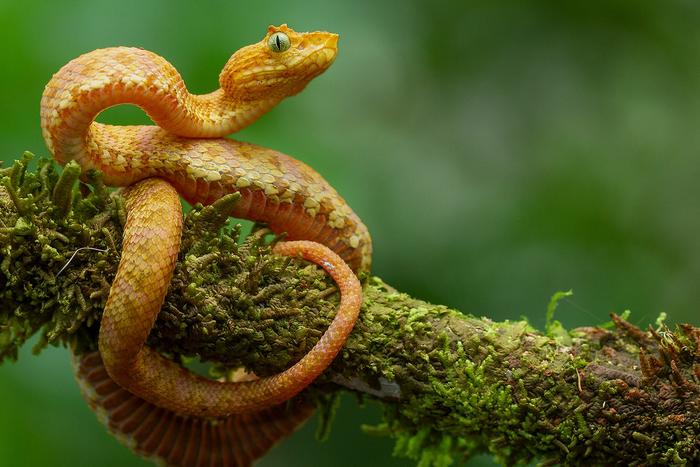
A group of scientists led by researchers of Khamai Foundation discovered five dazzling new species of eyelash vipers in the jungles and cloud forests of Colombia and Ecuador. This groundbreaking discovery was made official in a study published in the open-access journal Evolutionary Systematics.
Prior to this research, the captivating new vipers, now recognized as among the most alluring ever found, were mistakenly classified as part of a single, highly variable species spanning from Mexico to northwestern Peru. The decade-long study initiated with an unexpected incident wherein one of the authors was bitten by one of these previously undiscovered species.
Eyelash vipers stand out due to a distinctive feature: a set of enlarged spine-like scales positioned atop their eyes. These “lashes” bestow upon the snakes a formidable and fierce appearance, yet the true purpose of this feature remains unknown. What is definite, however, is that certain populations exhibit longer, and more stylized eyelashes compared to others. The variations in the condition of the eyelashes led researchers to hypothesize the existence of undiscovered species.

Eyelash vipers are also famous for another feature: they are polychromatic. The same patch of rainforest may contain individuals of the turquoise morph, the moss morph, or the gold morph, all belonging to the same species despite having an entirely different attire. “No two individuals have the same coloration, even those belonging to the same litter (yes, they give birth to live young),” says Alejandro Arteaga, who led the study.
For some of the species, there is a “Christmas” morph, a ghost morph, and even a purple morph, with the different varieties sometimes coexisting and breeding with one another. The reason behind these incredible color variations is still unknown, but probably enables the vipers to occupy a wide range of ambush perches, from mossy branches to bright yellow heliconias.
Where do these new snakes live?
Three of the five new species are endemic to the eastern Cordillera of Colombia, where they occupy cloud forests and coffee plantations. One, the Rahim’s Eyelash-Pit viper, stands out for occurring in the remote and pristine Chocó rainforest at the border between Colombia and Ecuador, an area considered “complex to visit” due to the presence of drug cartels. The Hussain’s Eyelash-Pit viper occurs in the forests of southwestern Ecuador and extreme northwestern Peru. The researchers outline the importance of conservation and research in the Andes mountain range and its valleys due to its biogeographic importance and undiscovered megadiversity.
What’s with the venom?
“The venom of some (perhaps all?) of the new species of vipers is considerably less lethal and hemorrhagic than that of the typical Central American Eyelash-Viper,” says Lucas Bustamante, a co-author of the study. Lucas was bitten in the finger by the Rahim’s Eyelash-Pit viper while taking its pictures during a research expedition in 2013. “I experienced intermittent local pain, dizziness and swelling, but recovered shortly after receiving three doses of antivenom in less than two hours after the bite, with no scar left behind,” says Bustamante.
How threatened are these new species?
One of the study’s key conclusions is that four of the species in the group are facing a high risk of extinction. They have an extremely limited geographic range and 50% to 80% of their habitat has already been destroyed. Therefore, a rapid-response action to save the remaining habitat is urgently needed.
Who is honored with this discovery?
Two of the new species of vipers, the Rahim’s Eyelash-Pit viper (Bothriechis rahimi) and the Hussain’s Eyelash-Pit viper (B. hussaini), are named in honor of Prince Hussain Aga Khan and Prince Rahim Aga Khan, respectively, in recognition of their support to protect endangered global biodiversity worldwide through Focused On Nature (FON) and the Aga Khan Development Network. The Shah’s Eyelash-Pit viper (B. rasikusumorum) honors the Shah family, whereas the Klebba’s Eyelash-Pit viper (B. klebbai) and the Khwarg’s Eyelash-Pit viper (B. khwargi) honor Casey Klebba and Dr. Juewon Khwarg, respectively, for supporting the discovery and conservation of new species.
What is next?
Khamai Foundation is setting up a reserve to protect a sixth new species that remained undescribed in the present study. “The need to protect eyelash vipers is critical, since unlike other snakes, they cannot survive without adequate canopy cover. Their beauty, though worthy of celebration, should also be protected and monitored carefully, as poachers are notorious for targeting charismatic arboreal vipers for the illegal pet trade of exotic wildlife,” warns Arteaga. Finally, he and his team encourage the support of research on the venom components of the new species of vipers. This will promote their conservation as well as help communities that regularly encounter eyelash pit vipers.
IMAGE CREDIT: Lucas Bustamante
Sign up for the Daily Dose Newsletter and get the morning’s best science news from around the web delivered straight to your inbox? It’s easy like Sunday morning.



Leave a Reply