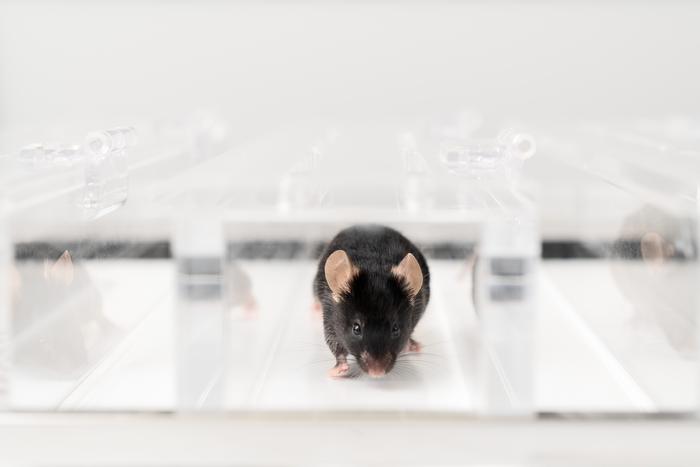
To study muscle diseases, scientists rely on the mouse as a model organism. Researchers at the University of Basel have now developed a new method that is not only faster and more efficient than conventional ones but also greatly reduces the number of experimental animals needed for studying the function of genes in muscle fibers.
Researchers use the mouse as a model organism to study the structure and function of skeletal muscle, neuromuscular diseases and aging processes in muscle. The scientists are aware of their responsibility in the use of animals and have committed themselves at the University of Basel to rigorously implement the so-called 3R principles – Replacement, Reduction, Refinement – in animal-assisted research and animal husbandry.
The new method developed by Professor Markus Rüegg’s research group at the Biozentrum, University of Basel, is a further step towards reducing the number of laboratory animals. This method also opens new ways to investigate several genes simultaneously or even entire signaling pathways in muscle fibers quickly, cost-effectively and efficiently. The results of the study have now been published in Nature Communications.

Studying gene function in muscle is challenging. On the one hand, muscle fibers are very large and very fragile when isolated. On the other hand, in humans, they are up to half a meter long and contain thousands of nuclei. In order to change and study gene function in muscle fibers, all of the muscle fiber nuclei must be changed, which is difficult to achieve.
For some years now, scientists have been using the CRISPR/Cas9 method to study gene function. This method uses a virus to introduce the so-called Cas9 protein and a specifically designed guide RNA into the organism and thus into the nuclei. The Cas9 protein cuts the genomic DNA at the site recognized by the guide RNA. This combination of Cas9 protein and guide RNA allows altering gene function in the cell.
The CRISPR-Cas9 method can be split up
However, to ensure that the virus only alters the gene expression of muscle fibers and not those of other organs at the same time, the research team combined the CRISPR/Cas9 method with another method: First, the researchers succeeded in breeding mice with the Cas9 protein already present in their muscle fibers – but only there. They then introduced the desired guide RNA into the organism with a so-called adeno-associated virus, which infects muscle.
This combination causes the guide RNA in the muscle fibers to encounter the Cas9 protein, changing the genetic material as desired. “The method enables us to ensure that only the muscle fibers actually change their genetic material,” explains first author Marco Thürkauf.
Fewer laboratory animals and more efficient results
Since the adeno-associated virus can also transport several guide RNAs simultaneously, the team can now use the method to investigate several genes simultaneously or even entire signaling pathways. Furthermore, the method significantly reduces the number of experimental animals required.
“All animals used are suitable for studying genes and do not have to be bred over years. This makes it possible to study muscle fibers as well as neuromuscular diseases without using a large number of mice,” says Marco Thürkauf.
Other research groups have also already signaled their interest. “We already have several interested groups in our research community that would like to use our method,” says Markus Rüegg. “This is a great gain for both muscle research per se as well as for our goal of reducing animal experiments.”
IMAGE CREDIT: University of Basel, Philippe Wiget
Sign up for the Daily Dose Newsletter and get every morning’s best science news from around the web delivered straight to your inbox? It’s easy like Sunday morning.



Leave a Reply