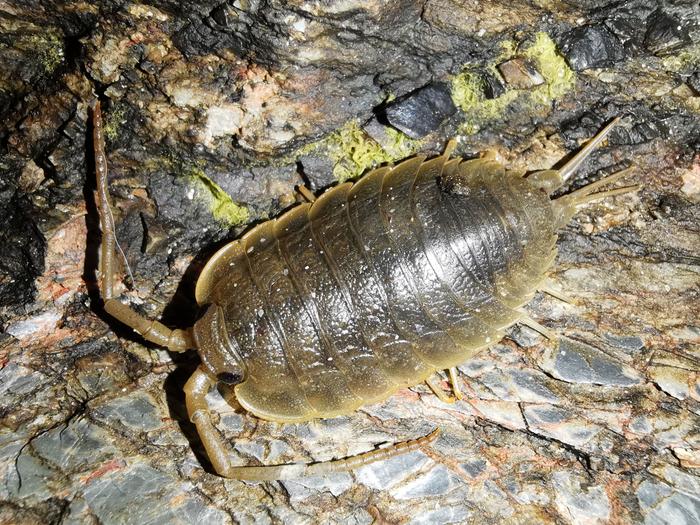
Artificial night-time light confuses a colour-changing coastal woodlouse, new research shows.
The sea slater is an inch-long woodlouse that lives around the high-tide line and is common in the UK and Europe.
Sea slaters forage at night and can change colour to blend in and conceal themselves from predators.
If you enjoy the content we create and would like to support us, please consider becoming a patron on Patreon! By joining our community, you’ll gain access to exclusive perks such as early access to our latest content, behind-the-scenes updates, and the ability to submit questions and suggest topics for us to cover. Your support will enable us to continue creating high-quality content and reach a wider audience.
Join us on Patreon today and let’s work together to create more amazing content! https://www.patreon.com/ScientificInquirer
The new study, by the University of Exeter, tested the effects of a single-point light source (which casts clear shadows) and “diffuse” light (similar to “skyglow” found near towns and cities).
While the single light did not interfere with the sea slaters’ camouflage, diffuse light caused them to turn paler while hiding on a dark background – making them more visible.
“With night skies getting brighter worldwide, it’s important to understand how this will affect the natural world,” said Kathryn Bullough, who led the study as part of her masters at the Centre for Ecology and Conservation on Exeter’s Penryn Campus in Cornwall.
“We know artificial light causes all sorts of negative effects for animals and plants, but our results show that shadow-casting light can have very different impacts to diffuse skyglow, even when both have the same overall brightness.
“Under point-source light, the sea slaters turned darker and sought out refuge on dark stones and shadows when available.
“But diffuse light caused them to become lighter, even though this would make them easier for predators to spot.”
In the study, sea slaters were placed in a circular chamber with white pebbles covering half of the floor and black pebbles on the other half.
They were then exposed either to point-source or diffuse light.
Under both kinds of light, sea slaters spent more time on the black pebbles, which more closely matched their starting colour and therefore provided better camouflage.
Under point-source light, they also turned darker – better matching the black pebbles.
But under diffuse light, they became on average 27% lighter.
“We can’t say exactly what causes this, but diffuse light clearly interferes with the sea slaters’ colour-matching mechanism,” said Dr Jolyon Troscianko, also from the Centre for Ecology and Conservation.
“One possibility is that they respond to this light as if dawn was approaching.
“We know that nocturnal animals have very sensitive light vision, so skyglow will appear very bright to them.”
With human populations clustered in coastal areas, shorelines are disproportionately affected by light pollution.
While sea slaters are not a threatened species, they are commonly eaten by shore birds such as oystercatchers and gulls.
“Many shore bird species are in severe decline, so it is critical that we understand how human activity affects their prey as part of a complex ecosystem,” Dr Troscianko said.
The study was partly funded by the Natural Environment Research Council (NERC).
The paper, published in the journal Proceedings of the Royal Society B, is entitled: “Artificial light at night causes conflicting behavioural and morphological defence responses in a marine isopod.”
IMAGE CREDIT: Jolyon Troscianko





Leave a Reply