HAVE YOUR SAY.
Join us in The Bullpen, where the members of the Scientific Inquirer community get to shape the site’s editorial decision making. We’ll be discussing people and companies to profile on the site. On Wednesday, April 26 at 5:30pm EST, join us on Discord and let’s build the best Scientific Inquirer possible.
Three engineers at the University of Massachusetts Amherst have invented a fabric that concludes the 80-year quest to make a synthetic textile modeled on Polar bear fur. The results, published recently in the journal ACS Applied Materials and Interfaces, are already being developed into commercially available products.
Polar bears live in some of the harshest conditions on earth, shrugging off Arctic temperatures as low as -50 Fahrenheit. While the bears have many adaptations that allow them to thrive when the temperature plummets, since the 1940s scientists have focused on one in particular: their fur. How, the scientific community has asked, does a polar bear’s fur keep them warm?
Typically, we think that the way to stay warm is to insulate ourselves from the weather. But there’s another way: One of the major discoveries of the last few decades is that many polar animals actively use the sunlight to maintain their temperature, and polar bear fur is a well-known case in point.

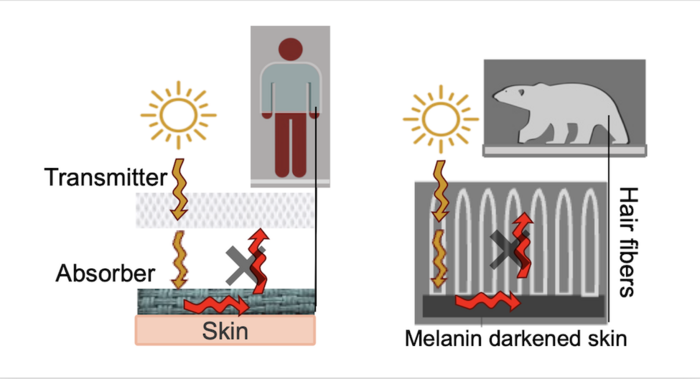
Scientists have known for decades that part of the bears’ secret is their white fur. One might think that black fur would be better at absorbing heat, but it turns out that the polar bears’ fur is extremely effective at transmitting solar radiation toward the bears’ skin.
“But the fur is only half the equation,” says the paper’s senior author, Trisha L. Andrew, associate professor of chemistry and adjunct in chemical engineering at UMass Amherst. “The other half is the polar bears’ black skin.”
As Andrew explains it, polar bear fur is essentially a natural fiberoptic, conducting sunlight down to the bears’ skin, which absorbs the light, heating the bear. But the fur is also exceptionally good at preventing the now-warmed skin from radiating out all that hard-won warmth. When the sun shines, it’s like having a thick blanket that warms itself up, and then traps that warmth next to your skin.
What Andrew and her team have done is to engineer a bilayer fabric whose top layer is composed of threads that, like polar bear fur, conduct visible light down to the lower layer, which is made of nylon and coated with a dark material called PEDOT. PEDOT, like the polar bears’ skin, warms efficiently.
So efficiently, in fact, that a jacket made of such material is 30% lighter than the same jacket made of cotton yet will keep you comfortable at temperatures 10 degrees Celsius colder than the cotton jacket could handle, as long as the sun is shining or a room is well lit.
“Space heating consumes huge amounts of energy that is mostly fossil fuel-derived,” says Wesley Viola, the paper’s lead author, who completed his Ph.D. in chemical engineering at UMass and is now at Andrew’s startup, Soliyarn, LLC. “While our textile really shines as outerwear on sunny days, the light-heat trapping structure works efficiently enough to imagine using existing indoor lighting to directly heat the body. By focusing energy resources on the ‘personal climate’ around the body, this approach could be far more sustainable than the status quo.”
IMAGE CREDIT: Viola et al., 10.1021/acsami.2c23075




Leave a Reply