HAVE YOUR SAY.
Join us in The Bullpen, where the members of the Scientific Inquirer community get to shape the site’s editorial decision making. We’ll be discussing people and companies to profile on the site. On Wednesday, March 8 at 5:30pm EST, join us on Discord and let’s build the best Scientific Inquirer possible.
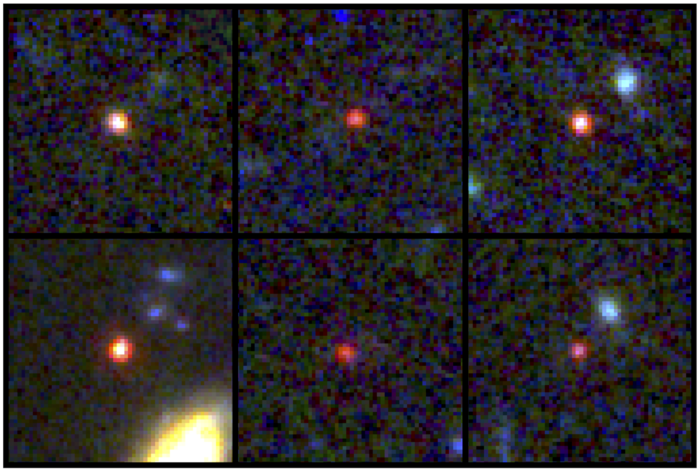
Six massive galaxies discovered in the early universe are upending what scientists previously understood about the origins of galaxies in the universe.
“These objects are way more massive than anyone expected,” said Joel Leja, assistant professor of astronomy and astrophysics at Penn State, who modeled light from these galaxies. “We expected only to find tiny, young, baby galaxies at this point in time, but we’ve discovered galaxies as mature as our own in what was previously understood to be the dawn of the universe.”
Using the first dataset released from NASA’s James Webb Space Telescope, the international team of scientists discovered objects as mature as the Milky Way when the universe was only 3% of its current age, about 500-700 million years after the Big Bang. The telescope is equipped with infrared-sensing instruments capable of detecting light that was emitted by the most ancient stars and galaxies. Essentially, the telescope allows scientists to see back in time roughly 13.5 billion years, near the beginning of the universe as we know it, Leja explained.

“This is our first glimpse back this far, so it’s important that we keep an open mind about what we are seeing,” Leja said. “While the data indicates they are likely galaxies, I think there is a real possibility that a few of these objects turn out to be obscured supermassive black holes. Regardless, the amount of mass we discovered means that the known mass in stars at this period of our universe is up to 100 times greater than we had previously thought. Even if we cut the sample in half, this is still an astounding change.”
In a paper published today (Feb. 22) in Nature, the researchers show evidence that the six galaxies are far more massive than anyone expected and call into question what scientists previously understood about galaxy formation at the very beginning of the universe.
“The revelation that massive galaxy formation began extremely early in the history of the universe upends what many of us had thought was settled science,” said Leja. “We’ve been informally calling these objects ‘universe breakers’ — and they have been living up to their name so far.”
Leja explained that the galaxies the team discovered are so massive that they are in tension with 99% percent of models for cosmology. Accounting for such a high amount of mass would require either altering the models for cosmology or revising the scientific understanding of galaxy formation in the early universe — that galaxies started as small clouds of stars and dust that gradually grew larger over time. Either scenario requires a fundamental shift in our understanding of how the universe came to be, he added.
“We looked into the very early universe for the first time and had no idea what we were going to find,” Leja said. “It turns out we found something so unexpected it actually creates problems for science. It calls the whole picture of early galaxy formation into question.”
On July 12, NASA released the first full-color images and spectroscopic data from the James Webb Space Telescope. The largest infrared telescope in space, Webb was designed to see the genesis of the cosmos, its high resolution allowing it to view objects too old, distant or faint for the Hubble Space Telescope.
“When we got the data, everyone just started diving in and these massive things popped out really fast,” Leja said. “We started doing the modeling and tried to figure out what they were, because they were so big and bright. My first thought was we had made a mistake and we would just find it and move on with our lives. But we have yet to find that mistake, despite a lot of trying.”
Leja explained that one way to confirm the team’s finding and alleviate any remaining concerns would be to take a spectrum image of the massive galaxies. That would provide the team data on the true distances, and also the gasses and other elements that made up the galaxies. The team could then use the data to model a clearer of picture of what the galaxies looked like, and how massive they truly were.
“A spectrum will immediately tell us whether or not these things are real,” Leja said. “It will show us how big they are, how far away they are. What’s funny is we have all these things we hope to learn from James Webb and this was nowhere near the top of the list. We’ve found something we never thought to ask the universe — and it happened way faster than I thought, but here we are.”
IMAGE CREDIT: NASA, ESA, CSA, I. Labbe (Swinburne University of Technology). Image processing: G. Brammer (Niels Bohr Institute’s Cosmic Dawn Center at the University of Copenhagen)


Leave a Reply