HAVE YOUR SAY.
Join us in The Bullpen, where the members of the Scientific Inquirer community get to shape the site’s editorial decision making. We’ll be discussing people and companies to profile on the site. On Wednesday, February 22 at 5:30pm EST, join us on Discord and let’s build the best Scientific Inquirer possible.
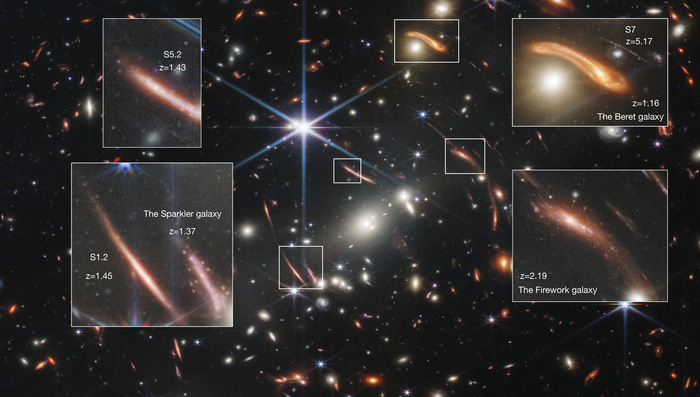
Thanks to the James Webb Space Telescope’s first images of galaxy clusters, researchers have, for the very first time, been able to examine very compact structures of star clusters inside galaxies, so-called clumps. In a paper published in the Monthly Notices of the Royal Astronomical Society, researchers from Stockholm University have studied the first phase of star formation in distant galaxies.
“The galaxy clusters we examined are so massive that they bend light rays passing through their centre, as predicted by Einstein in 1915. And this in turn produces a kind of magnifying glass effect: the images of background galaxies are magnified”, explains Adélaïde Claeyssens, Department of Astronomy, Stockholm University, one of the lead authors of the study.
The magnifying glass effect together with the resolution of the James Webb Space Telescope made it possible for the researchers to detect stellar clumps, very compact galaxy structures. These observations allowed the researchers to study the link between clump formation and evolution and galaxy growth a few million years after the Big Bang. And that in a way that has not been possible before.

“The images from the James Webb Space Telescope show that we can now detect very small structures inside very distant galaxies and that we can see these clumps in many of these galaxies. The telescope is a game-changer for the entire field of research and helps us understand how galaxies form and evolve”, says Angela Adamo, Oscar Klein Center, Stockholm University, one of the lead authors of the study.
The oldest galaxy studied in the paper is so far away that we see what it looked like 13 billion years ago, when the Universe was only 680 million years old.
IMAGE CREDIT: NASA, ESA, CSA, STScI


Leave a Reply